Amateur (Ham) Radio
By Joel Epley
Last Updated: 27 October, 2003
Amateur, or ham radio is a hobby all about communication with others. Whether someone is talking with an old friend across town or a brand-new acquaintance across the world, they are fulfilling the purpose of ham radio. The purpose of ham radio is, according to the Federal Communications Commission (the government agency that, among other things, regulates ham radio), a service for:
(a) Recognition and enhancement of the value of the amateur service to the public as a voluntary noncommercial communications service, particularly with respect to providing emergency communications.
(b) Continuation and extension of the amateur's proven ability to contribute to the advancement of the radio art.
(c) Encouragement and improvement of the amateur service through rules which provide for advancing skills in both the communications and technical phases of the art.
(d) Expansion of the existing reservoir within the amateur radio service of trained operators, technicians, and electronics experts.
(e) Continuation and extension of the amateur's unique ability to enhance international goodwill.
How are these purposes met? The Federal Communications Commission (FCC) says that the amateur service is: "A radiocommunication service for the purpose of self-training, intercommunication and technical investigations carried out by amateurs, that is, duly authorized persons interested in radio technique solely with a personal aim and without pecuniary interest." This means that amateur radio is for authorized people who do this without getting money, and only talking to each other. Amateurs, or hams, are given limited amounts of the radio spectrum. They need to pass tests on radio rules, regulations, techniques, theory, and electronics to be authorized. They do what they do for fun, to increase their knowledge of electronics, and as a public service.
How do hams communicate? They use transmitters, receivers, power supplies, and antennas. Transmitters send out radio frequency energy from microphones or other signal sources, while receivers receive radio frequency and turn it back into usable sound or data. Both transmitters and receivers need to be connected to antennas to transmit or receive, and all transmitters and most receivers need to have a power supply, which gives it electrical power. Transmitters and receivers are often combined in ham radio uses, to make a single unit called a transceiver. Antennas are electrical conductors that radiate and receive radio waves. They can be of all different sizes and shapes. Power supplies can be batteries, generators, or a device that converts household current to something usable by radios. Transceivers can usually operate on a number of different frequencies on the radio spectrum. Amateurs have a wide range of frequencies available to them, ranging from 1.8 megahertz (just above the AM broadcast band, which is low in frequency) to microwave and infrared frequencies. Different frequencies have different characteristics and thus are used for diffferent purposes. There are a variety of modes of communication, from Morse code, voice, digital modes with a computer, video and still pictures, and even remote control of model craft, such as cars, boats, and even airplanes.
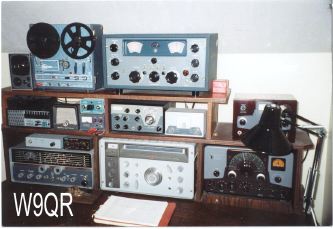
Pictured below is a well-equipped radio station owned by a friend of mine, Larry Wheeler. It uses restored older equipment for the HF, or shortwave bands. A station like this, with several transceivers, could perform very well, and when coupled to a good antenna system, could regularly communicate with other amateurs across the globe. In the lower left corner, you can see a callsign, which is an identification combination of letters and numbers that are unique to each amateur. The callsign is assigned by the FCC in the United States and by its corresponding agency in other countries. The call's prefix (the portion before the number, W in this case) indicates what country the amateur is from, and the number indicates where in the country the amateur was living when he or she was issued his or her call. The 9 in this American callsign indicates that the callsign was issued in the 9th call district, which comprises Indiana, Illinois, and Wisconsin. The suffix (the part after the middle number, though some prefixes have numbers in them) is for differentiation between amateurs and says nothing about where the person is located. My callsign, KC9AIC, indicates that I am also from America (American callsigns have a number of different prefixes, as there are many American amateurs), and that I was issued my callsign while living in the 9th call district, which is true, as I was licensed while living in Indiana.
For more information on amateur radio, visit the American Radio Relay League's website here. The ARRL is an American association of amateur radio operators, and includes a lot of information about getting started in Ham radio. Howstuffworks.com has an informative article here. Some other useful and interesting sites for ham radio operators who are beyond the basic level are QRZ.com and eham.net.