
Introduction
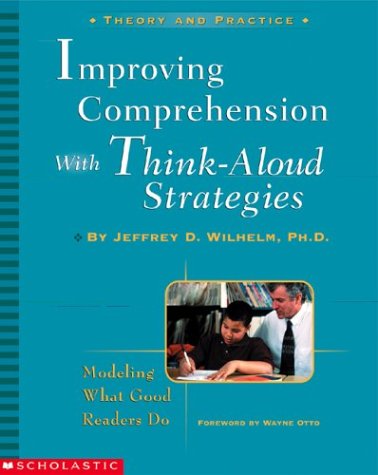
Improving Comprehension with Think-Aloud Strategies: Modeling What Good Readers Do by Jeffrey D. Wilhelm, Ph.D., is an excellent resource for the teacher of any subject. Informed by the research of Russian psychologist Lev Vygotsky, Wilhelm focuses on the child's "zone of proximal development." His goal is to provide teachers with practical tools for teaching the thought process itself.
Dr. Wilhelm spent 13 years developing and practicing these ideas with his own secondary students. Currently a teacher at the University of Maine's Professional Development Network and the Maine Technology for Teachers Institute, he is the respected author or co-author of six other books, including the popular You Gotta BE the Book: Teaching Engaged and Reflective Reading with Adolescents. He has also
Focus of the Book
Improving Comprehension bridges the gap between what children know and what we're trying to teach them - the gap of "HOW do you teach?" As he points out in chapter 1, most teachers have a problem: they "are expert readers, and as such, they are unaware of all the cognitive, emotional, and visual processes they enact as they read. So automatic is their expert reading that it's hard for them to grasp the difficulties of those who most need their help, those who are least like them, the kids who are unmotivated to read and who don't do it very well" (27). Thus, Wilhelm sets out to provide the scaffolding we ourselves need to understand how struggling readers learn.
Wilhelm's theory is that think-alouds can lead to "engaged and reflective reading" (16). His supporting arguments ring true as we recognize methods we may have used without even thinking about it. For example, most teachers should find this modeling strategy familiar: step 1, teacher does/students watch; step 2, teacher does/students help; step 3, students do/teacher helps; and step 4, students do/teacher watches (14). It may seem simple, but it lays the foundation for everything that follows. The value of Wilhelm's work is that he brings that internalized knowledge to the level of conscious thought so we can examine it, improve it, and expand it into a deliberate pedagogical method.
The "think-aloud" itself is basically the thought process made visible and observable. One important application Wilhelm points out is with inferential thinking: students may often have trouble understanding just how we get from point A to point E. Using specific examples from his own teaching, including transcripts of actual teacher-student conversations, Wilhelm teaches us how to slow down and think out loud so students can see how we are making the connections. In turn, we can use student think-alouds to assess their thought processes and figure out where they need help. In terms of Vygotsky's work, the think-aloud helps us to teach actively in the zone of proximal development.
Perhaps the primary contribution of Improving Comprehension lies in Wilhelm's emphasis on teaching how to learn, rather than simply imparting facts. It seems that the focus has traditionally been on facts - which facts, in what order, at what age, and with what creative methods. Wilhelm's work serves to remind us how important it is to help students learn to reason for themselves.
Wilhelm provides an extraordinary amount of support for the individual teacher. Throughout the book he includes worksheets, tips, and text boxes that sum up vital information. Some examples are: "Interpretive Strategies to Model for Kids" on page 25; "Book Selection/Previewing Prompts" on page 62; "Rules of Notice" on page 80; "Guidelines for Creating a Directed Reading and Thinking Activity" on pages 88 - 92; and "Guidelines for Determining an Author's Main Idea" on pages 128 - 130. The final chapter is devoted to using think-alouds for performance-based student assessment. It is difficult to choose a "most useful" chapter in this excellent book, but this one may qualify simply because reliable, authentic assessment can be so difficult. He includes checklists for both teacher and student, which not only make grade-reporting much easier, but can also provide evidence to the student that he is, in fact, making progress and getting good at something.
My Response to the Book
I think Improving Comprehension is invaluable, not only to English language arts teachers, but really to anyone who teaches. As a graduate student, I did take issue with Dr. Wilhelm's vague references to research without providing citations for further study; however, the book is so useful and practical that I am willing to take it as it is.
After reading this book, I can look back on my own education and see just how teacher-centered it was. Very few of my teachers took a learning-centered approach as Wilhelm describes it, and those, invariably, were my favorite teachers. Since then, I have become a parent, a writing tutor, and a Bible class teacher, and I've developed my own ideas about how to teach. Improving Comprehension has confirmed the best of what I've done and has taken it leaps and bounds further. When I begin my first secondary teaching position, this book will play a major role in everything I do. That's the best endorsement anyone can provide.