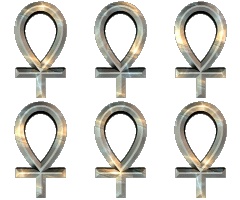
Ankh
Symbol of eternal
life. The gods are often seen holding an ankh to someone's lips this is
considered to be an offering of
"The Breath of Life". The breath you will need in the
afterlife.
�
�
�
�
�
�
�
�
�
�
�
�
�
Ba
The Ba is what we
might call someones personality. It would leave the body at the time of death.
During the days the Ba would make
itself useful, at night it would return to the tomb. At this
time, it would look for the person
to which it belonged. This would be the mummy, however,
often the egyptians would supply
the Ba with a statue in the likeness of the deceased in case
the mummy was lost or damaged.
�
�
�
�
�
�
�
�
�
�
�
�
�
Feather of Maat
Represents truth,
justice, morality and balance. It was pharaoh's job to uphold Maat.
When a pharaoh died, Maat was lost
and the world was flung into chaos, only the
coronation of a new pharaoh could
restore Maat.
�
�
�
�
�
�
�
�
�
�
�
�
�
�
�
Scarab
Called the dung
beetle because of its practice of rolling a ball of dung across the ground.
The Egyptians observed this
behavior and equated it with the ball of the sun being rolled
across the sky. They confused this
balled food source with the egg sack that the female
dung beetle laidand buried in the
sand. When the eggs hatched the dung beetles would
seem to appear from nowhere, making
it a symbol of spontaneous creation.
In this role
it was associated with the sunrise.
Khepri was the scarab headed
god.
�
�
�
�
�
�
�
�
�
�
�
�
�
Pshent
The Double Crown,
the red crown and the white crown put together to represent a unified
Egypt. Although Egypt was not
always a unified nation it was stronger that way.Therefore
unification was desirable. Narmer
(Menes), the founder ofthe First Dynasty around
3100 B.C., was the first man
recorded wearing this crown.
�
�
�
�
�
�
�
�
�
�
�
�
�
Ieb
This symbol
represents a heart. The Egyptian believed the heart was the center of all
consciousness, even the center of
life itself. When someone died it was said that their
"heart has departed." It
was the only organ that was not removed from the body during
mummification.� In the Book of the dead, it was the heart
that was weighed against the
feather of Maat to see if an
individual was worthy of joining Osiris
in the afterlife.
�
�
�
�
�
�
�
�
�
�
�
�
�
Ka
The ka is usually
translated as "soul" or "spirit" The ka came into existence when an
individual was born. It was
believed that the ram-headed god Khnum
crafted the ka on his
potter's wheel at a persons birth.
It was thought that when someone died they "met their ka".
A persons ka would live on after
their body had died. Some tombs included model houses
as the ka needed a place to live.
Offerings of food and drink would be left at the tomb
entrance so the ka could eat and
drink.
�
�
�
�
�
�
�
�
�
�
�
�
�
�
Menhed
A scribes pallet.
Writing was a very important skill to the ancient Egyptians. It was
practiced by a group called
scribes. The writing equipment used by scribes consisted
of a palette, which held black and
red pigments, a water jar, and a pen. To be a scribe
was a favorable position, even some
kings and nobles are show proudly displaying
scribe palettes.
�
�
�
�
�
�
�
�
�
�
�
�
�
She
A pool of water.
The Egyptians portrayed bodies of water by means of equally spaced
vertical wave lines. When these
lines are inclosed by a rectangle it denotes a lake or pool.
The Egyptians believed water was
the primeval matter from which aII creation began.
Life in Egypt's desert climate
depended on water, and a pool of water would be a great
luxury.� There are many tomb
paintings that show the deceased drinking from a pool in
the afterlife.
�
�
�
�
�
�
�
�
�
�
�
�
�
Akhet
This symbol
represents the horizon from which the sun emerged and disappeared.
The horizon thus embodied the idea
of both sunrise and sunset. It is similar to the two
peaks of the Djew or mountain symbol with
solar disk in the center. Both the beginning
and the end of each day was guarded
by Aker, a double lion god. In the New Kingdom,
Harmakhet ("Horus in the
Horizon") became the god of the rising and setting sun.
He was pictured as a falcon, or as
a sphinx with thebody of a lion. The Great Sphinx
of Giza is an example of
"Horus in the Horizon".
�
�
�
�
�
�
�
�
�
�
�
�
Ushabtis
Literally
translated it means "to answer." It is a small mummiform figure placed in tombs
to do work in the afterlife on
behalf of the deceased. In some tombs of the late New
Kingdom whole gangs of ushabti
workers were included with different tools for doing
different work. A complete
collection would consist of 401 Ushabti: one for each day
of the year, 365 plus 36 foreman.
�
�
�
�
�
�
�
�
�
�
�
�
�
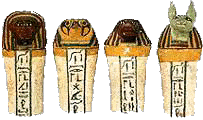
Canopic Jars
During
mummification the internal organs were removed and placed in four containers.
These containers often have human
or animal-headed stoppers. The word, canopic,
comes from the Greek name of the
local god of Canopus in the Nile delta, who was
represented as a human-headed pot.
Canopic jars can be made of limestone, alabaster,
wood, pottery, or even cartonnage.
The heads of the canopic jar represented the
Four Sons of Horus. . . . .
From left to right they are;
Duamutef
: The jackal or wild dog headed guardian of the stomach.Back to