



Cranial Electrical Stimulation (CES)
"NeuroXXXTM Multiplex"
 |
|
BRIEF DESCRIPTION OF DEVICE
 | Electrical stimulation for therapeutic purposes is not new. At least two millennium ago, physicians used electric pulse to relieve pain. Experimentation with low intensity electrical stimulation of the brain was first reported by Drs. Leduc and Rouxeau of France in 1902. Initially, this method was called electrosleep as it was thought to be able to induce sleep. Research on using what is now referred to as cranial electrotherapy stimulation (CES) for treatment of anxiety began in the Soviet Union during the 1950's. |
Cranial Electrotherapy Stimulation is a simple treatment that can easily be administered at any time. The current is applied by easy-to-use clip electrodes that attach on the ear lobes, or by stethoscope-type electrodes placed behind the ears. In the 1960's and early 1970's, electrodes were placed directly on the eyes because it was thought that the low level of current used in CES could not otherwise penetrate the cranium. This electrode placement has been abandoned over 20 years ago.
Cranial electrotherapy stimulation leaves the user alert while inducing a relaxed state. It is also believe to be able to improve balancing, mood control, IQ, sleep, exploration of altered states, peak performance, and much more. Psychologists call this an alpha state. The effect differs from pharmaceutical treatment in that people usually report feeling that their bodies are more relaxed, while their minds are more alert. Cranial electrotherapy stimulation may also be used as an adjunct to anxiolytic medication and/or psychotherapy, behavioral modification, and other conservative methods of treatment. For people who have difficulty falling asleep, CES should be used at least three hours before going to bed or the increased alertness may interfere with sleep. A review article can not adequately describe the CES experience. Only trying it or witnessing its use will do that.
 |
|
Occasional self-limiting headache, discomfort or skin irritation under the electrodes, or lightheadedness may occur. Patients with a history of vertigo may experience dizziness for hours or days after treatment.
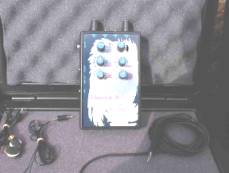
The NeuroXXXTM Multiplex claims that it is the a premier device developed for 21st century use, with a host of programmable features and functions far beyond any device on the market today. It is able to achieve total brain state management in minutes by generating a wide range of resonant brain frequencies which modulate a variable frequency pulse from approximately 80 Hz to 111 Hz. However, FDA approval for this device is in process. The device is categorized as Class IIa. Type BF medical device generating microcurrent pulses that are thought to reach the brain directly via ear lobe stimulation with 42% reaching the cortex through a perineuroal or vascular pathway via the auditory meatus. The average current density in the brain tissue is 1 mA (5-18 uA per cm.) Electric field in brain tissue is at 1 mA (2.8 to 8 mV per cm.)
The technical specification
of this device is as below:
(a)�
Output
Characteristics: Variable 82 Hz� to 112 Hz� Square wave, centered
at 94 cycles with user-selected variable duty cycle 50% to 3% (Harmonic
Generator), modulated by a secondary tunable brainwave oscillator for all 5
brainwave ranges, with fine tuning range adjustment for Delta High/Low
exploration. Total exploration range: (0.25Hz - 69Hz continuously
variable with infinite within-range harmonics, accurate to +-10%)
.� Bi-phasic pulsed micro current output.�
(b)� Two
separately controlled jacked output channels, each with variable intensity
(0-850uA).
(c)� Precision
Op Amp for prevention of output offset.
(d)� Bi-colored
LED real-time visual pulse polarity/frequency display.
(e)� Accessory
output jack which is capable of driving any existing light goggle unit. Output
is from 0 to 100mA, variable intensity.
(f)� 9 volt
alkaline battery powered.
(g)� 1 Pair
Ear Clips, with leads, and 1 Pair of Flat Electrodes included.
During the treatment, some patients will experience a subjective change in their body weight. They may feel heavier at first and then lighter, or they may feel lighter initially. The patient will feel worse during the heavy cycle and this feeling may last for days unless extra treatment time is given. Therefore it is important to continue the treatment for a few extra minutes if the patient feels heavier at the end of the allotted time, even if it has already been 20 minutes or more. Continue for at least 2 minutes after the patient feels lighter. Although quite common, not all patients will be aware of these weight-perception changes. Although CES treatment is indicated for insomnia, because of the increased alertness some patients find it difficult to fall asleep immediately after a treatment. Accordingly, it is recommended that CES be done at least 3 hours before going to bed. Also, in most cases after daily treatments for the first week or two, treating every other day is usually more effective than every day.
EVIDENCE (OR LACK OF) SCIENCTIFIC PRINCIPLES
The CES technology a result from the innovation of Transcutaneous Electrical Nerve Stimulation (TENS) technology, which is used for pain-relieve treatments. CES differs from traditional TENS, which is low-frequency (200 Hz or less), high-current (hundreds of mA) modality, and produces different wave-forms.
Until today, some scientists agree that application of CES technology is relatively effective in pain, depression and anxiety treatment, in comparison to conventional therapeutic methods. It is also noted in the websites that CES is also being used in treating drug addiction and children with neuromuscular, cognitive, and learning disorders.
There is no uniform agreement on the mechanism of action of CES at present because it is not fully understood by the researchers. Researchers had proposed a hypothesis regarding the mechanism of action of CES technology towards its therapeutic significance: Microcurrent pulsed high frequency carrier waves used will reestablish optimal neurotransmitter levels and functioning in the brain. The entrance of microcurrent has a mild effect on the thalamic or hypothalmic area of the brain (which facilitating the release of neurotransmitters), interacting with cell membranes that produces modifications in information transduction associated with classical second messenger pathways, calcium channels and cyclic AMP.
From results obtained in experiments conducted, application of CES is said to have
effectiveness to cause increases in:
(a)� Serotonin (associtate with relaxation and calmness)
(b)� Norepinephrine and dopamine (both associated with alertness and feelings of pleasure)
(c)� MAO-B in blood platelets and CSF
(d)� DHEA, 5-hydroxy-indol-acetic acid
(e)� Enkephalins
And also decreases in:
(a)� Cortisol (one of the primary stress-related biochemicals)
(b)� Trvptophane
The increment and decrement mentioned above probably contributes to the reason why so many CES users report feeling both relaxed and alert. Cranial electrotherapy stimulation leaves the user alert while inducing a relaxed state. Psychologists call this an alpha state. The effect differs from pharmaceutical treatment in that people usually report feeling that their bodies are more relaxed, while their minds are more alert. Most people experience a feeling that their bodies are lighter, while thinking is clearer and more creative. A mild tingling sensation at the electrode sites may also be experienced during treatment.
The experiments conducted to confirm the CES concept, are descript in the websites and the journals. Moreover, scientists are actively involved in the studies of application of electromedicine currently. Dr. Daniel L. Kirsch is one of the researchers. He had conducted experiments onto animal and human subjects.
The significance of CES research for treating anxiety has been reconfirmed through meta-analyses conducted at the University of Tulsa by O�Connor (1991), and by Klawansky (1995) at the Department of Health Policy and Management, Harvard School of Public Health.
Based on the experiments conducted, the hypothesis on CES mechanism is widely accepted and approved by the FDA recently. However, some scientists are still questioning about the reliability and the verification of the CES concept, and refuse to accept the hypothesis. Contradictions always arise as the mechanism of the brain is still not fully understood by human.
The main reason is caused by the lack of knowledge on its mechanism as mentioned above. Biofrequency is one of the new fields in medicine where lots of facts and assumptions are still under investigation and yet to be confirmed. Current technology has difficulties to obtain the bulk capacitance of the body and the modulation of brain bioactive frequency at low current level (we have just EEG machine). These two parameters are essentially important in order to obtain the range of the microcurrent that the device should impose to. Besides that, the body electric and cross currents are two relatively new phenomena, which are still under investigation. Also available in an internet source describing a medical officer asking about the issue of cell proliferation or adverse neurological effects which might be resulted from excessive use. It is interesting that the manufacturer representative uncomfortably replied by saying that they are going to be looking into it.
For the particular machine we have chosen, i.e. the NeuroXXXTM Multiplex, it is found that the FDA approval for the product is still in process. Approval from FDA is crucial as FDA provides standards and control of medical devices. Although there are a lot of criticisms towards the policy, politics, prerequisites and the system of FDA, its approval is recognized to be an accreditation to a product.
The output of the NeuroXXXTM Multiplex (850mA) is slightly higher in comparison with other conventional FDA-approved CES device (600mA). The claim about the ability of the device to achieve total brain state management in minutes by generating a wide range of resonant brain frequencies which modulate a variable frequency pulse is also not convincing because the technology used is not mentioned in scientific approaches supported by experimental results. The manufacturer also the device will output and entrain a brain to the alpha frequency. However, it is found that there is no evidence to support that this CES device works on an entrainment principle.
POTENTIAL HAZARDS TO THE USERS
It is believed by the publics that the CES devices, including the NeuroXXXTM Multiplex, are safe to be used. A group of researchers had done an experiment to investigate the side effects which might be associated with the application of CES. According to their report, 17 studies conducted follow-up investigations from one week to two years after treatment and none of the 17 studies revealed any long-term harmful effects. However, it is felt that the claim is not convincing. This is because the assumption is being made due to no hazards case is reported to the FDA. There are possibilities of non-reported hazards case that might be experienced by the users.
 |
�����1.� Pregnancy Furthermore, some patients had been found associated with dizziness if the current applied is too high. However, the responses to CES current are very individual due to the difference in physical and mental conditions and complication of treatment. Some people may experience a state of deep relaxation called euphoric feeling, or prolonged alpha state. It may temporarily impair their mental and physical abilities for the performance especially of potentially hazardous tasks.
|
RECOMMENDATION OF USE
Although the current applied to the cranial is in terms of micro to milliamperes, it is insufficient to cause electrical shock in nature, the device must eliminate any possibilities of leakage current. No circuit breaker, which behaves like a fuse is being mentioned in the specification. Thus, it is important to investigate the electrical safety issue and precautions to electrical hazards in the design. It is noted also that electrodes must be wet with saline solution during applications. Electrical burn might occur if this procedure is forgotten. Thus, the user manual must clearly educate the users about the standard and step-by-step procedures in using the device.
The euphoric feeling, or prolonged alpha state will reduce the mental and phisycal abilities of a user. Therefore, users are adviced not to perform potentially harzadous tasks such as operating a motor vehicle or heavy machinery, for up to several hours after treatment.
 |
The treatment will cause tingling sensation at electrode side and sooner and later relief pain and stress. This might convey wrong assumptions to the user that they require no further diagnosis from medical doctor because their pain is cured. Thus, it is advised that the devices should not be used without physician or medical officer's diagnosis and consultation. |
The users should be always reminded that CES is just another alternative to the therapeutic methods available. Consultation from physician must be obtained before using the device.
REFERENCES:
A Practical Protocol For Electromedical Treatment of Pain, A retrospective study to determine the effect of cranial electrotherapy stimulation (CES) on patients suffering from anxiety disorders, Cranial Electrotherapy Stimulation as a Treatment for Anxiety in Chemically Dependent Persons, Richard Schmitt, PhD, Thomas Capo, BS, Elvin Boyd, MD, Alcoholism: Clinical and Experimental Research, Vol. 10, No. 2, 158-160, 1986
Tomaszek, David E., et. al. The use of CES in reducing pain in spinal pain patients. Completed in the spring of 1999. In Press. Tan Gabriel, Monga Trilok, and Thornby John. Efficacy of microcurrent electrical stimulation on pain severity, psychological distress, and disability. American Journal of Pain Management, 10(1):35-44, 2000. Unedited abstract with rebuttal to the editor. www.elixa.com/mental/mgestim.htm http://www.algy.com/anxiety/cranial.html
http://www.futuredynamicadvantage.com/products/brainlightning.html http://www.futuredynamicadvantage.com/neuromatrix/pictures.html