(Page 2 of 2)
Iraq is considered by some to be the cradle of classic
Arabic poetry and music, a tradition carried on by the Musical
Institute of Baghdad, where Mr. Sahir studied. Born in
northern Iraq, he lived in austerity with nine siblings. At
age 10 he sold his bicycle to buy a guitar and started
inventing romantic stories for his girlfriends. By age 13 he
was not only writing love letters for his older brothers to
send to girlfriends but also composing classical-based songs
for his own girlfriends.
Known primarily as a songwriter for other musicians, he
worked for several years to persuade the music establishment
there to let him both compose and sing his own songs. And when
he finally appeared on television with his own "Ladghat el
Hayya" ("The Snake Bite") in 1987, it was banned for lyrics
that discussed Baghdad's atmosphere of fear and restriction
near the end of the Iran-Iraq war.
He soon earned a reputation for being an exacting,
detail-oriented composer with one foot in the classical world
and the other in the pop world. He revived traditional
romantic classical music and incorporated out-of-use Arabic
musical scales, paved the way for other contemporary Iraqi
singers to seek fame outside the country, collaborated with
some of the Arab world's finest poets and refused to replace
his large orchestra with synthesizers. He is composing an
opera based on the "Epic of Gilgamesh."
The Persian Gulf war and the ensuing embargo, however, had
a heavy impact on his art and career, which was derailed for
several years. "There was no electricity and no petrol," he
recalled. "I had to bike two or three hours to see my friends.
But I composed my best songs in this time."
During the bombings, he continued, he put all his music in
a part of the house as far from his bedroom as possible. He
wrote a note that he placed on top of the recordings,
instructing whoever found them to release the music. This way,
he said, if the house was bombed during the night, "either me
or my music would survive."
When the interview turned political, Mr. Sahir politely
sidestepped the questions, as he has throughout his career.
But when asked what he would like to say to President Bush, he
answered: "Think about the children and the innocent people.
Don't let them suffer."
When asked what he would like to say to Mr. Hussein (whom
he said he had never met), he laughed, looked at the floor and
grinned. Whatever he thought, he kept it to himself.
Though he has written political songs about topics like
Iraq's starving children, Mr. Sahir is primarily a singer of
romantic songs — passionately delivered, occasionally playful,
poems of love to make women swoon. "Ana wa Laila," which he
tinkered with for some five years until he was satisfied, is a
song about a man who cannot extinguish his passion for a woman
who does not love him in return because he is not rich.
"Everything you see now on the TV is about the negative,
the war, the weapons of mass destruction, the killings, the
explosives," he said. "We need something lighter now to feel a
little bit of hope and to relax."
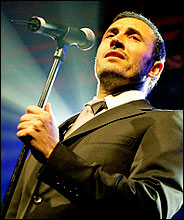
At the Key West Room in the Palms the next night, the
audience didn't quite relax as Mr. Sahir performed. And for
that matter, neither did Mr. Sahir, who was at his exacting
best, leading his band through a two-hour set. Keenly
calibrating the mood of the audience, he constantly deviated
from the set list, cut songs short and doubled the choruses of
other hits, constantly challenging the 15 Arabic-American
musicians performing with him for the first time. At the same
time, he refused to play songs with complicated orchestrations
— often stopping them after several seconds and then
restarting — until the audience was playing full attention.
When a scuffle broke out in the audience during his first big
hit, "Abart al Shat" ("Crossing the River"), he quickly
changed to less rousing numbers.
When he performed "Beauty and His Love," the audience sat
patiently for this one, waiting for the right moment. As soon
as he bellowed the name of his true love, the people in the
audience erupted, rising to their feet. And for a brief
moment, the word Baghdad in this country was associated not
with war and tyranny but with beauty and homesickness.




.gif)












.gif)


 Florida Properties
 Connecticut Homes