 hen a foreign pop star performs in New York City, a
national flag is usually tossed onstage from the audience.
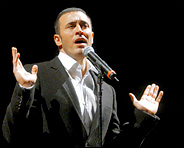
Kazem al-Sahir, who started his United States tour on Friday
night at the Beacon Theater, was no exception. But he didn't
do any flag-waving. He left the flag carefully folded and put
it down, then spoke about his hopes for peace. Mr. Sahir is
from Iraq.
hen a foreign pop star performs in New York City, a
national flag is usually tossed onstage from the audience.
Kazem al-Sahir, who started his United States tour on Friday
night at the Beacon Theater, was no exception. But he didn't
do any flag-waving. He left the flag carefully folded and put
it down, then spoke about his hopes for peace. Mr. Sahir is
from Iraq.
|
Advertisement 
|
.gif) |
|
For both Mr. Sahir, whose recordings have sold in the
millions across the Arabic-speaking world, and for an audience
that sang and clapped along with his hits, the concert was
about something more than his set of ardent love songs. It was
about Baghdad as a place of poetry and song, culture and
romance, a place far removed from its current role in the news
as the seat of a dictatorship and a potential target for
invasion. His songs implied that daily life and private
affairs continue in every political climate, with yearnings
that are only compounded by the threat of war.
Mr. Sahir's music has earned him a place as one of the Arab
world's major stars. He has a rich, grainy voice that's both
hearty and imploring, and he moves easily between Arab
classical traditions — suitelike compositions and an
improvisatory dialogue between singer and instruments — and
the shorter, simpler melodies and heavier drumbeats of pop.
Mr. Sahir was backed by a 15-piece orchestra, mixing
instruments like hand drums and ney (flute) with trap drums
and electric guitar and bass. The two backup singers were his
daughters. Many songs began with an introspective solo called
a mawal, with his vocal lines curling above the feathery
phrases of Jamal Sinno on qanun (zither). Within the songs Mr.
Sahir's voice was answered by melodies from accordion or
violin, as pensive ballads made their way toward Middle
Eastern dance rhythms.
Unlike many singers who reach for an international audience
— the lyrics on his albums are often translated from Arabic
into French and English — Mr. Sahir's attempts at crossover
rarely turned tacky.
His Beacon set included only one song, and part of another,
that veered toward disco, and only a few moments when his
finely turned inflections opened out toward Broadway-tinged
melodrama. For most of his set he was a voice of loyal
devotion, bemoaning a lover's inconstancy and wishing to be
reunited.
To his audience the metaphors of love, sadness, longing and
jealousy in his songs can take on multiple meanings.
The distant, impossible love he addresses could be a nation
as well as a person. "You are the woman I love, you are my
home and my shelter," he sang in "Zeidini Ishqan," and his
listeners knew that at this moment home and shelter remained
far away.













.gif)





