|
|
Kazem Al Sahir-2003
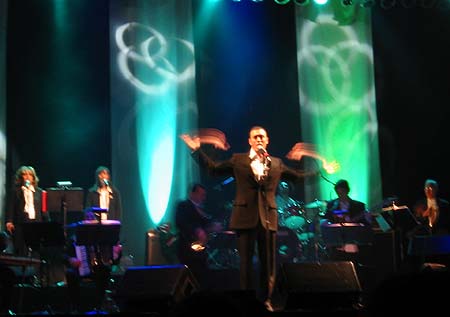
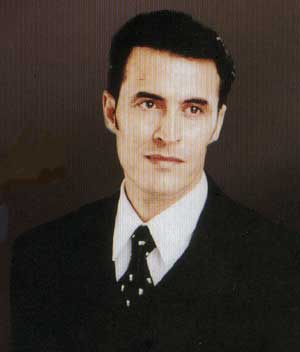
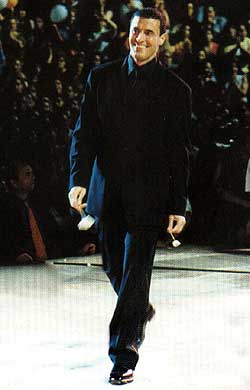
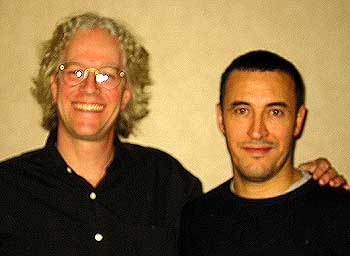
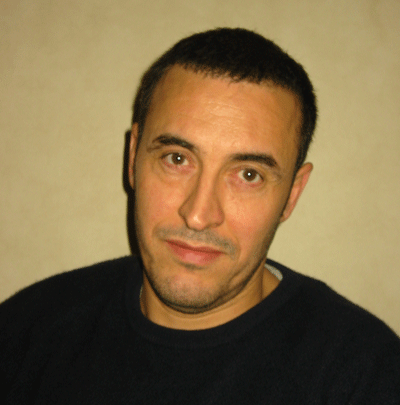
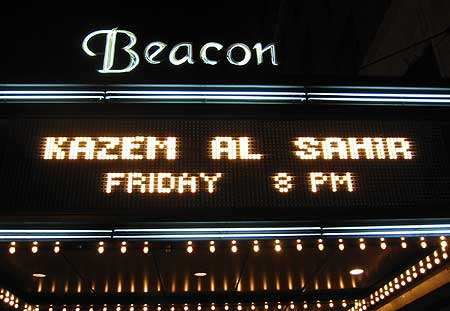
Iraqi superstar singer Kazem Al Sahir couldn't have picked a more poignant moment to bring his elegant love songs, deeply informed by Arabic classical music, to the United States. Since the Gulf War of 1991, Kazem has lived many places, and based his musical career mostly in Cairo, Egypt. But he remains proudly Iraqi, and with the U.S. moving ever closer to war against his homeland, Kazem wanted to present another side of the story: Saddam Hussein's picture and one television, and Kazem Al Sahir's on another, you might say. After Neil Strauss's February 26 article in the New York Times, media interest became fierce, and many microphones and television cameras had Kazem in their sights. On the eve of Kazem's performance at the Beacon Theater, Banning Eyre sat down for a conversation with the singer in his New York hotel. Communication was not always easy. Kazem's English is coming along, but still rudimentary. His Arabic is exceptional, but in a dialect that was not always easy for the translator, Kazem's tour producer, Dawn Elder. Nevertheless, the interview offered insights into the art and life of one of the most well-loved and talented musicians working in the Arab world today. Banning Eyre First of all, I'm very glad you came here now. Thank you for that. Kazem Al Sahir Thank you. B.E. I read in the New York Times that your first instrument was a guitar. Kazem Yes. I was twelve years old. I sold my bicycle and I bought a guitar I saw in a small shop. Then, I was studying [the guitar] for about three months, and I wrote the first song after three months, a very classical song. B.E. I was curious as to why you picked guitar. Was it because you were interested in guitar or because that was what you found? Kazem That was what I found. B.E. Tell me about your circumstances at that time. Kazem You want me to talk about my family? Nobody wanted me to be a musician. They wanted me to finish my school. They didn't believe I would be famous. One time, my brother took me to the place where there are many artists. They don't have work. They sit at the cafeteria, just waiting for a job or something. He said, "Look. These people don't have jobs. They are artists. You will be like them." Then he took me to a big castle where there is a famous artist. He said, "If you respect your music, and respect yourself, if you study well, you will be like him." So this was my brother. And my mother, she helped me. If there was something on the TV, reporting about music or something, she would change to channel [there, so I could watch.] B.E. So she was more supportive. Kazem More than all of my family. B.E. I'm interested that you say that that first song you wrote was very classical. Kazem I saw the words in a magazine. I composed the music. I don't know who wrote those words. I just composed. Then I took it to my teacher, and when I played it for him, he said, "Who composed this music?" I said, "Me." He didn't believe me. So after, when I said, "I swear. I composed this song," he said, "Look, you will have a good future, the best future, so be careful." I'm sorry about my English. B.E. If you prefer to speak Arabic and have Dawn translate, that's fine. Kazem I think it's better. [Dawn tells him in Arabic that he should keep trying English. She says he should feel comfortable experimenting. Clearly, he does not, but he continues, in and out of English.] B.E. I guess I have the same question your teacher had: where did the music for that first song come from if you had just begun to study guitar? Kazem Just three months. And I had played on the stage and sung one song. B.E. But you listened to a lot of classical music. Kazem Yes, I loved it. B.E. You heard the music, and you just
found the notes on the guitar, and there it was. Kazem It just appeared, from I don't know where. B.E. So at that point, you began to really study. Kazem Yes, I studied classical music, like the Iraqi maqam. I changed to the oud because it's more traditional, more parts of the roots of the music. I prefer oud to guitar. B.E. And you still play? Kazem Yes. B.E. I should have had you bring it. I'm interested in the way classical and pop music seem to relate more in the Arab world than in the West. Kazem I think [I do this] to make it easier for European and American people. [Switches to Arabic: Dawn translates.] I feel it's important to make the music comfortable for Western ears. So by combining Western pop and traditional Arabic, it makes the music more accessible. B.E. Was that idea from the start? When did you start to think you would sing for so much of the world? Kazem In 1996, I told my friend, "No one knows me. But look, in 1997, I will be famous in Iraq and all over the Gulf." They were laughing at me. They didn't think I was serious, but I said, "No, by 1997, I am going to own the Gulf and the whole Arabic world musically. They'll have me in their hearts, and I'll be number one." B.E. How did you know that? Kazem Because I had prepared like six
or seven songs, very classical songs. How can I
explain? B.E. Are any of these songs on these albums? [I show him my eight Kazem Al Saher CDs, but he says no, none of these.] But Kazem, I was asking you about classical and modern or pop music, and you answered me in terms of Arabic and Western music. Kazem When I recorded in Cairo in 1994, I used all the classical instruments live, flute, piccolo, French horn, clarinet, saxophone, everything. From day one, I used these natural sounds. Someone came in and said let's use a keyboard. I said, "No way. We'll use a piano." I didn't want synthesized sounds. Dawn Elder When you say "modern," you have to define your terms clearly. For him, it has nothing to do with drums or bass or keyboard. It's the concept of using full-on orchestration. When he thinks of modern, it's just creating something new, and something familiar in the sound, something that makes it more accessible to the Western ear. Kazem I said all that? The thing is, I've recorded with keyboards, but live, I feel that the real instrumentation is better. B.E. When we spoke the last time, you told me about the first song you recorded for television, "Ladghat El Hayya." Kazem "The Snake Bite." B.E. And you told me about how your friend helped you to get that song on television. Kazem He was the director. B.E. But then the censors said no. Kazem Yes, they stopped the song. B.E. I'm curious to know why. What was it
in the song that they objected to? Kazem The words. It was very difficult. The snake! There is another meaning in this song. They thought there was another meaning in this song. But there was not. They thought it was a metaphor for something else, with the snake and the bite, but really, it was just a very simple song. B.E. What did the song mean to you? Kazem From the beginning, if you want to sing a song on the TV, you have to give them the words before hand. There are like six Arabic classical teachers. They have to see the words, all of them. And they have to say, "Yes, you can sing this song." If they say no, I can't. So I recorded this song--no one knows about it--with my friend. He came from Mosul. He said, "I will go to the south and I will make a report about the people here, so come with me." It was about two hours drive. I said okay. He said, "You have a song? I will film it there." I went with him and he filmed the song in one hour, and he put the song in the middle of his report. His higher up, his manager, didn't listen to the song, but when they broadcast it, by the second day, all the Iraqi people loved the song. Everywhere, you can hear it, in the streets, everywhere. A big company came from Kuwait asking, "Who sang this song? We want to make a contract with him." I was very poor. So all the nightclubs called me. They wanted me to sing. Then Modir, the higher up [man] called me and said, "Come. We want to talk to you. Who gave you permission to sing this song?" I said, "No one, but my friend filmed it as part of his reporting. No one gave me permission." He said, "Okay. Change the words." He wanted me to change the first line. I said, "No, I can't. I have many songs. If you want me to sing another song, it's okay. But for this song, I can't change." After six months when they saw that people loved this song, the higher-up, Modir, he now liked the song. He invited me to his house to sing it in front of him. You know? [He chuckles.] So I can't explain. B.E. This was in 1987. Kazem 1987, yes. B.E. And in that first television performance, did you have a band? Kazem No, just a keyboard. My friend Fadhil [Falih]--he's still in my team--he played the keyboard. B.E. Later, you went to conservatory. Kazem Yes, for six years. B.E. Baghdad is a great city for music. It
has a great cultural tradition and history. I
recently did some research on the oud, and I
learned a little about that history. Kazem Munir Bashir. He's the best. B.E. Yes. Anyway, I'm sure you got a great education there. But I gather you were perceived as too progressive there. What happened? KazemAt the conservatory, I was studying traditional folk, and maqam, classical music. Then I composed "Obart al Shat" (I Crossed the Ocean), the song became number one, and the professors heard it. Munir Bashir he heard this song, and he said, "Who composed this song?" They said, "A student. His name is Kazem." He said, "Kick him out. So we don't want a student to sing like this. We teach them classical, very classical. We don't want them to sing this shaabi, street music." I said, okay. So then there was a concert at the Al Rachid, and the promoter [Salma Abdel Karim] really liked me a lot. He told me I should compose a classical tune so that he could get me on the program. So I composed a very classical song. Munir Bashir, he did not know that I would be on the stage. I just had my oud and one percussionist and some backing singers. Munir Bashir was protesting. "Why is this man on the stage?" And the promoter said, "Just listen to him." So I took my oud and my backing singers and my one percussionist and I played the song, and Munir Bashir gave me the signal of A-OK. B.E. That must have felt good. Kazem Yes. B.E. What do you think the effect was on you of having to impress these great classicists? 30:49 Kazem [Starts in Arabic. Dawn translates.] I used to watch singers and see what they were doing, and I saw that if I just did classical, it would be much harder. So I would enter [introduce] a little pop song just to bring the attention to my music. I would put a few songs this way, and a few of the classical. I was trying to reach the people, and I saw that that was what they liked, the shaabi, or street music, so I gave them a little bit of that, just so they could hear the classical. But my roots are classical. Everything about me is classical. w B.E. Fascinating. I want to ask you about some songs, starting with the song that the BBC radio poll voted the number 6 song in the world. It seems to me that a worldwide hit has to have a hook. Can you sing that for me now? Kazem [Sings song from the beginning.] B.E. Mmmm. That's beautiful. Kazem That's the first part. It's very classical. B.E. Yes, I've listened to it. What do you think it is about this song that makes it so popular all over the world? Kazem It has a big message. B.E. Tell me about what it says. [As Kazem answers in Arabic, I hear words I recognize: Romeo and Juliet, "like Shakespeare language." Dawn Elder, translating: This song is rather unique. Kazem [Interrupting with a chuckle.] Dawn is not perfect in Arabic. She is 80%. Me, I am 20% in English. You are 80% in Arabic. D.E. There's a problem between the Iraqi and the Lebanese language. Okay. [Silence.] B.E. Now, you've intimidated her. [Laughter.] D.E. Okay, it is the language of Shakespeare, like Romeo and Juliet. The song has two meanings, one of the great love, including the love of the past, and the other the current situation. There is a dual meaning there. The words are difficult. No one could just write those words. B.E. Who did write them? Kazem Hussain Al Marwani. He wrote just one song. That's it. Just this song, in around 1973, or '74. B.E. And you say two meaning, one this love
of the past. Not romantic love. Kazem Very romantic love. B.E. Between a man and a woman? Kazem Between a man and a woman, and between a man and his country. Many things. B.E. And then the second meaning. The current situation? Can you explain? Kazem The life of a person is tied to the land. The spirit of a person comes from the land, the country. There are a lot of different meanings here. It is difficult for Dawn to explain, because [in this song] I speak classic Arabic. She speaks Lebanese Arabic. It's different. In one year, I will see you and I will explain all of these songs. B.E. I look forward to that. You are already doing much better than the last time we met. But Kazem, despite this difficulty of language, all these people all over the world voted this song number six out of all the music in the world. That's amazing to me. I mean, this is high art, and it's on the list with Cher singing "Believe." 39:45 Kazem [In Arabic. Dawn translates.] If they had chosen one of my lighter songs, I wouldn't have been so happy. But when they chose one of my most complicated songs, it made me very happy. It's the music and the words together, not just the words. h B.E. I want to ask you about the song that Neil Straus wrote about in the New York Times, the love song to Baghdad. It's beautiful the way you introduce the idea of a man telling his girlfriend that he has another love, and then the love turns out to be, not another woman, but the city. Kazem Yeah. B.E. Who wrote that? Kazem Kareem Al Iraqi. He has written
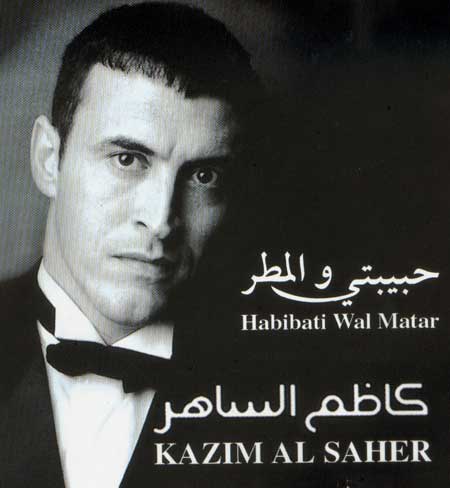
some forty songs for me. B.E. Americans, of course, have a pretty limited idea of Baghdad. What is it about the city that this song celebrates? Kazem [In Arabic. Dawn translates.] I was in Beirut. I had left Baghdad four months earlier, and I was going back three days later to do a concert. So Kareem Al Iraqi came over, and we wrote this song in a day, and we went back to Baghdad and performed it. So the song was inspired by my being in Beirut for four months, and having to go back. People love this song. At all my concerts, I have to sing it twice, even if I'm in Beirut or Syria or the Gulf, or Cairo, or Tunis, Morocco. B.E. What year did you write this? Kazem I think 1996. [We look for it on my eight CDs. But we don't find it.] No, it's not here. B.E. Again, though, what it is about Baghdad? KazemIt's like a beautiful lady, Baghdad. There is many things in Baghdad. [Switches to Arabic. Dawn translates.] You can see the singer, the artist, the philosopher, the poet, and the integrity of the people, the creativity of the city. Everything in it is beautiful. [In English again 45:00. The people are very nice there. They are very romantic. They want to live like everyone in the world. B.E. Well, I really want to visit there one day. Kazem For the pleasure. In sha'Allah. B.E. Tell me about some of the songs on these newer CDs that you are going to play in the concert. Kazem Yeah, there are many. "Qoulee Ouhibbouka," Say You Love Me. (from his 1991 release Habibati Wal Matar on EMI). "If you love me, I will be a more handsome man." [Sings and snaps fingers.] I made a video clip in Rome, Italy, for this. Then I will sing "Dalaa" and "Eid Wa Hob" from the new album (Qusat Habebain on EMI.) "Dalaa" is for children. I made a video clip in Istanbul, just for fun. It's for dance and for children. [Dawn adds that Dalaa mean "coquette" in English, and she says "Eid Wa Hob" is a traditional Iraqi debka dance, with the handkerchief.] It means, "today is a holiday. If you are with me, it's like Valentines day." [Switches to Arabic] How can I explain? D.E. It's a double celebration. It's
Valentines Day and I am with you. He's trying to
explain that it's like this special moment in
life when you hit the jackpot. You got both, a
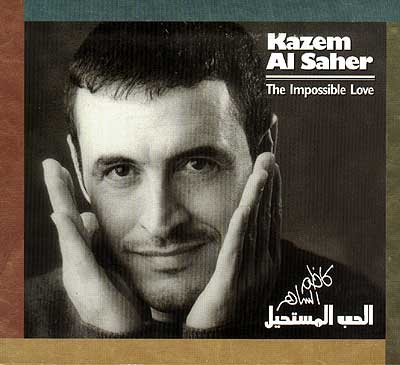
holiday and the girl: the double celebration. Kazem [In English.] No, it's not like this. [They thrash it out, but basically, Dawn has it right.] That's my 80%! [Laughter] B.E. We talked last time about how the Gulf War interrupted your life and career. You were in Iraq then. Were you in Baghdad? 49:55 Kazem I was in Baghdad. I composed the best songs. "Fi Madrasat Al Hob" is a very classical song. This song talks about love. It says, "Your love taught me how…." It's very difficult words. [Goes to Arabic. Dawn: You taught me what real love is, its true essence. Even if a man cries, that's still a real man.] Yeah, a real man. You taught me to respect love. It's a very long song. e B.E. You wrote this in the midst of danger and fear and tragedy, and that was a kind of inspiration, wasn't it? Kazem[Translated by Dawn] I composed the melody, but the words were written long before by a very famous poet, Nizar Qabbani. I even placed this song in a different room and I slept in another room so that just in case a bomb came, only one of us would go, the music or me. And I wrote the letter. I put it with the song. If anyone found it, please respect the music and put it in the right way. B.E. That's amazing. Tell me now about what the war, when it was over, meant for your career. Kazem[Translated by Dawn] The first four years were very hard. I had an Iraqi passport [and so couldn't travel to many places], there was very little money, there were no studios working. It was very hard for me to get my music out. B.E. And since then, you've lived in.. Kazem Jordan until '92. Then Lebanon, Tunis, Cairo in '95. In London in '92, I gave a concert for the children of the church. I've played here in America, many places. B.E. So where is home now for you? Kazem I don't know. I don't know. I have my houses in Cairo, and Lebanon, and Paris and Dubai. I don't know where. B.E. Do you go back to Baghdad now? Can you go back? Kazem I can. Yeah, of course, I can. I left Baghdad five years ago. So one time, In sha'Allah, I will be back. B.E. Why did you choose to come to play in America at this particular time? Kazem It think [it's] the best time to say something to the people, to show another face of the Iraqi people. Because the people of the world, when they think of Iraq, they think about war. There is no one who thinks about many beautiful things. I think, for me, it is the best time. B.E. Thank you. Tell me about the musicians you are working with. You've just done one concert with them so far. Kazem They are very good. From the beginning, I was very afraid, very nervous, because I don't know anyone. It's the first time without my team. My band is always with me. So, it's the first time. Dawn, she called me and said, "Don't worry. They are the best here." So they did rehearsal for twelve hours a day. They are very nice. I know my music is very difficult for them. It's very, very difficult. One song, "Ana Wa Laila," it took them like six hours, seven hours--just one song. But they did well. I'm very happy with them. And they chose the difficult songs. I ask them, "Please, change the songs. I have very short songs, like three minutes, four minutes." They say, "No, we want to play 'Fi Madrasat Al Hob,' fourteen minutes. They want to play 'Ana Wa Laila,' fourteen minutes. They want to play 'The Impossible Love.' It's like ten minutes. "You don't have time, guys. You have to play the short songs." They said, "No, please. Let us to do." B.E. I understand that you've recorded this song "The War is Over" with Sarah Brightman. Kazem Yeah, "The War is Over Now." B.E. What war are you referring to? Kazem The part that I sang with her is,
"In morning dew, a beautiful scene came
through, like war is over now, a pure moment of
thought. The true meaning of love. The war is
over now. I feel I'm coming home again."
Karim Al Iraqi wrote two sentences. [Speaks them
in Arabic] "Peace of God to all people in
the world. When we will live with love and
security." It talks about the war of the
soul, the war inside us. B.E. We have to stop now, don't we? Kazem
Yes, but thank you very much.
|
 |
||||||