Encoding: Due to this results and having
the knowledge that the information of an image after Fourier Transformation
is mostly focused on the four corners, we rather keep just the values mentioned
above, which correspond to the positions of the entire image.
| 0,0 | 0,1 | 0,2 | 0,3 | ||||
| 1,0 | 1,1 | 1,2 | |||||
| 2,0 | 1,2 | 2,2 | |||||
| 3,0 | |||||||
| 6,1 | 6,2 | ||||||
| 7,1 | 7,2 |
In order to be able to store the floating-point values of the transform
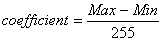
table, we have to map each value into the range [0,255] of unsigned char
using a normalization process by finding the maximum and minimum of these
elements. Normalizing process is this:

This operation leads to some loss of data but we try to minimize this
effect that mainly depends on the value of coefficient by keeping the coefficient
small.
Again when we examine the transform
table, [0][0] entry is a very large positive number (of the order of 10.000)
but the remaining elements are respectively small
( [ -1000,1000] ) . If we consider [0][0]
element in normalization, the coefficient will be a number like 40 and
this will cause a very large error during normalization. We overcome this
problem by storing the [0][0] element apart from the remaining elements.
This optimization decreased the error in the normalization in a perceivable
amount.
We find the minimum and maximum of the
selected elements (except [0][0] of real part) of both real and imaginary
parts and calculate a common coefficient for all the numbers to be normalized.
Normalized values and other necessary
data are stored in the resulting 8x16 bytes segment is:
| 0,1-re | 0,2-re | 0,3-re |
|
||||
| 1,0-re | 1,1-re | 1,2-re | 6,1-re | 6,2-re | |||
| 2,0-re | 2,1-re | 2,2-re | 7,1-re | 7,2-re | |||
| 3,0-re |
|
|
|||||
| 1,0-im | 0,1-im | 0,2-im | 0,3-im | (MARK) | |||
| 2,0-im | 1,1-im | 1,2-im | 6,1-im | 6,2-im | |||
| 3,0-im | 2,1-im | 2,2-im | 7,1-im | 7,2-im | |||
We write only five columns and seven
rows of these 8x16 segments to the output image because gathering the empty
spaces together results more compression during png conversion.
To eliminate the similar segments to
be stored repeatedly, we calculate the rms values for every consecutive
segment pairs while tracing through the image, and compare the results
with a specified rms value. If the result is less than the acceptable error
amount we only take the information on one of the segments and put a mark
on the other segment to indicate that the corresponding values are stored
on another segment, which is directed by the two pointers of x and y dimensions.
These pointers are situated at positions [4][0]-[4][1] and [4][2]-[4][3]
(two bytes each), since we don?t have any other information there in this
case. Elsewhere, if rms value is greater than the specified error value,
we take both segments into account.
Instead of using short int we prefer implementing
conversion of int to 2 bytes short int and its reverse by hand, not to
be machine-dependent. Also instead of using a 4-bytes long float coefficient,
we convert the coefficient into fixed-point number of 2-bytes long. Maximum
value of coefficient did not exceed 30, a precision of 1/1000 is obtained
with 2 bytes.
Decoding: The reverse process of encoding
is followed, calculating the original values form the quantization table
entries by the formula:

and then restoring these blocks according to the symmetry properties.
After restoring the real and imaginary parts of transform values, inverse
Fourier
transform is applied and original pixel values of the 8x8 image segment
are obtained.
|
|
|
|
|
|
| Lena |
245.805
|
141.973
|
4.58
|
42%
|
| Oguz and selim |
155.198
|
110.959
|
2.88
|
26%
|
| Generated 1 |
25.823
|
31.421
|
11.78
|
- 22%
|