 |
 |
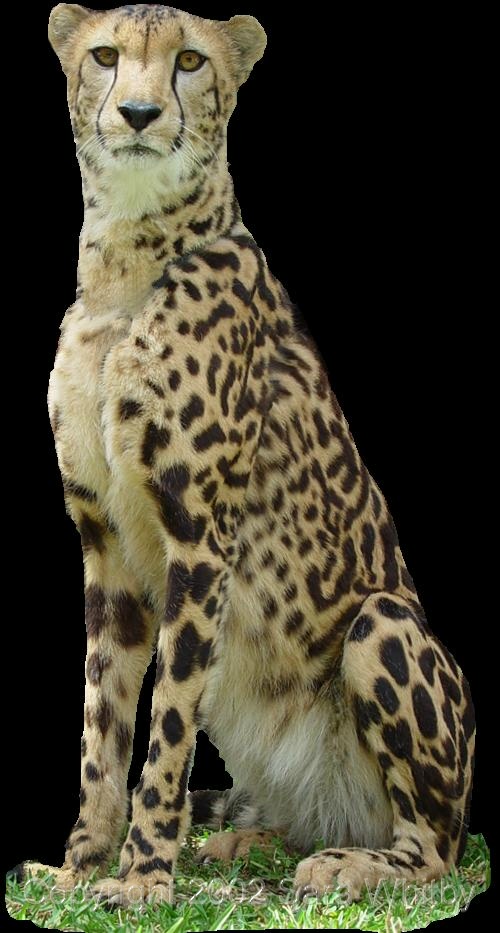 |
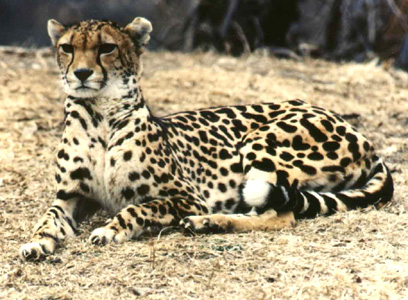
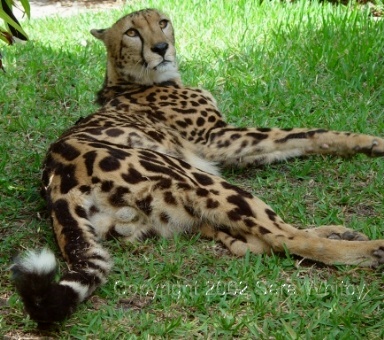
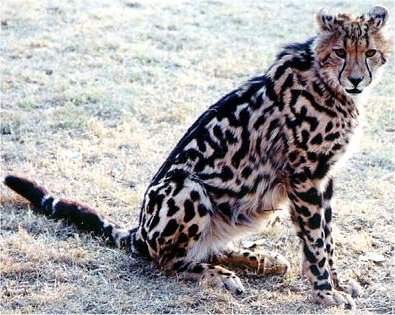
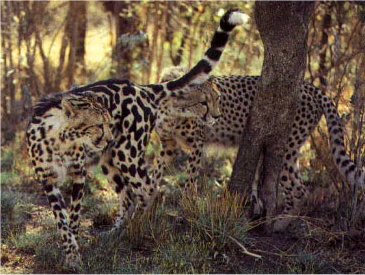
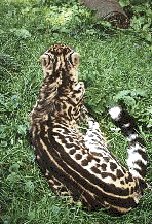
| Name: Mukancheetarah Gender: Female Type: King Cheetah Concept: Wild Beast *Sound is a cheetah's bark* Sleek curvature of feline form, graceful and elegant with each step. Long tail offered a bit of balance to the five foot long beast as she paced about, never really staying in one place for long. Slender body of golden tan fur marred by black splotches with three black stripes aligning her spine and five rings of black encircling her tail. Fur of pure white was noted under her chin and at her belly. Short, muscular legs give inclination of the agility this feral beast has. 5' long from shoulder to rump 2 1/2' tail 3' high at the shoulder 150 lbs non-retractable claws Runs typically at 50 mph |
| A cheetah is carnivorous and eats a variety of small animals. While most cats are nocturnal predators, the cheetah is primarily diurnal, hunting in early morning and late afternoon. Since it depends on sight rather than smell, it likes to scan the countryside from a tree limb or the top of a termite mound. Other big cats chase only a few hundred meters: the cheetah chases 3.4 miles (5500 meters) at an average speed of 45 miles per hour (72 kilometers per hour). The stalk is as important as the sprint: usually it will creep within 50 yards (46 meters) of an intended victim before the final acceleration. Full sprints last about 20 seconds and almost never exceed 1 full minute. If it succeeds in catching an animal the cheetah will suffocate it by clamping the animal's windpipe, sometimes as long as 5 minutes. Very small animals like hares are killed by a simple bite through the skull. But whatever the meal - large or small - cheetah eats quickly for if challenged it will most often lose. Cheetahs have unusually clean eating habits: they do not return to their kill nor do they eat carrion; they leave the skin, bones and entrails of their prey.
ALL females are solitary except when they have a litter. Average female home ranges extend to 833 square kilometers. Males and females mix only to mate: a female raises her cubs alone. Special paw pads and non-retractable claws provide great traction. Large nostrils and lungs provide quick air intake; a large liver, heart and adrenals also facilitate a rapid physical response. A long, fluid, greyhound-like body is streamlined over light bones. Small collarbones and vertical shoulder blades help lengthen the stride. The tail acts as a rudder for quick turning; the eye's retinal fovea is of an elongated shape, giving the cheetah a sharp, wide-angle view of its surroundings. The dark tear marks beneath each eye may also enhance its visual acuity by minimizing the sun's glare. The spine works as a spring for the powerful back legs to give the cheetah added reach for each step. But this spring-like movement is very taxing physiologically. The top speed, 71 miles per hour (114 kilometers per hour), can usually be maintained for only 200-300 yards. (274 meters). Cheetah sounds include purrs, bleats (distress call type meow), barks, growls, hisses and chirps Churring: staccato growl, high-pitched Nyam-nyam: cubs' sound when feeding � Ihn-ihn: mother's call to her young � Purring: like a house cat � Staccato purring: sound made by courting males � Bleating: like a meow - a distress call Cheetah are easily tamed and can even be taught to play games like "fetch". But they cannot be housebroken; even a wild cheetah will soil its resting place since it is very mobile and has no true lair. |
 |
 |
 |