
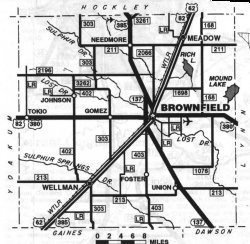
Terry County

Terry County
(The text of the historical markers will be in quotation marks. The directions to the marker's locations will be in parentheses.)
.
"Terry County, organized in 1904, had no jail facility until this frame structure was erected in 1916 on the southeast corner of the courthouse square. The one-room building with two steel cells was replaced in 1926 by a jail located on the top floor of the new courthouse. This small structure then became property of A. T. Fowler, who moved it to his farm in the 1940s. The outside walls were plastered and the interior use for storage. Given to Terry County Heritage Museum in 1974 by A. T. and Terrell Fowler, the old jail was transferred to this site and restored."
(1975. Located at 608 East Cardwell in Brownfield, Terry County, Texas.)
"Landmark for pioneers, freighters, the "Shin Oaks" are unusual for growing spontaneously on treeless high plains."
(1969. Located US 62/82, at north City Limits, Brownfield, Terry County, Texas.)
"Early classes in the Tokio area were held in the ranch house of the J Crosse Ranch near the turn of the century. In 1911, a school building was constructed near the center of town (about 300 feet N), and classes were relocated. Larger school buildings later were erected, once due to fire and twice due to changing space needs. The school facilities continued to serve the community's educational as well as religious and civic needs until 1941 when Tokio School was consolidated with the Brownfield Independent School District." (1991. Located in Tokio, 14 miles west of Brownfield on US 380/82 R. O. W.)
"A. M. Brownfield , for whose family this town was named, came to Terry County as a rancher in 1900. An early community leader, he organized the Brownfield State Bank in 1905. Built as a home for his family in 1928, this structure exhibits influences of the Spanish Colonial style of architecture. The concrete and clay building materials were used to make the home as fireproof as possible, since an earlier family residence had been destroyed by fire in 1915." (Recorded Texas Historic Landmark, 1985. Located on East Cardwell, Brownfield, Texas.)
"County seat of Terry County founded in 1903 by developers W. G. Hardin and A. F. Small. Named for Brownfield family, prominent property owners and ranchers in the area. Measuring with only 100 feet of wire, Hardin and Small laid out a town on this site (then a pasture) and offered a lot to each voter in the county. Streets (named for first settlers) were designated and a general store, hotel and school were built. In 1904 the town vied with Gomez for county seat, winning by a slim margin. Present economy is based on farming and oil." (1971. Located on Courthouse Grounds, US 380, Brownfield, Texas.
"Native of Kentucky. Came to Texas in 1831. Member Secession Convention. Commanded reinforcements of state troops sent to Rio Grande for the capture of federal arms, property at Fort Brown. Went to Virginia hoping to be in the first battle of the war. Cited for valuable volunteer service in the First Battle of Manassas. Returned to Texas with orders to raise a Cavalry Regiment which soon attained fame as Terry's Rangers. Accepted his commission only when men elected him Colonel. Killed Woodsonville, Kentucky leading unit's first charge. His loyal Rangers carried his name until war's end. Buried in Glenwood Cemetery, Houston. Terry's Texas Ranger's - Ten companies of the "Kid Glove" gentry of Texas enlisted for the duration of the Civil War, forming the famed Terry's Texas Rangers. With their able leaders, this 8th Texas Cavalry Regiment joined Johnston's command in Kentucky. History finds it easy to call these Texas men fighters. They were excellent horsemen, marksmen, utterly reckless. Individual heroism was not uncommon. Their deeds were praised at Shiloh, Murfreesboro, Chickamauga, Bragg's Raid into Kentucky and their last charge at Bentonville, N. C. Called upon to cover retreats, to invade enemy lines to get information, harass the enemy and to lead charges." (1963. Located on Courthouse Lawn, Brownfield, Texas, US 380.)
"Longtime residents recall the burial of a woman, probably Mrs. W. C. Lusk, on this site in 1922 or 1923. Other burials occurred here as well, in what was then an open field on J. A. Forrester's farm. Forrester and his wife Nealie sold a two-acre lot, which became known as Forrester Cemetery, to the Union Independent School District in 1925. The first recorded burial was that of Edna Mae Edwards, an infant who was born and died on April 23, 1926. The many unmarked children's graves reflect the harsh conditions of farm life in the early part of the century. The last recorder burial was that of Melvin Hill in 1961. The cemetery is all that remains of the community." (1999. Located off Texas FM 403 south of Brownfield about 6.6 and west of Foster Gin about 2.2 miles.)
"In 1903, owners of land here in center of then-unorganized Terry County platted this town, secured a post office named for Spanish American patriot Maximo Gomez, drilled a public water well, and induced merchants and citizens to move here. This was the first inhabited townsite in the county. Its promoters hoped it would be the county seat, but that honor went to Brownfield (4.4 mi. E) in 1904 when the county was organized. Gomez had a post office until 1926, school until 1941. A church , some businesses (.75 mi. NW) and the old cemetery retain the name." (1974. Located 4.4 miles west of Brownfield on US 380.)
"On August 3, 1903, nine worshipers gathered together to organize a Baptist church. Led by the Rev. J. R. Miller, the congregation met once a month in the Gomez schoolhouse. A one-room sanctuary, erected in 1909 , was moved three-quarters of a mile northwest when Gomez was relocated due to highway construction. A larger church building was erected n 1936, and by 1942 the church had its first full-time pastor. The Gomez School, converted for church use in 1953 was destroyed by fire in 1960 and was replaced by a new structure." (1988. About 6 miles west of Brownfield on US 380/82.)
"Established in 1902 in Gomez (then 0.5 mi. W of here), first settlement in Terry County. Original 4-acre tract was deeded to Gomez School Trustees in 1906 by pioneer settler H. F. Adams. some of earliest settlers are buried here. Many graves were moved to Brownfield in 1918." (1970. Located west of Brownfield on Highway 380/82 about 5.6 miles on county road about .5 miles.)
"Home of Monroe Brown Sawyer and wife Rebecca (Skeen); built 1902. One of the earliest homes in Terry County, it predated town of Brownfield. Building material for original five rooms was hauled from Colorado City and Big Spring by wagon. House has been remodeled extensively. In 1881 and 1882 M. B. Sawyer was a Texas Ranger, Company C, Frontier Battalion. He expanded 21 sections of land, bought in 1901, into a 33-section ranch." (Recorded Texas Historic Landmark - 1970. Located southeast of Brownfield about 7.3 miles on FM 403.)
"In 1906, three years after the founding of Brownfield, eleven women gathered together to form a club. Named Maids and Matrons, the club became primarily a study group in 1907 and the members founded the town's first library that year. Affiliated with the Texas Federation of Women's Club's in 1915, the club continued to operate at the library and supported numerous civic causes. When the Kendrick Memorial County Library was organized in 1957, the club donated their 3,000 volume collection of books to form the nucleus of the institution's holdings." (1990. Located at 702 East Broadway in Brownfield, Texas.
"W. J. French (1859-1930) settled here in 1903, and built two story house. Site became regular water stop for freighters and drovers. In 1905, French obtained the mail contract between Lamesa and Gomez, via Brownfield. Five passenger "hacks" started each day from Lamesa and Gomez, and met at this half-way point at noon to exchange mail and passengers and change horses. After the riders were served a hot meal, cooked by Mrs. French, "hacks" returned to starting points, completing a 40-mile round trip. Service was discontinued in 1910, when mail was rerouted." (1973. About 14.5 miles southeast of Brownfield on SH 137.)
"Meadow was founded in 1904 on public land grazed by L-7 Ranch herds; village moved to this site on the Santa Fe Railway Line in 1917. Soon settlers were arriving with livestock in one end of a boxcar, furniture in the other. A boxcar was used as a station. This depot was built in 1911 at White Deer (200 mi. NE) moved here in 1923, used until 1965, then given to the community and relocated in the park (1967) as a relic of the town's early development.."
(Recorded Texas Historic Landmark, 1975. Located in Meadow Park. Meadow is located about 10 miles north of Brownfield.
"Methodist worship services were held in this area as early as 1904 by the Rev. J. A. Sweeney, a pioneer West Texas circuit rider. On Feb. 1, 1920, the Rev. J. W. Baughman formally organized this congregation with 17 charter members. Services were held in the schoolhouse or in the Baptist church building until the members built their own sanctuary in 1922. The Meadow Methodist Church was long associated with the Plains Circuit, serving for a time as its headquarters. The congregation welcomed its first full-time pastor in 1951." (Texas Sesquicentennial 1836-1986. Located at the corner of Third and Sefton Streets in Meadow.)
"Built for F. M. Daugherty about 1904, one year after son-in-law A. M. Brownfield helped found town. Lumber was hauled here by wagon. Style is typical of era. Site of early gatherings. Later home of the local midwife. Has been remodeled." (Recorded Texas Historic Landmark, 1969. Located at 1206 Tahoka Road, Brownfield, Texas.)
"Army and civilian effort in 1877 to halt raiding of Chief "Old Black Horses" Comanches. In group were 60 Negro troops of Co.A, 10th U, S, Cavalry, and 22 buffalo hunters known as "The Forlorn Hope." Troops departed Fort Concho early July, led by Capt. Nicholas Nolan. Eluded by Indians and finding water holes dry, on July 7 men were thirst-
crazed. By drinking horse blood and urine, soldiers lived 86 parched hours; finally reached old supply base. Hunters left group; found water alone. All but 4 soldiers survived this heroic test of endurance. (1972. Located about 2.5 from Meadow on U.S. 62/82 southwest.)
"Formed from Young and Bexar Territories; created August 21, 1876, organized June 28, 1904. Named in honor of Colonel Benjamin Franklin Terry 1821-1861. Leader of the famous Terry's Texas Rangers. Brownfield, the county seat primarily a farming area."
(1936. Located 10 miles east of Brownfield on US 380/82 at roadside park.)
TO RETURN TO TERRY COUNTY
