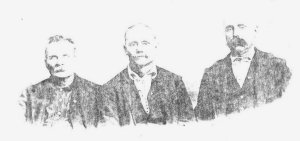
The Black Brothers sons of Stephen Black and Martha
Foree Black L-R William Henry Harrison Black,
George Black, Sr., and John Black Circa 1899
The Black family arrived in Texas between 1846 and 1850 from Pettis County, Missouri. Stephen Black was born in Virginia about 1816 and married Martha "Patsy" Foree in 1836 in Oldham County, Kentucky. Martha was born in 1817 in Oldham County, Kentucky. Stephen was of Scots descent and Martha of French Huguenot. They had their first five children in Missouri and the last two in Texas. They were first found in Lamar County, Texas in 1850. Little is known of Stephen and his final years. Lula Black Veale, a granddaughter states that he died in his sleep. This was between 1851 and 1860. Martha is next found with her children living in Fannin County, Texas. Miss Lula tells in her memoirs how hard the times were for Martha raising the children without a father. Times were very hard. It has been said that if the neighbors allowed them to milk their cows they had milk with cornbread. If not they had cornbread and water. The Black children had very little formal education. They were taught to read from the Bible by Martha. Martha established the Muleshoe Brand in 1856 and that brand is still used today by descendants. The Muleshoe Brand was chosen in 1936 as one of the 25 early brands to be placed in the Centennial Building in Dallas, Texas.
The children of Stephen Black and Martha Foree Black were:
1. William Henry Harrison Black born in Pettis County, Missouri in 1839. He married (1) Elizabeth Whitton in Fannin County, Texas. He married (2) Sarah Braley also in Fannin County, Texas.GEORGE BLACK, SR.2. Malinda F. Black was born about 1840 presumably in Pettis County Also. She married John Corrin in Fannin County in 1858.
3. Amanda Black was born in Missouri also and married Amos Baker In Fannin County in 1860.
4. George Black, Sr., my great-grandfather, was born in 1844 in Pettis County, Missouri. He married Stacy Frances Forbes in Fannin County in August 1865. He died in Terry County, Texas December 1917. I will have more to say about George and his direct Descendants later in my story.
5. John Black was born about 1846 in Pettis County. He married Isabella Young in Fannin County in 1867.
6. Mary E. Black was born about 1853 in Lamar County, Texas. She Married first a Mr. Holt and second J. D. Bigbee in Fannin County. She died in 882.
7. Sarah "Sait" Elizabeth Black was born April 25, 1855 in Lamar County, Texas. She married (1) John Montgomery Dodds and (2) Amos A. Atkins. She died in 1904.
George enlisted in the Confederacy when he was sixteen years old. Another family historian suggests that George and his older brother, William Henry Harrison, served together in the 4th Arizona Calvary from Texas. They were sent to the southwest part of Texas to fight the Comanches. They participated in the Battle of Glorieta Pass in present day New Mexico. It was a bloody fight between Confederate and Union soldiers. They returned in rags and tatters with nothing left. I have a picture of George in his Confederate Uniform and a group photo of him at an Old Confederate Soldiers Reunion in Brownfield, Terry County, Texas but as of this date I have been unable to locate him on any roster or find his papers. I might add that Brother Henry's family was able to locate paperwork on him.
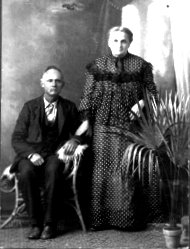
George Black, Sr., and Stacey Forbes Black
in their declining years.
Shortly after the war George married Stacy Frances Forbes in Fannin County August 8, 1865. Very little is known about Stacey's family or her early life other than she was born in Kentucky and was part Cherokee. She was very proud of her Indian heritage and passed that pride down to her children and grandchildren.
The various Black clan lived in the vicinity of Monkstown and Bois d'arc Creek in Fannin County. The Black and Monk families donated the land for Monkstown. Five acres coming from George's parcel. I have often wondered if Black Branch of Bois d'arc Creek received it's name from the Black Family.
About 1879/80 George, his mother, his brothers, sisters and their families with a large assortment of other people made the decision to move further west. They had run out of grazing land for their large herds of cattle, horses and other livestock. They moved a herd of 1000 cattle and 500 horses. Being afraid of being robbed they hid their gold coins in money bags onone of the nieces and a Negro woman thinking that no one would search them. Their original destination had been Quanah, Texas but after many hardships along the way they decided to settle on Bufford Creek in Stephens County. They were resting the livestock and drying out after crossing the Brazos when unfriendly ranchers suggested they not graze their large number of livestock and move on. Of course they were not accustomed to being told where they could not graze and with their Scots tenacity went into town the next day and paid for their land with gold coin.
The Black brothers sometimes herded their cattle up north through Indian Territory in Oklahoma to market in Kansas. On one such trip they were stopped and held hostage for three days by hostile Indians. They were released after they cut beef cattle out of the herd to give to the Indians.
Stacy was ill a great deal of the time and it was George's job to stay at home in the Black Ranch Compound and take care of the women and children while the other men were out working the cattle. George was small in stature but big-hearted and there was no limit to his courage. One evening when the other men were away rustlers came to take the cattle. George rode out on his mule and informed the leader that the children needed their milk and under no circumstances were they taking the milk cows. He told them he was cutting the milk cows out of the herd and they might shoot him but he was taking their leader down with him.
After Martha Foree Black passed away in 1888 George bought his mother's homeplace and paid for it in gold coin. About 1899 brother Henry bought George's land and George once again moved on. He relocated his clan to Randall County near Happy, Texas. Little is know about their sojourn in Randall County nor why they left. Perhaps it was the inclement weather in the Panhandle but in 1906 when this writer's Mother was a few months George moved his clan to Gomez, Terry County, Texas. There were less than 900 souls when they arrived in Terry County. The land had to be cleared of mesquite and grub. There were virtually no trees, hence no lumber. They lived in dugouts until they were able to acquire lumber for their homes.
Census records indicate that neither George or Stacey were able to read or write but I do have one canceled check in my possession dated 1911 and he was able to "draw" his name. George Black was admired among his peers and was instrumental in building schools and churches wherever he lived. He died January 23, 1917 in his home near Gomez. He is buried in the Brownfield Cemetery. Stacey died February 13, 1923 and is buried next to George.
The children of George Black and Stacey Forbes Black were:
1. Emily Jane Black born February 8,1867 in Fannin County, Texas. She married Sam Funderburk presumably in Stephens County, Texas. Her husband murdered her January 28, 1916 and he committed suicide the same day at their home near Gomez. Both are interred in the Brownfield Cemetery. They had no children.George Black, Jr. was born near Monkstown, Fannin County February 22,1878. His family left the area when he was a small child and he grew up near Bufford Creek near Breckenridge in Stephens County, Texas. Life was uneventful for young George. He did the same things that all boys did of that era, swam the creeks, hunted, fished and got into the usual mischief. He went to school at Yellow Fork School near his home. The Black families had built this school so their children and the neighboring ranch children would have a place to attend school. He met Mintor Josephine Moreland at an all night dance and it was love at first sight. They were married Eastland County February 18,1899. George was seven days short of being twenty-one years old. Mintor was seventeen. Mintor was one of the eight children of David Edward Moreland and Frances Welthia Richardson Moreland. Mintor was born in Cass County, Texas December 15, 1881. Shortly after their marriage George and Mintor moved to Randall County, Texas with the rest of the Black Clan. Three of their six children were born in Randall County and the other three in Terry County. They left Randall County in 1906 and settled near Gomez, Terry County, Texas. They were devoted parents seeing that their children had all the advantages of that era. They were civic minded taking an active part in the community. They were devoted members of the Church of Christ. Mintor prepared the Sacraments for church on Sunday morning for over eighteen years. According to other family members their house was the gathering place for the youth of the community. The Black family had a piano and an organ and some of the children were accomplished musicians. They had taffy pulls, played kick the can, fox and geese, and many more games. They were good neighbors. Mintor helped lay out the dead. She also took loving care of George, Sr. cutting his hair and keeping his nails clipped. She was an immaculate housekeeper. My mother said her idea of spring-cleaning was moving all the furniture into the yard and giving the inside of the house a thorough cleaning. George was called "Uncle George" by the young folks of the community. He had a voracious sweet tooth so a young person could always count on getting a treat from Grandpa. He raised some cattle, farmed with two dapple gray draft horses until the time of his retirement in 1947. At one time he owned a mercantile store in Gomez and a hotel in Brownfield. My favorite story is about Grandpa and his yearly "goober" crop. Each year he grew a crop of peanuts and hung them in the barn to dry and wait for Halloween Night when the neighborhood boys would come to raid his barn and steal his "goobers." Grandpa would dutifully stand on the porch waiting for the thieves to come and fire his shotgun into the air. He got a big kick and the thieves got a thrill.2. John Walter Black was born circa 1868 in Fannin County. He married Corrin Bridges in Stephens County. He died in Indian Territory, Oklahoma January 1903 and is buried there. She died 1940 in Terry County, Texas and is buried in Brownfield Cemetery. Their children were Joe Black, Edd Black and Norah Black Bozeman.
3. Laura Frances Black was born April 30, 1871 in Fannin County. She married Wiley Bridges, date unknown. She died July 5, 1950 in Brownfield, Terry County, Texas. Wiley died January 18, 1967. Both are buried in Brownfield Cemetery. They had one child, Emily Alice Bridges Phillips.
4. William Henry Black was born January 23, 1872 in Fannin County. He married Allean C. Bridges. He died near Gomez, Texas February 10, 1941. Allean died January 2, 1967. Both are buried in Terry County Memorial Cemetery. Their children were Mabel Stacey Black, Willis Frances Black Key, Beryl Olin Black, and Ross Oliver Black.
5. Mary Isabelle Black was born circa 1876 in Fannin County and Died about 1896 in Stephens County, Texas. She is buried in the Yellow Fork Cemetery. She never married.
6. George Black, Jr. (My grandfather) was born February 22, 1878 in Fannin County, Texas.
George Black and Mintor Moreland Black (Thought to be on their Wedding Day - 1899)He married Mintor Josephine Moreland February 15,1899 in Eastland County, Texas. Mintor died June 8, 1945 near Gomez, Texas. George died April 24, 1961 in Asherton, Dimmitt County, Texas. Both are interred in Terry County Memorial Cemetery. Their children were Dimple Deffie Black Nephew, Alson Black, Bonnie Allean Black Key Melton (my mother), Buelah Black Karr, Walter Houston Black and Gladys Black Willis King.
7. Stacey Maranda Black was born September 19, 1880 in Stephens County, Texas. She married Ira William Scott, Sr. She died May
8, 1960 in Amarillo, Potter County, Texas. Ira died August 8, 1948. Both are buried in Canyon, Randall County, Texas. Their children were Jessie Mae Scott Dodson, Opal Ella Scott Lee, Ira William Scott II, and Annie Laurie Scott Weaver.
8. Deffie Black was born April 4, 1883 in Stephens County, Texas. She married Willie Winn near Gomez in 1915. She passed away February 18, 1954 in Brownfield. He died October 23, 1967 in Brownfield. Both are buried in Terry County Memorial Cemetery. They had no children.
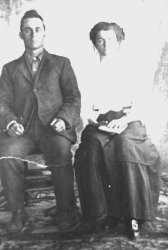
Eventually, their children scattered and they kept busy at their everyday lives. Grandpa was busy with his farming, livestock, grapes and tinkering. Mintor kept house, raised her chickens and made the most beautiful quilts.
At one point in the thirties during the height of the depression they along with several of their married children moved to Quemado, Texas on the Rio Grande. They were promised an oasis in the valley but life proved difficult and they moved back to Gomez about 1936.
Mintor died of a heart attack in her home at Gomez June 1945. George was lost without his companion of the past forty-six years. We lived with him and took care of him when I was a small child. He eventually went to live with the eldest daughter, Dimple Black Nephew. He raised oranges and complained he couldn't see out the window for all the shrubs. He was use to treeless West Texas. Grandpa passed away April 1961 in Asherton at the home of his daughter. Both he and Mintor are buried in Terry County Memorial Cemetery in Brownfield, Texas.
The children of George Black and Mintor Moreland Black were:
1. Dimple Deffie Black born November 9, 1900 in Randall County, Texas. She married Fred Nephew in Big Spring, Texas. She died February 9, 1970 in Asherton, Texas. They had one adopted daughter Joyce Dimple Nephew Drawe Harless. Joyce passed away June 1999.My father Bud Melton was born July 31, 1891 near Emory, Rains County, Texas to Thomas Beverly Melton and Nancy Telezine Kelly. The Melton family has been in Texas since 1839 when my great great grandmother applied and received a land-grant from the Republic of Texas. He was the second child of a brood of fourteen children. The Melton family moved to Fannin County about 1899. Life was very hard during those times and this writer has heard many times how far he had to walk to school and far down to the nub he had to use his pencil. He was an avidreader and was quick to correct our grammar and manners. His military pay record book indicates that he entered the United States Army by draft September 19, 1917 in Bonham, Fannin County, Texas. It also indicates that he received additional pay for Foreign Service leaving the United States June 30, 1918. He was in Battery "F" 344 Field Artillery, which originated at Camp Travis, San Antonio, Texas in September 1917. Due to the scarcity of materials he spent the first few months in foot drill, (more commonly known as marching) military courtesy and the fundamental principles of army life. He left for WWI via Camp Bullis, New York, England and France. They advanced their journey toward the Rhine and on Thanksgiving Day advanced very bravely on a cabbage and turnip field. There were no casualties but a number of prisoners were captured greatly adding to the variety of their Thanksgiving meal. Their final destination was Kempfeld, Germany were they drilled and practiced some more in preparation for a parade for General "Black Jack" Pershing. He received the princely sum of $33.50 per month less a deduction of $6.70 for insurance.2. Alson Black was born in Randall County November 25, 1903. He Married June Dollene Hawkins. He died June 25, 1981 in Crystal City, Texas. Their two children were Jimmy Fred Black and Jane Ann Black Barnes.
3. Bonnie Allean Black Key Melton (my mother) was born April 8, 1906 in Randall County, Texas. She married (1) Buster Belmont Key in 1925 in Brownfield, Texas. They divorced in 1936. Their Children were Wanda Key Grant Fortenberry, Dellbert Key, and Cloyes Key.
She Married(2) Gastford Latideon "Bud" Melton in Lovington, New Mexico in 1936. Daddy passed away in Big Spring, Howard County, Texas in 1956. Mama died in San Angelo, Tom Green County in 1996. Their children were Katherine Melton O'Neal, Bruce Thomas Melton. Bruce passed away in 1954 in Brownfield. All three are buried in Terry County Memorial Cemetery.4. Buelah Black Karr was born in Gomez, Terry County, Texas January 3, 1908. She married Cleburne Karr about 1926. Buelah passed away in Dallas, Texas April 30, 1985. Cleburne passed away January 26, 1986 in Garland, Texas. Both are buried in the Oddfellows section of Grove Hill Cemetery in Dallas. Their two sons were Duane Omera Karr and O'Neal Karr.
5. Walter Houston Black was born in Gomez, Texas May 4, 1915. He married Claudia Josephine Brown in Lovington, New Mexico January 9, 1933. He passed away March 4, 1971 in Lubbock, Lubbock County, Texas. Their children were Teddie Joe Black, Delphine Black Dempsey Rae, Dorothy Danielle Black Barnett, Eddie Wayne Black and Walter Houston Black, Jr.
5. Gladys Black Willis King was born October 3, 1918 in Gomez and passed away Thanksgiving Day 1993 in Del Ray Beach, Florida. She was cremated and her ashes spread at sea. She married (1) Johnny "Jack" Dower Willis in Lubbock, Texas in 1936. They were divorced about 1950. They had one child, Tyrone Dower Willis. Gladys married (2) James Edward King May 2, 1952 in Asherton, Dimmitt County, Texas. They had two sons Ricky James King and Russell Wayne King.
After returning from the war Daddy was footloose and jilted. He traveled many years seeing most of the United States. He was happiest when he was a cowboy. Free to pickup his bedroll and leave when the mood struck him. At one time he drove a mule train for U. S. Borax. This phase of his life was coming to a close in 1936.
He was walking down the street in Quemado, Texas when he met my mother, Bonnie Black Key. He was a goner. This confirmed bachelor was married in July of 1936. Mother already had three small children from a former marriage but he willingly married her and her three children.
They started their married life in Gomez, Texas but over the years lived many places. They lived in Milnesand, New Mexico, Sundown, Texas, Wellman, Texas, Brownfield, Texas, Seagraves, Texas and even as far west as North Hollywood, California.
I remember my father's sense of humor and his habit of sticking a nickname on everyone that came in contact. I remember him asking our young friends if they liked the burro milk they were drinking or if they were enjoying the quail eggs. He loved children, dogs and horses. He passed away in 1956 with pancreatic cancer. Mama lived forty more years after his death and retired from the school cafeteria. She was a wonderful cook and seamstress. In 1990 we had to move her from her home in Brownfield to my sister Wanda's home in San Angelo. She died on April 11, 1996. She was ninety years and three days old. It is hard to realize the many changes she saw in her lifetime. Theodore Roosevelt was president when she was born. She went from horse and buggy to an automobile with an automatic shift. She went from Kerosene Lamps to electricity. She saw the hemlines go up and down and up and down. She weathered the great depression raising her oldest children alone. She saw five wars sending a son off to one. She saw them put men on the moon. She went from living in a dugout to the microchip age. I wonder what she would think about the Internet and Email. As well as she liked the telephone she would love Email.

You Are The
Person To Visit
This Family Page
|
Or if you have any additional information I would love for you to share. Please feel free to E-mail me. Katherine Melton O'Neal at [email protected]
|