Michigan Festivals
Introduction to Festivals
Objective:
Rationale:
Students need to know locations of places on a map. By doing this lesson,
the students are learning names of cities and their locations. Locating the city
where they go to school will also help them realize the distance between the
festivals and their school city. Learning about different festivals will help
them learn about different cultures and celebrations that take place around
them.
Materials:
Opener:
The lesson will begin by asking the students by a show of hands how many
have attended festivals. They will also share their experiences at a festival.
From there they will be told that Michigan is a site for many festivals.
Procedure:
Evaluation:
Students will be evaluated on:
Closure:
After the lesson
has been introduced students will be told they will learn about their first
festival which will take place in August. After August is through they will be
introduced to the next festival in the beginning of the month of September which
takes place in September. Also they will be informed that the first day of each
month they will learn about a new festival
The
Perfect Time to Pick Apples
Objectives:
Students will be able to:
Benchmarks:
Content Standard 4
Economic Systems
All students will explain how a free market economic system works, as well as other economic systems, to coordinate and facilitate the exchange, production, distribution, and consumption of goods and services.
Analyze
how Michigan’s location has impacted its economic development.
Materials:
1.
Book: Apple Picking Time
2. Information about Apples
3. USA Map
4. Average High Temperature, January - Michigan State, map
5.
Farm, Mineral and Forest Products in Michigan, map
6.
Chart paper and crayons or markers
Teacher Background:
Producers combine natural, human, and capital resources to make goods and
services. Background reading about the apple-growing industry will be helpful.
Also the Literature Annotation for Apple Picking Time: This is the
story of a young girl who spends a whole day picking apples with her family and
other workers in Washington state. It is both a tradition and a necessity for
the community to help bring in the autumn harvest.
Motivation:
Have a nice, juicy apple hidden from the students. Ask them to close their eyes
and listen as you make a sound. When they think they can identify the sound,
they should raise their hands. Take a bite or two of the crisp apple. Most
students will guess the sound fairly quickly. Ask: "How many of you eat
apples? How do apples grow? Would you like to help pick apples? What tools would
help you?"
Procedure:
1.
Explain that the book you are going to read to them is about a family
that picks apples in Washington State. Locate Washington State on the USA
Map. Read the story as the students follow along.
2.
Divide the class into groups of 3 or 4. Direct each group to make a mural
of the resources needed for apple picking, based on the story. Tell the students
they are to label each resource in the mural. Set up a color code for the
labels:
 | Green lettering = Natural Resource (label Apple Tree
in green) |
| Brown lettering = Human Resources (label foreman in
brown) |
| Red lettering = Capital Resources (label ladder in
red) |
3.
Copy this flow chart for apple growing onto the chalkboard:
Apple
seeds are planted
Apple
trees grow in warm
Apple
blossoms form in early spring
Bees
pollinate the blossoms
Apples
develop on the branches
Apples
are ready to be picked in autumn
The
trees rest in cold weather
4.
Discuss: What hazards could interfere with the growth cycle of the
apples? (Insect pests could harm the trees; humans could cut the trees; trees
could die in a bad storm; there could be a very dry year; winter could be too
harsh; and so on)
5.
Introduce the idea that certain farmers specialize
in growing apples because the natural resources in the community are well suited
to the apple crop. Explain that specializing in growing apples means that apples
are the only crop the farmer grows. Ask the students why a farmer might
specialize in one crop. Help them brainstorm a list of advantages and
disadvantages of growing only one crop on a farm. Discuss the concept of migrant
workers since many crops are only harvested at one time of the year.
6.
Project an overhead transparency of "Information About Apples".
After reading the information with the students, ask them why Michigan might be
a suitable place for people to specialize in apple growing. Include the idea
that the geography of an area, its rainfall, and seasonal temperatures affect
which crops can be grown there.
7.
Hand out the Temperature Map of Michigan.
Remind the students that in "Information About Apples", it states that
apples need a cold winter. Ask which areas of Michigan have winter temperatures
near or below freezing. Have a student reread aloud the information about the
type of landscape best suited to growing apples. Have the students use the
relief map of Michigan to locate hills and slope areas. Ask the children to
predict which areas in Michigan might be the apple growing areas because of
their geographic features and temperatures.
8. Hand out the "
Farm, Mineral and Forest Products" map. Have the children compare their
predictions with the actual growing areas for apples.
Draw conclusions about the best winter temperatures for growing apples, based on
the information on the maps.
Conclusion/Closure:
Review the resources needed to produce an apple crop. Review the necessary climate conditions for growing apples.
Evaluation: Students will be evaluated on:
1. Their ability to identify economic resources
2. Ability to explain pros and cons of specialization
3. Ability to draw conclusions based on the temperature map
Extension:
Take a class field trip to visit an apple orchard to view production and
technology.
Kalamazoo, MI: RUSSIAN
FESTIVAL!
Saturday November 20th, 2004
(Traditionally the 3rd Saturday in November)
Strand II. Standard II.I
Diversity of People, Places, and Cultures
All students will describe,
compare, and explain the locations and characteristics of places, cultures, and
settlements. The mosaic of people, places, and cultures expresses the rich
variety of the earth. Natural and
human characteristics meld to form expressions of cultural uniqueness, as well
as similarities among peoples. Culture
is the way of life of a group of people including language, religion,
traditions, family structure, institutions, and economic activities.
Objective(s)-
The objective of this lesson is for the students to learn and understand the Russian culture in Michigan. Migrating patterns, living styles, and cultural differences will all be points for the students to focus on. The field trip portion of this lesson will enable the students to experience first-hand what the Russian culture is like in the field trip to Kalamazoo, MI.
Evaluation-
The students will be evaluated by journal entries upon return from the field trip. The extensiveness of each child’s reflective writing should be able to determine how well the lesson on Russian culture in Michigan paid off.
Rationale
The rationale behind this assignment is for the students to experience another culture that they may not see in the classroom. The Russian Festival in Kalamazoo is very unique, and since diversity is being stressed in the classrooms of today, it is important for children to know and understand that not every culture is the same as theirs. Acceptance and understanding of these different cultures is an essential part of the students’ learning experience in the elementary classroom.
Materials
·
Pictures of Russian festival (found at www.russianfestival.org)
·
Pictures of Russian landmarks, cities,
etc (found at http://www.loc.gov/exhibits/empire/)
·
Journal notebooks for prior and post
writings
·
Transportation to Kalamazoo, MI
· Field Trip Permission Slips for students
Opener
It is extremely important to open this lesson with a lot of enthusiasm. To start, hold up a picture of the Kremlin. Have students discuss what they think it is, along with where they think it is. Briefly go over where Russian is by explaining how far away it is in terms that they could understand. Then ask the students if they would like to visit such a place? Explain that while a trip all the way to Russia is not allowed for an elementary classroom, a trip to Kalamazoo for the Russian Festival is!
Procedures
Day One
1. Call 269-501-7464 and ask for Mr. Boltenko, who is in charge of festival tours.
2. Start the lesson by holding up a picture of the Kremlin. Then have the students discuss what they think it is, along with where they think it is.
3. Explain the field trip to Kalamazoo for the Russian Festival. By now, the students should be pretty excited.
4. Since this lesson is a two-day lesson, the first day (the day before the field trip would work the best) is spent going over different Russian cultural aspects. Farming, the fall of communism, and language differences are all ideas to bring into discussion.
5. Take the Hermitage Museum Virtual Tour
6. Have the students write a brief journal entry about what they expect to experience the following day in Kalamazoo during the Russian Festival.
7. Collect the journal entries.
8. Read over the journal entries and write down questions that any of the students may have. This will help for the following day as far as answering questions goes.
Day Two
9. This is the day for the field trip. Have the students board the bus or whatever mode of transportation will be used.
10. Drive to Kalamazoo, MI.
11. Meet up with Aleksandr Boltenko at the “mock” Hermitage Museum. Boltenko is in charge of giving tours to classrooms at the museum.
12. The rest of the festival is up to the discretion of the teacher, as far as what to see and what to do because the festival is set up different each year. This is the 8th year for the festival.
13. When you get back to the school, have the students write a reflective journal entry telling about their experiences at the Russian Festival.
Wrap-up
Upon arrival back to the school, it is important to settle down the students and go over what they learned. Stress the cultural differences and how it is important to understand and respect people of all sorts. From here, it would be good to start another lesson on a different culture. This would enable the students to compare the Russian culture to the new one. Comparing cultures (not just ours to another) is a good concept for the students to practice.
North
American Snowmobiling Festival –Cadillac, Michigan Controversial Lesson Plan
Objectives:
 | Students will be able to identify and locate the North American Snowmobile Festival on the State of Michigan map. |
| Students will be able to understand and debate the controversial issue of snowmobiles on our environment. |
| Students will be able to locate supporting evidence on the Internet for their particular side of the debate. |
| Students will understand how
they can become involved in political issues by writing to their local
senator, city or community mayor, stating their position and reasons related
to this debate. |
Evaluation: Students will be
evaluated on their responses to open-ended questioning regarding snowmobiles.
The students will need to be able to show how to locate information regarding
their side of the controversy on the Internet, particularly Google search.
Students will be evaluated on their ability to correctly locate Cadillac, MI on
the State of Michigan map. Students will be evaluated on their participation in
the Snowmobile Festival debate and use of supporting evidence for both pro and
con sides. Students will be evaluated on their reflective journal entries
stating their position on the issue and reasons for this.
Michigan Benchmarks to be used:
SOC.V.2.2: Gather and analyze information using appropriate information
technologies to answer the question posed.
ELA.11.3: Organize and analyze information to
draw conclusions and implications based on their investigation of an issue or
problem.
Rationale: The
students need to know about this festival because it is a part of Michigan’s
economic well being and tourism. Most importantly students need to be aware of
the effects this festival can have on our environment. They need to be familiar
with both sides of this controversial issue in order to take a stand and argue
on the issue to be debated. Students also should be aware of how to voice their
opinion and support a position to their community and senator.
Materials:
| Cadillac North American Snowmobile Festival website http://www.cadillac.michigan.com/snowmobile.html |
| Computers with Internet access |
| Notebooks/journals for social studies |
| State of Michigan map |
| Chalkboard/chalk |
| Overhead projector |
| Overhead transparency of
snowmobile picture |
Opener:
Show students the overhead transparency of a snowmobile. Ask the students what
do they think of when they hear the word snowmobile. How many students have been
on these or been around one? What did you notice? Take a poll of students and
ask if any students would ever ride these and write a tally on the chalkboard of
yes or no.
Procedures:
Day 1:
Day 2:
Day 3:
Day 4:
Day 5:
Wrap-up: Students will be asked
to write a reflective journal entry responding to the debate and after hearing
both sides of the issue what position they would take and why. Students would
also have the chance to write a letter to Senator Carl Levin of Michigan or
Governor Jennifer Granholm of Michigan stating their opinion of their class
debate. Students would also brainstorm ways of how to make snowmobiles more
environmentally friendly or alternatives to the Cadillac North American
Snowmobile Festival in Michigan.
**This lesson spans over three days. The activities
are split up between these three days as seen in the procedure. **
ü Standard SOC.II.1: All students will describe, compare and explain the locations and characteristics of places, cultures and settlements.
ü Benchmark SOCII.1: LE1: Locate or describe the major places, cultures and communities of the nation and compare their characteristics.
ü Standard SOCII.2: All students will describe, compare, and explain the locations and characteristics of ecosystems, resources, human adaptation, environmental impact, and the interrelationships among them.
ü
Benchmark SOCII.2.LE4:
Explain how various people and cultures have adapted to and modified the
environment.
Objectives:
· Students will learn about the January Festival of Tip-Up-Town in Houghton Lake and they will learn that ice fishing is a large part of this festival.
· Students will learn the basic concepts of ice fishing.
· Students will learn that Alaska is another region that practices ice fishing.
· Student will create their own ice fishing poles.
Rationale:
I chose to create this lesson because the Tip-Up-Town festival in Houghton Lake is an infamous Michigan festival that I felt students could learn from. This is because ice fishing is a major event in this festival. Therefore, I incorporated ideas of ice fishing into this lesson. The students will discuss ice fishing, build a fishing pole and use the Internet to learn about ice fishing in Alaska. Therefore, the students will learn that ice fishing is not only a part of this Michigan festival but also a part of Alaskan life. I felt it was a good opportunity for students to see that this is practiced not only in Michigan but also in a state across the country. I thought it was an interesting and hands-on topic, which is why I chose to create a lesson based on ice fishing.
Materials:
· Large map of Michigan
· Chalkboard to write on for students
· Computers with Internet access for the students to use
· Construction paper
· Markers
· Paper clips
· Scissors
· Boxes with holes cut in them
· **The following materials are needed for the students to build fishing poles and they are needed for each student. **
· Cardboard tubes
· Large safety pins
· Small safety pins
· Empty thread spool
· Erasers
· Fishing Line
· Magnets
Activating Prior
Knowledge or Opener:
I will begin the lesson by pointing to a Michigan map and showing the students Houghton Lake. I will explain that this is an important place in our state because it is the place where a festival called Tip-Up-Town is celebrated every January. Then, I will ask the students to tell me what kind of games and events they have at this festival in the middle of winter. I will list these on the board and I will prompt the students to tell me that they ice fish. At this time, I will begin a discussion of ice fishing. I will show them several pictures of people ice fishing. I will ask them questions like, “Have any of you ever went ice fishing”, “How do you think they stick their fishing poles in the water if it is frozen”, “Do you think the fish are frozen in the lake”. These questions will activate the student’s knowledge of ice fishing and it will spark their interest.
Procedure:
**Day One**
1. After I’ve activated the student’s knowledge of ice fishing. I will tell them that we are going to build ice-fishing poles but instead of fishing for fish we are going to fish for facts.
2. Next, the students will build their fishing poles. We will do this as a class. I will demonstrate the process step by step as the students are following me.
3. To build the pole, first the students will carefully poke the small safety pin to one end of the cardboard tube. Next, they will poke the large safety pin through the middle of the tube but putting the spool, first, and the eraser on the safety pin first. Both of these should be snapped close after they have been poked through the other end of the tube. Therefore, the spool and the eraser should be resting on top of the tube and the large safety pin is holding it.
4. Next, the students will measure eight feet of fishing line out. They will cut the line and wind it around the spool leaving about two feet out of it. This access fishing line will be thread through the small safety pin and then it will hang off the edge of the tube.
5. Finally, the students will tie a magnet on the end of their fishing line. We will save these poles for our next activity, which will occur the next day. They should be stored away for safekeeping.
**Day Two
6. The next day, I will ask the students to recall the ice fishing that we discussed the prior day. I will then ask them to name other places in the world that probably ice fish besides just Houghton Lake. The students should name Alaska and Eskimos in a short period of time, or I will prompt them to do so.
7. The students will then get in-groups to answer questions I have listed on a sheet of paper. Each group will get a different set of questions that they will find the answer to on the Internet.
They will use the following three web sites for their research:
8. Once the students have found these answers they will get different colors of construction paper in which they will cut fish shapes out of. On one side of the fish they will write the question they received and on the other side they will write the answer. The fish will have paper clips attached to them so they can be picked up with magnets. These questions will all be about Alaskan ice fishing that the students can find using research. These will include:
· What time of year do Eskimos go ice fishing?
· What kind of fish is the most popular to the Eskimos?
· Name a lake or river where ice fishing is popular?
· What is the average size of the fish they catch?
· Name three pieces of equipment that they use when they go ice fishing?
· Do some people make a living ice fishing in Alaska?
· Is ice fishing dangerous in Alaska? Why or why not?
9. The fish will be stored for the next day of activities.
**Day Three**
10. I will ask the students to get their fish facts out. The students will place their fish in the pretend ice fishing containers I have made for each group. This is a large box with a small hole cut out of the bottom of it to resemble fishing through the ice. The groups will ice fish out of another groups fish container so they can learn new facts about Alaskan ice fishing.
11. After, all of the fish have been picked up and all of the facts have been read the students will create their own reports about Alaskan ice fishing. They will pretend that they are a reporter reporting about ice fishing and at the end of their papers they should write, Reported by ___________________________ (their name).
Closure:
To close this activity I would have several of the students read their reports aloud to the class. I would also lead a class discussion in which the students would tell me what they’ve learned about ice fishing. We could also hang these reports on a bulletin board in the classroom as a closing activity. I will then explain that we will learn about our next festival next month.
MCF Standard V.l:
Information Processing All students will acquire information from books, maps,
newspapers, data sets, and other sources, organize and present the information
in maps, graphs, charts, and time lines, interpret the meaning and significance
of information, and use a variety if electronic technologies to assist in the
accessing and managing information.
Objective(s)- The learner will
| Be able to read and process information and create a program in Inspiration with the information processed. |
| Weigh, measure and compare fish |
| Students will learn about the National Trout Festival (ww.kalkaskami.com/trout/) |
| Students will be able to locate Kalkaska on a Michigan map. |
Background knowledge:
 A
Bit of History
A
Bit of History
In 1855, English-born William Copeland became Kalkaska
County's first settler when he purchased 216 acres of land near Round Lake in
the extreme northwest corner of the county. In 1859, Copeland married Mary
Swaney and doubled Kalkaska's population.
The original name of the county was Wabasee, after a
Potawatomi chief. Six years after the state of Michigan was admitted to the
Union (in 1843), the name was changed to Kalkaska, which may have come from a
Chippewa Indian word meaning burned over. Others say it once meant a
flat table of land
It’s no secret. Tourism is crucial to
Michigan’s economy. In his remarks to attendees of the 2003 Michigan Tourism
Conference, George Zimmerman, Vice President of Travel Michigan made that fact
even clearer.
Zimmerman announced that in 2002, 189 million travelers
experienced Michigan’s splendor and spent approximately $15 billion;
generating $868 million in state taxes and accounting for 188,000 jobs
statewide. This is up slightly from 2001.
Michigan ranks seventh in the nation in both total visitor
spending and for leisure visitor spending. Leisure travel is 79% of the total,
business travel 21%.
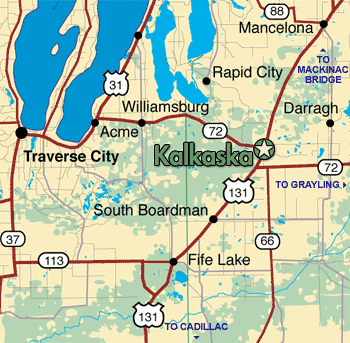
The Village of Kalkaska is located in the
central northwestern portion of Kalkaska County in the heart of Michigan's lower
peninsula northlands. As the largest community and county seat in Kalkaska
County, the village functions as the economic service center for a large rural
area, providing educational, cultural, and social opportunities for a population
substantially larger than that of the village. The nearest communities offering
a greater ranger of services are Traverse City -- 23 miles to the west; Cadillac
-- 40 miles to the south; Grayling -- 25 mmiles to the east and Gaylord -- 42
miles to the northeast.
In spite of the community's relative isolation from major urban markets (i.e.
Grand Rapids, Lansing, Saginaw and Detroit) the area is served by several state
and federal highways, which provide good accessibility. Michigan Route 72
provides a direct link with Interstate 75 at Grayling, which in turn provides
access to the Upper Peninsula and Detroit metropolitan area. In addition, US-131
which goes through the middle of the state is slated for upgrading to interstate
standards at some date in the future. At present, construction is in progress to
bring the freeway around Cadillac to a point just a few miles south of Manton.
This, of course, will substantially produce accessibility.
| Population (County 2000) 16571 |
| Population Change from 1990 to 2000: 22.8% |
| Median household money income (1999): $30,783 |
| Total housing units (County 2000): 10,822 |
| Average July temperatures: 54 F min., 81 F max. |
| Average January temperatures: 9 F min., 26 F max. |
| Average annual snowfall: 126 inches |
| Land area (square miles) 2000: 561 |
| Persons per square mile, (2000): 29.5 |
| Main highways: M-72, M-66, US-131 |
| Rail line: Tuscola-Saginaw Bay Railroad |
| Closest public airport: Cherry Capital Airport, Traverse City |
In spite of the community's relative
isolation from major urban markets (i.e. Grand Rapids, Lansing, Saginaw and
Detroit) the area is served by several state and federal highways, which provide
good accessibility. Michigan Route 72 provides a direct link with Interstate 75
at Grayling, which in turn provides access to the Upper Peninsula and Detroit
metropolitan area. In addition, US-131 which goes through the middle of the
state is slated for upgrading to interstate standards at some date in the
future. At present, construction is in progress to bring the freeway around
Cadillac to a point just a few miles south of Manton. This, of course, will
substantially produce accessibility.
The natural setting of the area is characteristic of much of
northern lower Michigan. The terrain is relatively level but heavily wooded with
isolated clearings for small farms and urban settlements. Numerous rivers and
streams with water qualities reminiscent of more ancient times, enhance the area
providing fishing and boating opportunities for local residents and in-state and
out-state tourists. In addition, many small lakes offer opportunities to swim,
boat, fish, water ski and generally enjoy the pleasures of water related
activities. Kalkaska County is also blessed in that it is very close to Elk and
Torch lakes -- large bodies of water that offer attractive development
incentives in addition to their recreational aspects. The headwaters of the
Boardman River, a blue ribbon trout stream, begin in and around the Village of
Kalkaska.
The importance of these natural features is perhaps
exemplified by the fact that the Village of Kalkaska is the home of the National
Trout Festival a weeklong festival filled with activities that take place
annually with the opening of trout season. The festival draws visitors and
tourists from all over Michigan and some out-state areas and, in the process,
substantially increases retail sales, particularly in terms of hotel and motel
accommodations, restaurant receipts and other retail establishments. The theme
is taken from the bountiful supply of trout in the Big Manistee, Rapid and
Boardman rivers.
The Village of Kalkaska and the surrounding area exhibit many
of the characteristics typical of northern Michigan resort communities. There
are a large number of motel/seasonal cabin establishments along US-131, bait
shops, a tourist information center at the Chamber of Commerce and other
attractionsfor tourists. The community has seen a tremendous increase in winter
tourism, due to the impact of the snowmobile industry. The village has a
snowmobile staging area it maintains with a warming station. This is connected
to a state maintained snowmboile trail system consisting of hundreds of miles of
trails. The village has also allowed snowmobiles, through a local ordinance, to
be operated within the incorporated village limits.
Several thousand acres of the county are included in the
Kalkaska State Forest which provides outstanding hunting opportunities. Numerous
parcels of state forestlands are located close to and adjacent to the village
itself. AS a result, the area has an atmosphere of woods, rustic scenery and
open space.
The soil of Kalkaska County has been named the state soil for
Michigan. The vast majority of the soils in Kalkaska County are already sandy in
nature. They have good to fair load bearing capacities, offer fair to good
foundation material for footings, for the most part, slight limitations for
septic tanks and filter fields. This situation was partially responsible for the
development of the public sewer and water systems in the village.
As the county seat, the village serves as headquarters for
township, county and state offices. On the other hand, the village has a
substantial industrial base with several large industrial firms. The village is
in the process of constructing the Kalkaska Enterprise Industrial Park, which is
a 28-acre park with 10-industrial lots for further industrial development and
growth in the area.
The village-owned airport is located in the southwest corner
of the corporate limits (off Island Lake Road) behind the Kalkaska County Road
Commission garage and Kalkaska Public Transit offices and it saw many
improvements in 2002. Over $550,000 dollars in improvements were made which
included the paving and lighting of a 3,500 foot runway, paving and lighting the
taxiway, a paved tie down area and precision pathway indicator lights were
installed. Future plans include the design and leasing of hangar areas and the
paving of taxiways to the hangars. The Kalkaska Airport is now classified as a
general aviation airport and is maintained and open year around.
Kalkaska was originally part of Wabasse County in 1840. Then
in 1853 it was attached to Grand Traverse County and then in 1863 it was
attached to Antrim County. Crawford County, unorganized at the time, was part of
it. The county seat was located in Kalkaska where the county was formed and had
been there ever since. Our first courthouse and hall was a wooden building, our
second was a brick building, now we have a beautiful Governmental Center on
Birch Street. Other towns in the county are Rapid City, South Boardman and part
of Fife Lake. Kalkaska, an Indian name, is said to have the meaning of
"Table Land" or "Burned Over Land".
When Hiawatha and his tribesmen stalked the deer in our area
the land was mostly covered with tall whitepine trees. Some of the largest of
these trees measured four to six feet at the base. A whole house could be built
from one of these giants. Then the lumbermen came, and in a few short years
scalped the land of its grandeur, burning the tops and branches where they lay
and floating the logs down the river in spring or shipping them to a nearby
sawmill on one of the narrow gauge railroads that had laced the communities
together. Logging camps and shacks for living quarters were sometimes moved by
train from one camp to another and the remains of these "ghost towns"
may be seen throughout the county. Lumberjacks from many nations were imported
to fell the trees and float the logs down the river or load them on railroad
cars. So we became an integrated population in this area
When the lumbering was completed the camps were moved farther
north and only the community centers where sawmills and wooden ware factories
were located remained as towns. Many of those working in the camps had married
local girls and were reluctant to uproot their families, so they stayed on as
farmers and this became part of the sand-land potato area. Every farmer raised a
few chickens, some pigs, some milk cows and beef cattle. They called it
diversified farming and every family could live from its own larder except for
coffee, tea and flour.
Then the people of the metropolitan areas discovered this was
a place of recreation. The wild areas sprouted young trees and bushes, which
were great for deer to browse and cover for the smaller animals. It became a
great hunting and fishing place and many cottages and cabins sprang up along the
rivers and on the lakeshores. Land prices skyrocketed from a dollar an acre to
between five and ten dollars an acre. When the Depression hit our county in the
1930's, much of our land went back to state ownership because the speculators
could not afford to pay the taxes on it. Now almost 50 percent of our land is
still state forest lane and is used as recreational area monitored and developed
by the Department of Natural Resources. Snowmobile, motor bike, horse and hiking
trails criss-cross our county for those who love the outdoors, all maintained by
the DNR. They also maintain good habitat for our wildlife and fish. They
maintain many campgrounds throughout the county where any person may camp while
enjoying our fresh air and exploring the wonders of nature.
Oil and gas was discovered by the Sun Oil Company 30 years
ago in the southwest corner of Kalkaska. Drilling started in earnest in the
early seventies and we have something more over a hundred producing wells here
now. The gas is being purified in plants south of Kalkaska called refractory
plants. Twelve manufacturing plants have moved to the county in the last five
years and we have an economic and population growth far beyond our expectations.
Kalkaska has had the greatest percent of population growth of any county in the
state, having increased 100 percent. The income per person has also tripled,
making our economic picture more pleasing.
Both new residents and those who have lived here many years
are generally happy with this area. The lakes are considered good fishing lakes
and the larger ones are enjoyable for boating, swimming, and water skiing. Our
rivers produce many trout and other fish. They also provide canoeing and
camping. This county being almost 50 percent state and federal land provides
miles where you can hunt, bike, enjoy bird watching, photograph wild flowers and
pick mushrooms without trespassing on private property.
Evaluation-
· I will be observing the students during the weighing and measuring of the fish.
· The Inspiration project they will turn in so that I will be able to check.
· During a grand conversation, I will ask specific questions to check their knowledge as well
· I will have them write in their journal about the experience
Materials
Opener : The students will
have already learned about other festivals in Michigan. We would hold a grand
conversation to review some of the festivals we had already learned about. This
grand conversation would lead us into the April Festival that is the National
Trout Festival in Kalkaska Michigan. I would have a Michigan map already on the
wall all year. We would talk about where Kalkaska is. Some of the lesson we
would be doing would cover the different areas of the Trout Festival (car show,
craft show, fishing, flea market, Taste of Trout (recipes), Wood Memorial Race
(1 Mile Fun Run/Walk), Grand Royale Parade. There are rules and regulations for
all these areas. I would print them out and have the copies for the students for
the second day projects.
Procedures: (Teacher)
· I would be familiar with the background knowledge of the Trout Festival and the city of Kalkaska.
· I would have copies of all the area of the Trout Festival for the students to use during their “trip” to the Trout Festival.
· I would try to obtain flyers from the Trout Festival to have on hand for the students to use.
· I would send a note home at least a week prior (and then a reminder the day before) telling parents what we are doing and what is needed from them. I would also let them know that we will be eating tuna salad for lunch and if their child did not want to eat it, then they should bring their own lunch.
DAY ONE:
Go to www.inspiration.com
The students will make an organization chart of each area of the Trout Festival using the following elements with information gained through the website or handouts from the teacher:
1. Flea Market
2. Craft Show
3. Car Show
4. Taste of Trout
5. Wood Memorial Run
6. Grand Royale Parade
Day Two:
We will celebrate a National Trout Festival in our class through learning centers:
The students will be evenly divided into 6 groups. Each group will work together at each learning center. Depending on the schedule in my class, I would hopefully give each group 30 minutes at each center.
| Flea Market: Children will bring in items to “sell” at the auction. I would send a letter home prior to the festival day. During their center time, they will talk with their group to decide prices and set up their own flea market. The selling of items will occur later in the day after the learning centers are completed. The items they will bring will be items from home they do not want anymore. I would ask each student to bring in 3 (I would have extra things on hand to add to it in case someone was unable to bring something in). They can then earn fake money at each center they go to. |
| Craft Show: We will have a fish tic tac toe game and plaster paint your own fish craft for the students to create (both available at www.orientaltrading.com) for each student to do. |
| Car Show: Using materials from arts n scraps students will create their own car. |
| Taste of Trout: Students will follow directions to make their own tuna salad to eat for lunch. (if the students do not like tuna salad, they will have brought their own lunch) |
| Grand Royale Parade: using a shoebox as a “float”, students will use fish foamies and other art supplies to create a float for a parade. |
| Fish weighing and measuring: The students will weigh a variety of fish that I will bring in. They will create a graph with their group for the weight and length of each fish. |
| Wood Memorial Run: This is a center I would do as a group at the end of lunch; I would take the students on a one-mile walk through the community (hopefully I would have a few parent volunteers to go along). |
| At the end of the day, I would plan to have the students display their parade floats.. maybe have |
Core Democratic Value: During these centers, children can think about:
The Pursuit of Happiness: As long as you don't interfere with others you have the right to seek happiness in your own way. Each student may not like every station, but most likely someone else in his or her group will. This will help show them that each person finds happiness in their own way.
Closure: I would wrap the two day festival up with a grand conversation of what we did and learned. Some of the questions I might ask:
| Where is Kalkaska on the map? |
| What type of activities do they have at the Trout Festival besides fishing? |
| What was your favorite center and why? |
| Which fish weighed more/was the longest? |
Resources:
http://www.kalkaskami.com/trout/
Lee,J
(2003). How to Draw Fish, Powekids Pub.
Pallotta,J.
(2001) The Ocean Alphabet Book
Pratt,K
(1994). A Swim Through the Sea, Dawn Publishers
Venetian
Festival Lesson Plan
Objectives:
·
Students will be able to comprehend the brief history of the
origin of Venetian Festivals found in Venice, Italy, St. Joseph, Michigan, and
Charlevoix, Michigan.
·
Students will be able to compare and contrast traditional Venetian
Festivals in Italy to those presented in the State of Michigan.
·
Students will be able to use economic concepts such as opportunity
cost, wants/needs, money exchange, and budgeting during our own classroom
Venetian Festival.
·
Students will be able to identify all concepts and terms used
throughout this lesson when they travel to one of the Venetian Festivals in
Michigan in July 2004.
Evaluation:
The students will be involved in grand conversations regarding traditional Venetian Festivals. They will respond to various open-ended and specific questions related to the material presented. The students are to write similarities and differences found between traditional Venetian Festivals to Michigan’s Venetian Festivals. A reflective journal entry is to be written based on students’ experiences with the Venetian Festival in their own classroom and how they rationalized using various economic terms such as, opportunity cost, wants/needs, exchange of money, and budgeting. The students are to send myself an e-mail during the summer describing their experiences with the Venetian Festivals. They are to explain how they identified and used the economic terms/concepts presented.
Michigan Benchmarks
to be used:
SOC. IV.1.LE.2: Identify the opportunity costs in personal decision making situations.
SOC. IV.1.LE.3: Use a decision making model to explain a personal choice.
SOC. II.1.LE.2: Locate and describe diverse kinds of communities and explain the reasons for their characteristics and locations.
ELA.VIII.1.LE: Identify and use mechanics that enhance and clarify
understanding. Examples include
sentence structure, paragraphing, appropriate punctuation, grammatical
constructions, conventional spelling, and relating in sequence an account of an
oral or visual experience.
ELA.VIIII.2.LE: Draw parallels and contrasts among key ideas, concepts, and varied perspectives found in multiple texts.
Rationale:
Students need to understand and enhance their knowledge of diversity of various festivals’ located in Michigan. The Venetian Festivals, in Michigan and Italy, provide students with the outlook and example of the celebration of life, family, and cultural differences. Students need to be able to develop a real world connection in order to help them draw on and develop meaning behind why these festivals are a continued tradition, and that these festivals do exist in their own state.
Materials:
· Living in Venice book
· Chalkboard/chalk
· Students social studies notebooks
· Loose-leaf paper
· Pencils
· Large sheets of paper (for banner making)
· Markers
· Crayons
· Feathers/beads
· Paint (tempera) and brushes-assorted colors and textures
· Water
· Glue
· String
· Poster board
· Single hole punch
· Assorted colors of construction paper
· Scissors
· Tape
· Stereo including CD’s and tapes of Italian and American music (age appropriate)
· Strings of lights (supplied by teacher or parent)
· Variety of food/drinks (parent/teacher supply this on day of festival)
· Festival sign-up sheets created by teacher to keep track of students activities, food, drinks, volunteer responses, and so on.
· Camera (for teacher to take pictures of students at festival for classroom information board)
· Cups, forks, spoons, napkins, and plates
· Sanitary wipes
Opener:
The teacher will ask the students, what do you think of when you here the word Italy? Allow students time to brainstorm ideas and the teacher should write these responses on the board. Continue by asking students, what does the word festival mean to you? Have students brainstorm their ideas to each other and then present these to the class. Introduce students to Venice, Italy be mentioning a few facts taken from the book Living in Venice. Show students various pictures of the city and proceed to discuss the topic for today, Venetian Festivals’.
Procedures:
Day 1-
1. The teacher will begin using the ideas brainstormed by the students to start a discussion on Venetian Festivals in Venice, Italy (Refer to the list of resources for information). The ideas discovered should be written on the chalkboard for students to write down in their social studies notebooks. Be sure to divide the board into two sections labeled: Traditional Venetian Festivals-Venice, Italy and Michigan Venetian Festivals.
2. Students are to take out pencil and their social studies notebooks to write down information from the chalkboard.
3. After this initial discussion, the teacher would continue by asking students what they think of when they hear Michigan and festivals.
4. The students will brainstorm their thoughts and ideas to the teacher and each other. The teacher should write down the students’ responses under the heading Michigan Venetian Festivals.
5. The teacher will introduce Venetian Festivals found within the State of Michigan, St. Joseph and Charlevoix and record these onto the blackboard.
6. Students will write these notes in their social studies notebooks as the teacher explains the terms.
7. Based on the information presented in class today, students will write a compare/contrast response to Venetian Festivals in Venice, Italy and Venetian Festivals in Michigan. The assignment needs to be on lined paper, and have one of the students pass one sheet to each member of the class.
8. The teacher is to explain the compare/contrast assignment to students including complete sentences, paragraphs, grammar, and punctuation, and neatness. If students have any questions they should ask the teacher.
9. The students can begin this assignment during social studies instruction, if time permits. Otherwise the assignment is to be completed at home and brought to class the following day for discussion and evaluation.
Day 2-
1. The teacher is to randomly go around the room and ask students either a compare or contrast they found between the Venetian Festival’s in Venice, Italy and Michigan. Students should have their assignments completed and in front of them for discussion.
2. The teacher should collect the compare/contrast assignments from the students for evaluation.
3. After the discussion, the teacher will explain to the students that we will be having our own
Venetian Festival at the end of
the week (Friday) using the ideas/concepts developed from yesterday’s
discussion. The teacher should put in the students’ mailboxes volunteer
notices for parents to possibly help two weeks prior to the assignment.
4. The teacher will explain that the students are to work in their groups (desks already arranged in groups of 4-5) on a particular aspect of the festival including:
5. The teacher should develop a sign-up sheet to see what each group will be developing/working on. The teacher should also have supplies ready for students to use at the beginning of the day.
6. After each group has decided what area they will work on, they may begin brainstorming ideas as to what they want to do. (The teacher should be traveling around from group to group monitoring the students’ decisions and offering suggestions as needed). The groups are free to use any of the materials presented in the room to develop their ideas.
*** This planning and preparation of our classroom Venetian Festival will be continuing from Day 2-Day 4.
Day 3-
1. Student and teacher continued preparation for classroom Venetian Festival.
2. Possible suggestions for both teacher and student include the following:
1. Name of the festival: Richard Venetian Festival
2. Date/Time of the festival: Friday, May 21, 2004 from 12:30-2:30p.m.
3. Room number: 203
4. Listing of what will be at the festival: games, food, arts and crafts, parade with mask decorating, and much more.
3. The teacher should have students volunteer to work at each area along with parent volunteers.
Day 4-
1. Students will be given time approximately 30 minutes to continue working on their assigned tasks for the festival. The teacher should be monitoring the students’ progress and help with last minute items.
2. The teacher will stop the students and have them put away their materials for the festival in their assigned containers.
3. The students will return to their desks and take out their social studies notebooks for a brief review of economic terms, covered throughout the year. These include opportunity cost, wants/needs, money exchange, and budgeting.
4. The teacher should ask students what these terms mean and write the term and definition on the board. Have the students write these notes into their social studies notebooks for a future assignment. Explain to the students that they will also be using these at tomorrow’s festival. Remind them to keep track of these terms and what they did/thought when they were being used at the festival.
Day 5-
1. The teacher and students will make final preparations for the festival. This includes set-up of various materials such string of lights, food, arts and crafts, banner, and other items to be brought and presented.
2. Before the festival begins, the teacher should review classroom rules and safety procedures and remind students if their behavior is not presentable; they will be removed from participating in the festival. The teacher will pass out $20.00 in pre-divided bills to each student.
3. The teacher should have the festival go from approximately 1-½ hours to 2 hours maximum. The parade throughout the school will be done approximately 20 minutes before the end of the festival. (To be determined by the teacher). Students will wear their masks and display them by their walk as is done in Venetian Festivals.
4. After the festival is complete, have students begin the clean up process by putting all materials back in the assigned places. The teacher should clean up the food dishes and strings of lights.
5. The teacher should have the students’ gather on the “thinking rug” to get feed back on how they thought the festival went. Possible question: do you think our classroom Venetian Festival is similar to the festivals in Venice, Italy or Michigan or both and why?
Students will write a reflective journal entry about their experience with the classroom Venetian Festival. They will state how they used opportunity cost, wants/needs, exchange of money, and budgeting their money in purchasing or participating in the activities. Did they use all of their money or how much money was left over? What did they learn from this activity and why? In our continuation of diversity, we will be discussing our family heritage and celebrate this in our Family Heritage Festival starting next month (June 2004).
Michigan Festivals Chronology of Events
May
2004 Venetian Festival
Week
of May 17th-20th
Monday
Students will learn
the history of Venetian Festivals in Venice, Italy and Michigan through
discussions. Students will be able to compare/contrast these diverse festivals using information presented. The students will complete the compare/contrast assignment for homework. |
Tuesday Students will share
their compare/contrast assignment with the class.
Students should be able to explain their reasoning for the
responses related to the Venetian Festivals. Students will be introduced to our own classroom Venetian Festival by organizing and taking part in the set-up of the festival. |
Wednesday
Students will be able to display and demonstrate their creativity, according to the selected part of the festival, by brainstorming and creating items for our Venetian Festival. Examples: advertising, decorations, arts and crafts, games, food, monetary making, and so on. |
Thursday Students will continue working on their chosen part of the Venetian Festival through brainstorming and construction of and use of various materials. Students will participate in, understand, and use economic terms to be applied during the Venetian Festival. These terms include opportunity cost, wants/needs, money exchange, and budgeting. |
Friday Students will be able to participate in the “Richard Venetian Festival” using economic terms and understanding how traditional Venetian Festivals (Italy) and Michigan Venetian Festivals “feel-like” during the celebration. Students will be able to reflect on how they thought our classroom Venetian Festival is similar or different or both to the traditional Venetian Festivals in Italy and Michigan and why. Students will be able to use the history of these festivals and experience of the classroom Venetian Festival in supporting their responses to the discussion. |
Objectives:
Students will be able to identify the parts of flowers. Students will understand how to plant flower bulbs and know the components of aiding their growth. Students will understand Dutch culture and see the economic value of tulips in the Netherlands.
Evaluation:
The students will be evaluated in various ways. A short worksheet and quiz will be used in the identification of the parts of flowers. Their group work and actually planting of the tulip bulbs will be assessed through teacher observation. Caring for the tulips will be evaluated through a daily checklist and rubric, which the students will fill out themselves. Finally, the understanding of Dutch culture and the importance of tulips with will be assessed through class discussions, journal entries, a Venn diagram comparing and contrasting our two cultures, and the presentation of their collage.
Rationale:
I chose to create this lesson around the Tulip Time Festival in Holland, Michigan. I wanted to introduce the students to this because it is one of the biggest festivals in our state. It is also the 75th anniversary of the festival this year so that will make our discussion of it a little more significant. This lesson will show the students respect for nature and the aesthetic beauty of the tulip. Most importantly, however, the students will be able to learn and experience another culture. The Dutch culture is not one that is often talked about, therefore, this would most likely be a new experience for the majority of my students. Hopefully this will encourage them to continue to learn about other cultures and allow them to develop a tolerance and appreciation for cultures other than their own.
Materials:
Tulip bulbs Potting Soil
Small garden on school grounds Pots
Hand held shovels Water
Sunlight Computers
Construction paper Markers/Crayons
Glue Scissors
First Tulips in Holland, by: Phyllis Krasilovsky Worksheet
URLs for interactive website : http://www.urbannext.uici.edu/gpe/case1/html
http://www.backyardgardetner.com/linda/tulips.html
http://www.dundeemessenger.co.uk/garden/bulbs.htm
Opener:
I will ask students if they remember the tulips we planted in September. I tell them that they involve the next festival we will be studying. They will be asked to journal, answering the question, “I think the tulips represent…” They will also be asked to predict what culture tulips might be related to.
Once everyone has finished I will begin the book First Tulips in Holland by Phyllis Krasilovsky. After completing the first chapter we will discuss it. We will continue reading the book throughout the week.
Procedures:
1). On a sunny day in September my class and I will plant tulip bulbs. Before beginning we will read on how to choose a good site for the tulips (websites provided). This research will also include how to properly care for them. Together we will choose a plot and plant a little garden (with the consent of administration). Students will be told that this is a good starting project for the beginning of the year to teach us to work as a team. We will all commit to taking equal responsibility for caring for the bulbs as they grow. I will tell the student that in the springtime the tulips will become part of lesson.
(Day 1, Monday, May 3)
2). The first Monday in May we will dig up our tulips and replant them in pots. They will just be beginning to bloom. Each student will have their own pot for which they are responsible. They will be reminded that this their very own tulip that they will be able to take home to their mothers just in time for Mother’s Day. Therefore they must care for the tulip through water and seeing that it receives ample sunlight. Every student will receive a chart that they will check off duties each day and will rate their care for their tulip 1-5.
(Day 2, Tuesday, May 4)
3). Students will write a prediction journal on what Michigan festival this tulip might pertain to,
as we will be continuing our unit on this subject matter. They will also guess what culture this is associated with.
4). I introduce students to the Tulip Time Festival in Holland, Michigan as our festival of the month. I will tell them that it started yesterday and is taking place all week. We will discuss, “Why do you think this festival takes place in the city of Holland? Can you think of another place with the same name? What could this mean?”
5). I will begin reading in First Tulips in Holland by Phyllis Krasilovsky. Readings will occur
daily throughout the week. This book teaches the importance of tulips in Holland and how the flower fits into their culture.
(Day 3, Wednesday, May 5)
6). Students will do research on the festival via the Internet. URLs will be provided. They will journal, answering the question, “If I could go to any part of the festival, I would most want to see…” They must also give justification to their response and details about the event. They will answer where and when it takes place and the history and/or meaning/significance behind the event.
7). Students would find pictures via the Internet of that aspect of the festival. They will print them out and create a small collage with their reason for wanting to visit also written out on the project. These would be presented to the class on Friday in order to give the students experience with peer-teaching. They will be explaining the various events of the festival to their classmates.
8). We will complete our daily reading from our book.
(Day 4, Thursday, May 6)
9). We will beginning with reading from our book and will have a short discussion on the chapter.
10). Students will have time to finish research and/or putting together their collage.
11). Students will return to the computers to read a short interactive tutorial on the Internet about the parts of plants. They will fill out a short worksheet while reading the site. They will also complete the six question quiz at the end of the lesson (on the net).
(Day 5, Friday, May 7)
12). We will conclude our reading. After a discussion period, students will complete a Venn diagram on the differences between their culture and that of Holland.
13). Students will present their collage to their classmates.
14). Students will take their tulips home to give to their mothers on Sunday, May 9, Mother’s Day.
Wrap-Up:
Our wrap up will be discussing the differences between our culture and that of Holland. I will bring in a few Dutch traditional foods: potato soup, and cheese and crackers.