Kathleen Whitinger September 30,2004
3rd Grade Social Studies John F Kennedy School Ferndale, MI
Locating and Describing Our Local Community
Objectives:
| Students will be able to locate their community on a map |
| Students will be able to list different ways to describe the relative location of the community |
Standard
| Identify the local community in which they live and describe its characteristics and boundaries (II.4.EE.1) |
Materials Needed:
| Map of Michigan |
| United States map |
Teacher Procedure/Development:
| Write the word “geography” on the board. Ask students how many have heard the word before. Ask if anyone has an idea of what it means and talk about any answers that come up. Help children understand that the basic meaning is that geography can be defines as the study of Earth and its people. |
| Talk about how one important of geography is learning about different places. Ask students to name different places they know about or have visited. Ask students to answer the question: “ Where is the place located?”. Discuss with students why it is important to know the location of places. (one reason is so you can find your way home from somewhere) |
| Using a Michigan map, help students locate Ferndale on the map. |
| Explain that all places have a relative location, which means you can describe where they are in relationship to other places. |
| Have the students look at the US map and have them describe the relative location of Michigan. (Northern part of the US, east of Wisconsin, north of Ohio.) |
| Next, have the students describe the relative location of Ferndale on the Michigan map. (southeastern region, near Detroit, Lower Peninsula) Review the importance of location by emphasizing the importance of location to the local community. |
| Next explain to students that geography also answers the question: “What is a place like?”. Ask students why it might be important what a place is like. (it is important to know if a place has mountains or a desert if you were to go camping there, so you would know what type of clothes and supplies you would need). |
| Ask the following questions: |
What is your community like?
What natural features do you find in Ferndale?
What is the government like? What do you know about the history?
| Divide the students into pairs. Have each group construct a web describing their community using the characteristics on the board. |
| Follow up with the question: |
Which of the characteristics could be shown on a map? (Park, main roads, mall, schools)
| As a homework assignment, have students interview their parents or other adults and ask them the question: “What do you think are the three most important characteristics of our community?” Ask students to report back the results of their interview. |
Possible extensions:
Ø Graph the results of the homework assignment. Compare these results with the categories that the students developed in class. Use this information to ass to the list of community characteristics. Talk about the following questions:
v Do older people see community characteristics differently than students in our class?
v If so, why do you think that is?
Ø Have the students complete a three fold brochure that describes the characteristics of the community in pictures and informational statements. Each brochure should have themes (such as recreation, jobs, education, physical characteristics, human characteristics (festivals, celebrations) and presents in-depth information about he local community’s characteristics.
Ø Students could take a trip around their community searching for important places. They could also request community information from local planning departments, tourist councils, etc…
Evaluation of students:
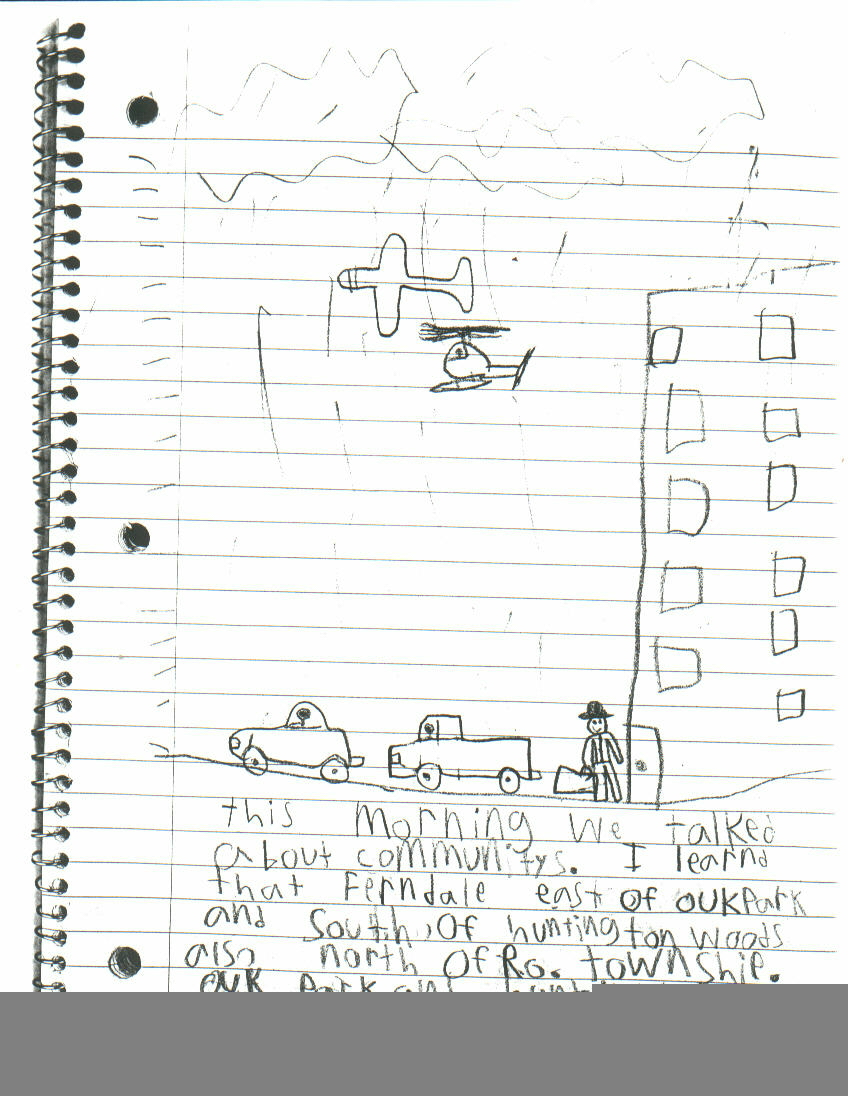
Students will write in their journal later in the day. They will be asked to write a paragraph describing the location of their community, including different ways to describe the relative location.