|
INTRODUCTION ON
KATHMANDU
As
Kathmandu is the capital of Nepal, there are more facilities available
than the other cities. Patan, Lalitpur, Bhaktapur are close to Kathmandu
which forces us to think that it is larger than the other cities in
Nepal. Now a days it can be noted that Kathmandu is westernizing day by
day. There are many temples where you can visit.
Kathmandu Durbar Square :
It is duly recognized as a world Heritage Site by UNESCO- this particular area best known as Kathmandu Durbar Square lies in the heart of this city. Locally
it is also called as Hanuman Dhoka-an ancient seat of the Nepalese
Royalty. Most of the buildings we see here date from 15th to 18th century.
Some of the important monuments to be seen here are:
Taleju temple, Jagannath temple, Kal Bhairav, Kumari Ghar, Kasthamandap
Swoyambhu Nath Stupa :
Located in a lovely little hill rock Swoyambhu Nath Stupa is one of the most fascinating architectural jewels of the world. This great Stoup is said to have been built around 250 B.C.
Generally a holy memorial site Stoup represents a typical Buddhist architecture. Its main feature the white dome is identified with a spotless pure jewel of Nirvana and a thirteen tiered golden spire in conical shape surmounted on the dome. Underneath this towering structure are a pair of all seeing eyes of Buddha painted on all four sides of the
Stupa.
The Stupa of Swoyambhunath stands on a typically stylized lotus mandala base-a long time ago believed to have originated from a legendary lake of Kathmandu Valley.
It lies about 3k.m. west of down town Kathmandu. There are two different ways to reach for this site. One is from the west side which is relatively a short cut and another is from the east side where it leads to the main entrance with 360 steps leading all the way to the top, where the most venerated Swayambhu Stupa stands-commanding a magnificent view of Kathmandu Valley and the breathtaking panorama of the north eastern Himalayan range.
Important days to visit this holy site:
1. Buddha Purnima, the birth day of Lord Buddha which fails on the full moon day of Baishak (April-May)
2. Gunla the holy Buddhist month according to Newari calendar (Aug.-Sept., early Morning).
3. Kojagrath Purni (Sept.-Oct.)
4. Samyak day of the Magh (Jan.Feb.) (every twelve years)
Natural History Museum :
Situated three kilometers west of Kathmandu city behind the famous Swoyambhunath hillock this museum has a unique collection of butterflies, fish, reptiles, birds, mammals, plants and a variety of fossils collected within the country. Photography inside the museum is prohibited.
Boudha Nath Stupa :
It is the biggest Buddhist monuments ever built in Nepal, Boudhanath is an imposing structure standing some 36 meters.
The basic feature of this great stupa is very much like that of Swoyambhunath stupa except its finial displaying. It is much bigger than Swoyambhu stupa and lies on the valley floor whereas the former one stands on the hill top. This stupa is said to have been built in 5th century A. D.
. |
|
Pani Pokhari :
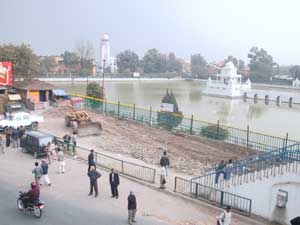
Situated in between Ratna Park and Jamal. This historical pond has been built by Pratap Malla to sympathize his beloved wife who was deeply shocked by the death of his son. The pond is opened for public only at the last day of Tihar -
"Bhai Tika". Those who doesn't have any brothers or sisters visit Rani Pokhari to pay homage to Lord Shiva on that day.
National Museum :
Two and half kilometers west of Kathmandu, the National Museum has a splendid collection of weapons, artifacts from ancient, medieval and modern Nepal. Its archaeological and historical displays are worth seeing. The museum is open everyday except Tuesday and government holidays.
Kaisar Library :
Located inside the premises of Ministry of Education, Kaisar library is a great centre of rare and valuable books and manuscripts. It is open for the public except Saturdays and other government holidays.
Singha Durbar :
A grand imposing palace built on the neo-classical style. Singha Durbar was the private residence of Rana Prime Ministers. Now it is the Secretariat of His Majesty's Government of
Nepal
Pasupatinath Temple :
Located on the banks of the Bagmati river, this two tiered magnificent golden temple with four triple silver doorways is unique example of the Nepalese temple architecture. It is one of the largest Hindu temple complex in South Asia with hundreds of Shiva lingams, shrines icons of various Hindu god and goddess insides. This temple site occupies an area of 281 hectares in total.
As non Hindus are not allowed to enter this temple courtyard, they are advised to go on the other side of the river in the
east to have a glimpse of the temple complex. In the middle of the spring (Feb.-March) every year there occurs a festival called
Shivaratri
Kathmandu is the capital of the kingdom, situated in a valley which is an open air museum of famous sites, ancient temples and shrines, golden pagodas and are inspiring deities, is a city of inexhaustible historic artistic and cultural interest. Several beautiful and interesting villages and towns surrounding the valley offer ideal destinations for mini treks. The dazzling Himalayan peaks are visible from several points on the mountains around the valley.
The capital is quite up to date in terms of comfort and convenience boasting luxury hotels, bars, restaurants, shops and casinos. Transportation is convenient and inexpensive. Medical service is quite good. Shoppers may purchase unusual gifts and souvenirs from an interesting assortment of items such as handicrafts, carpets, wooden art works, bronze casting and metal work,
thankas, Nepali paper prints and readymade garments.
" There are nearly as many temples as there are houses and as many idols as inhabitants here, not being a fountain or river or a hill within its limits that is not consecrated to one or the other of the Hindu or Buddhist deities "
- wrote a foreigner a long time ago
Become our member

|
|
Festivals in Kathmandu
Maghe Sankranti : (January)
Maha Shivaratri : (February)
Phagu Poornima or Holy : (March-April)
Holi is the festival of colour. It is observed for eight days just before the full moon of Phalgun during which time townsmen indulge in colour throwing at each other.
Ghodejatra : (March-April)l.
Chaite Dashain : (March-April)
Nava Varsha : (April 13 or 14th)
Festival of Seto Machchhendranath (March-April)
Matatirtha Aunsi or Mother's Day (April)
Buddha Jayanti : (full moon day of April/May)
This day which falls on the full moon of the month of Baisakh is celebrated to commemorate the birth, attainment of enlightenment and the death of Gautama Buddha, the founder preacher of Buddhism, more than 2500 Years ago.
Ghanta Karna : (June -July)
Naga Panchami : (July-August)
Janai Poornima (Rokshya Bandhon) (July-August)
Gaijatra : (July-August)
Pancha Dan: (July-August)
Gokarna Aunsi or Father's Day: (August-September)
Teej and Rishi Panchani: (August-September)
Indrajatra: (August-September)
Bada Dashain (September-October)
It is truly the national festival of Nepal. Every Nepai is stirred by the prospects of the joy this festival is supposed to bring with it. The change of mood is also
induced psychologically by the turn off autumn season after blue sky and a green carpet of fields. Each house also sets up a shrine to worship the goddess at this time. Barley seeds are planted on the first day in every household and nurtured for nine days.
On the concluding day of the festival called the tika, the elders of the family give tika to their junior members and to other relatives who may also come to seek their blessing.
Tihar and Laxmi Puja: (Festival of Lights,October-November)
This festival comes just after a fortnight of the departure of Dashain from the scene. The festivity lasts for five days and is marked by worship to different animals such as the crow, the dog and the cow on different days. Perhaps the most endearing sight of this festival is presented by the illumination of the entire town with rows of tiny flickering lamps at the duskbreak on the day of Laxmi Puja. In the evening of this day, the goddess of wealth, Laxmi, is worshipped at every household and it is in her welcome that myriads of lamps are burnt. On the last day, sisters show their affection towards their brothers with the performance of a puja and feed them with delectable food. They pray for their brother's long life to Yama, the Hindu god of death.
Bala Chaturdashi: (November-December)
Pilgrims from ail over Nepal throng at Pashupati temple from the night
before and burn an oil lamp to the god for the whole night. In the
morrow they take a holy dip in the sacred water of the Bagmati, pay obeisance to Pashupati and traverse the route prescribed for that occasion scattering 'a hundred variety of seeds' in Kailash forest of Pashupati so that their dead relations may reap the fruit of this merit in the next world |