 |
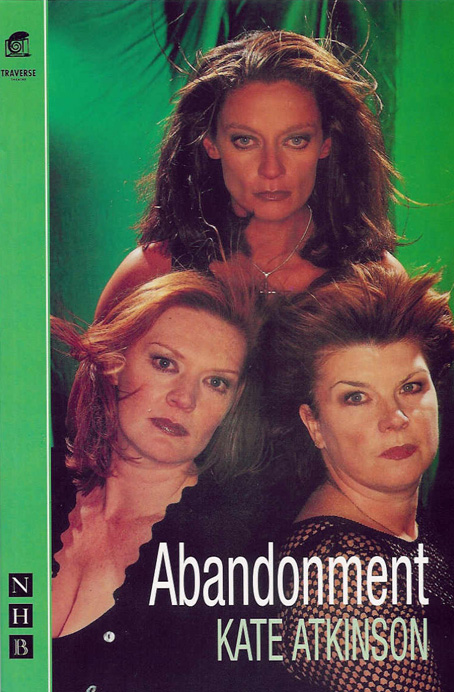
Work began on "Abandonment"
with casting, back in August. The most critical roles to fill were
our two sisters, Elizabeth and Kitty, and their mother Ina. To make
things even more interesting, Kitty and Ina double as Victorian characters
quite different in some respects from their modern counterparts, so
a wider playing range would be required of those 2 performers. Fortunately,
there is an abundance of theatre talent in Chicago, particularly among
middle-aged and older female actors, a group that is often wanting
for good roles. and turnout was encouraging at the auditions. Talented
artists were found for all the parts.
After casting, a meeting was held, in September, even though we wouldn't
start rehearsals until after Thanksgiving. This was done to cement
the cast, and hopefully inspire their early homework on the play.
We didn't read the script aloud, a "read-through", but rather
discussed the ideas of the play, based on our individual readings
of it, and discussed what we thought it could bring to our audiences.
As babies figure prominently in this show, one cast member shared
his very personal memories of being an adopted child, while others
discussed their efforts to conceive. And relationships were discussed
... how many of us were in the position of having to end them, and
how many of us were ourselves "abandoned" by a partner.
The artists began sharing the deep feelings involved here, the huge
sense of loss, longing, regret centered on significant events in their
own lives.
Needless to say, this was an inspiring session, exciting the actors
and designers invovled. The group came to certain conclusions about
this play. We decided it was a unique meditation on loss ... not dramatizing
the usual cycles of growth and death and rebirth ... but an unusual
emphasis on death, mourning, and unresolved loneliness that only at
the end finds redemption in the form of Elizabeth's new baby, aptly
named for Agnes, the spirit that may (or may not) have guided our
heroine to this resolution. And a work that emphasizes how, in the
face of so much loss, it is the individual's challenge to pursue their
own solutions, especially now, in the context of a culture often lacking
any meaningful answers on the big questions.
The second major phase of production involved the script itself. Corresponding
with Ms. Atkinson, I learned that the Traverse Theater, where the
show premiered, probably had a more "recent" version than
the published one in our possession, reflecting cuts and rewrites
executed late in their rehearsal process. Obtaining this, I indeed
found some interesting differences. For one, all references to Kitty's
suicide attempt was removed. And the text was slightly leaner, with
some cuts and rearrangements to help the action flow better. I'd highly
recommend that any companies mounting "Abandonment" obtain
this version of the script, either from myself, in electronic format,
or the Traverse Theatre, in typed hardcopy.
Additionally, this version of the script was transferred to an unspecifed
town in Canada from its original Edinburgh setting, largely to spare
actor and audience alike any battles with impenetrable Scottish dialects,
while maintaining as many UK references as possible. Some phrases
were adapted to our shores (e.g. "a slash" to "relieved
himself") and still other stretches of text were simply removed.
Ms. Atkinson herself told me she thought the play too long, and to
please freely to cut and adapt as I felt necessary. Removed were beats
of action or sentences that were, though highly entertaining and evocative,
perhaps not necessary to move the story forward or develop the main
idea. By my estimation, this "Chicago" rewrite of the "Edinburgh"
production script shaved about 15 minutes off the unedited, published
edition, and also improved the playability of certain scenes. I've
footnoted all alterations to the source, and can make my version available
electronically as a Word document.
Rehearsals began in late November. An entire week was spent reading
the script and analyzing, scene by scene, before even entering a rehearsal
hall. This work proved critical, as the script is quite challenging
... with elements of supernatural/science fiction, doubling between
the time periods that invites comparisons and contrasts between the
characters played by the same actor, and the dense web of relationships,
particularly among the modern roles.
In rehearsal, experiments and improvisations were used, selectively,
to explore certain challenges. Act One scene one involved many props,
as our staging was to have the sisters and Susie unpack boxes of remaining
"goods" of Elizabeth, transforming the room from a dusty,
empty abandoned house to something of a home, so Spolin Theater Games
involving 'space objects' where done. And Agnes's early scenes, we
believed, found her marooned between time periods, neither in the
past nor the present, so the actress was asked to perform her lines
in various physical states, including totally blindfolded, as if lost
in an impenetrable fog. Many of these exercises yielded good ideas,
and, in some cases, some staging and acting choices actually used
in performance.
Rehearsals took a 10 day break over the holidays, and afterwards we
moved our work to the stage. Final adjustments were made to the actors
work, and then enormous effort was expended on bringing the costumes,
set, lights, and sound design into the picture, supporting but hopefully
not overwhelming the story being told by the performers.
We opened just last Friday, with paint on parts of the set still wet,
and certain scenes still dimly lit, but with the actors confident,
energetic, and bringing their work to a new level not seen. By far
the most ambitious show Actor's Workshop Theater has produced, early
response has been positive and inquires about the author many. Our
run extends for a total of five weeks, through February 20th, and
we invite Atkinson fans visiting the Windy City to please reserve
your tickets, via Ticketmaster or the theatre website:
http://www.actorsworkshop.org/Productions/Abandonment/Production.html
Ms. Atkinson will hopefully develop many new readers among our audiences,
fascinated with the characters and storyline. To fans of her books,
however, we are in quite familiar worlds ... jumping between time
periods, meditations on mothers (good and not so good) and above all,
the efforts at finding or fashioning one's place in this life. And
now, her characters stand vividly before you, passionate and clever
and bold ... and living on this side of the Atlantic, to boot!
To theatre groups wanting a big challenge, and potentially big reward,
I'd highly recommend tackling this work. And to start searching for
those chartreuse curtains right away!
- Dave Kropp
|