
Register the OutputCOMEditor.exe by
running it once on your computer.
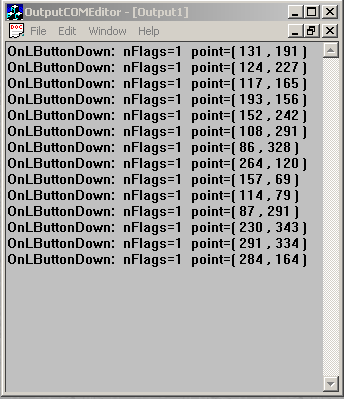
void CLeftClickView::OnLButtonDown(UINT nFlags, CPoint point)
{
	dumpStream<<"OnLButtonDown:  nFlags="<<nFlags<<"  point=( "<<point.x<<" , "<<point.y<<" )"<<endl;
	dumpStream.flush();
	CView::OnLButtonDown(nFlags, point);
}
A note of caution has to be made about attaching files from another MFC project. Every file of MFC project
has the #include "stdafx.h" statement. Each MFC project has the stdafx.h in its directory. Contents of
the stdafx.h is dependent on the project. If you compile a cpp file located in a directory of another MFC project then
it will certainly include the stdafx.h from another MFC project. Also, every stdafx.h file has the standard
protection against repeated compilation in the same compiler pass. Such protection is based on a unique #define
statement in every stdafx.h file. Therefore, you really don't have a protection against compilation of both
the stdafx.h of current project and the stdafx.h of another project in the same compiler pass.
These reasons may be a source of some weird diagnostics.
For example, it may look like the compiler is rejecting the standard STL header files.
