|
Victor Fleming received sole directorial credit for "Gone With the
Wind". But throughout the making of GWTW there were two other directors
who were at some point working on the picture: George Cukor and Sam Wood.
Each of the three directors contributed to the success of the film. The task
of directing GWTW was hard, exhausting but eventually rewarding.
~~~~
George Cukor was one of Hollywood's best directors. Prior to 1939 he'd
directed such great movies as: "The Bill of Divorcement" (1932),
"Little Women" (1933), "David Copperfield" (1935) and
"Camille" (1936) and was Selznick's first choice for the director
of "Gone With the Wind". From the moment Selznick International
bought the right to film the novel, Cukor was involved in all kind of
preparations: he went South numerous times to talk to Margaret Mitchell and
get the general feel of the South, to hold open auditions for the role of
Scarlett; he made hundreds of screen tests with actresses and was always
consulted by Selznick in matters concerning casting, script and preparatory
work on GWTW.
The faster the beginning of shooting approached, the more misunderstandings between the producer and
director sprouted up.
First hint of a "Cukor situation" was mentioned by Selznick in
September 1938. In a confidential letter to Dan O'Shea he wrote that
something had to be done about Cukor because he was costing the company too
much. Selznick was afraid that he would eventually end up paying Cukor $300
000, whereas Cukor wasn't willing to work on other pictures produced by
Selznick International. ("... We have a period of time before George
will be required on Gone With the Wind - time enough for a director in the
business to make a picture. We have only one picture for him to direct, and
that is Intermezzo. George doesn't like it...") Selznick mentioned
that he was willing to renegotiate the deal with Cukor, but pointed out (bringing
up the name of Victor Fleming for the first time) that there could be
benefits from signing other contract directors.
Once the shooting started, Selznick was less and less happy with Cukor's
work (even though he never questioned his talent and skills); his greatest
concern was the length of the film and he was afraid that Cukor's pacing was
too slow. (In 1947, in New York Times Magazine, Selznick was quoted as saying
"We couldn't see eye to eye on anything. I felt that while Cukor was
simply unbeatable in directing intimate scenes of the Scarlett O'Hara story,
he lacked the big feel, the scope, the breadth of the production".)
Selznick wanted to have each re-written scene rehearsed and discussed
together with Cukor before shooting on it. He often wanted to get his way
and he wanted no suprises in the projection room. In February 1939 this
system of prior consultations didn't work and there came the final issue of
the script: dialogues were rewritten on a daily basis but whereas Selznick
often changed the lines himself, Cukor wanted to work on Sidney Howard's
script.
The exact circumstances behind Cukor's resignation remain unknown and leave
room for speculation.
According to one widely spread version, Clark Gable had his part in firing
Cukor. Cukor was known in Hollywood as 'a woman's director' and Clark was
afraid that George would undermine Rhett's role in the story and shift the
focus of the film too much to Scarlett and Melanie. Olivia de Havilland
believes that it might have been the case "It would be logical for
Clark, who had never worked with George, to be concerned. After all, he was
the King - the biggest star in Hollywood. He felt an immense responsibility
to the public to fulfill the public's image of Rhett Butler that they had
from reading the book. And I think he was afraid that, with George, the
women would dominate the film".
George Cukor however said later that "it is nonsense to say that I
was giving too much attention to Vivien and Olivia. It is the text that
dictates where the emphasis should go, and the director does not do it.
Clark Gable did not have a great deal of confidence in himself as an actor,
although he was a great screen personality and maybe he thought that I did
not understand that. My own theory is after all these years in that for
David Selznick Gone With the Wind was the supreme effort of his career; he
was enormously nervous about the whole thing..."
The other account of what happened was presented by Susan Myrick in a
letter of February 14th to Margaret Mitchell: "George finally told
me all about it. [...] he felt responsible for getting me into this mess and
wanted me to know the truth. [...] For days, he told me, he has looked at
the rushes and felt he was failing. He knew he was a good director and knew
the actors were very good ones, yet the thing did not click as it should.
Gradually he became more and more convinced that the script was the trouble.
[...]So George told David he would not work any longer if the script was not
better and he wanted the Howard script back. David told George that he was a
director, not an author, and he (David) was a producer nd the judge of what
is a good script (or words to that effect) and George said he was director
and a damn good one and he would not let his name go out over a lousy
picture and if they didn't go back to the Howard script he, George, was
through. And bull-headed David said "OK, get out!".
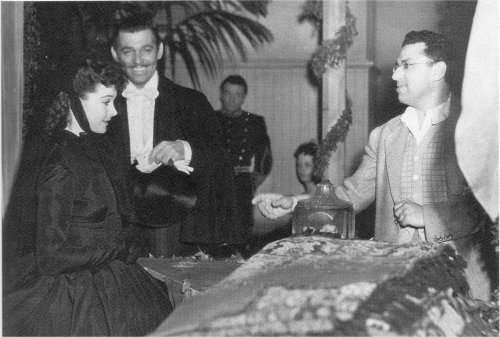
News about Cukor's resignation came on
February 7th. It was a day when the Atlanta Bazaar scene was filmed. Vivien
Leigh and Olivia de Havilland, both partisans of Cukor, were very upset and
appropriately donned (in their mourning dresses) went to plead with Selznick
but go nowhere.
Vivien, who believed that Cukor was the only person who "could
understand the subject perfectly", in a moment of indignation
considered pulling out of the whole project, but only learned from her
agent, Myron Selznick, that "if she quit the film, she would be in
court till her last day on earth". She later wrote to her husband:
"He was my last hope of ever enjoying this picture".
The two leading actresses didn't give up on Cukor and kept on visiting
him (unbeknownst to each other) on weekends to discuss scenes with him.
Olivia de Havilland recalls: "We had to do it in secret. I felt
terribly guilty about stealing up to George's house
on Sundays, asking his counsel about how to play certain scenes. I only did
it about three times and, finally, I told him that I felt this guilt. He
said, 'Don' t. Vivien is doing the same thing.'''
Selznick and Cukor issued a joint statement
on February 13th: "As a result of a series of disagreements between
us over many of the individual scenes of Gone With the Wind, we have
mutually decided that the only solution is for a new director to be selected
at as early a date as is practicible".
Victor Fleming was
finishing "The Wizard of Oz" when he was pulled off the set and
assigned to direct "Gone With the Wind". He was a great director,
having directed "Test Pilot" (1938) and "Captain Courageous"
(1937) he was known as the 'action director' with a flair for spectacular
scenes and quick action. He showed up on the set on February 17th. He
realized that there was no shooting script and the production was shut down
for 17 days. When it resumed on March 23d, the shooting
picked up speed.
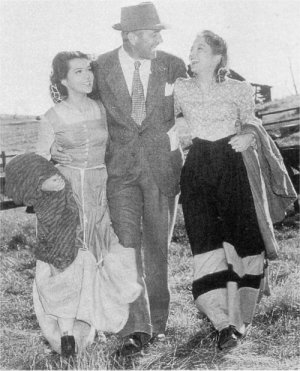 |
Some cast members took to
him. He was Clark Gable's buddy. Ann Rutherford: "I just sort of snapped to attention
whenever I saw Victor Fleming. He had a marvellous command. He was
the head of the table wherever he was. He was the father image. He
would brook no nonsense and we respected him deeply and liked him
and tried to be very obedient in anything he wished us to
do".
|
Others couldn't quite warm up to him. Marcella Rabwin:
"I think he did not like almost everybody in the world
except Clark Gable and himself. But he did something, he revitalized
the whole theme of GWTW, and the girls didn't realize that
they're crying for George
but what's happened is that the film has spirit and tempo. He was a very
fine director even though I personally couldn't stand the language that he
used on the set, the way he treated Vivien Leigh, he was very harsh with her.
I don't wonder that she cried for George Cukor [...] He allowed to be what she thought the role
should be. But Fleming didn't. Fleming demanded of her that she be the b*tch
that she was described as."
Fleming
came on too short a notice and didn't have time to read
the book, nor was he on top of the script problem which immediately earned
him low marks with Vivien, who missed Cukor's devotion and understanding of
the story. They often argued about the script and interpretation. During
their fiery fights the crew was often asked to leave the set. Vivien
resented his attitude, lack of directorial advice ("Ham it up")
and the fact that he never read the book ("Miss Leigh, you can stick
that script up your royal British a*s.")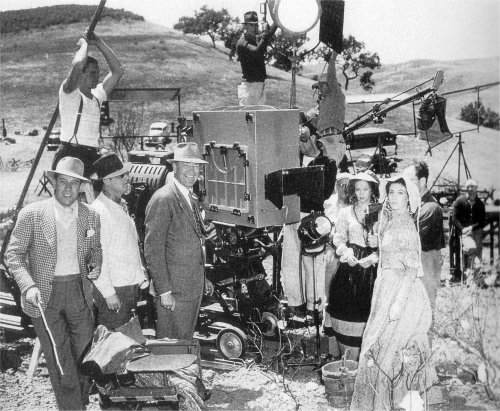
On April 14th, Selznick wrote to Ginsberg and O'Shea: "I have for
some time been worried that Fleming would not be able to finish the picture
because of his physical condition". He suggested looking for a
substitute director to relieve Fleming (possiblilities were Bob Leonard and
Bill Wellman).
On April 29th, after a hard day on the set Fleming walked off the picture.
He suffered a nervous breakdown and took a two-weeks break from filming.
Marcella Rabwin thought the underlying cause for this leave to be different:
"It was simply a punishment for David Selznick. He was disturbed by
the fact that Selznick would take over the filming. [...] You can't do it to
a director, who's as competent as Fleming was".
Meanwhile MGM again came to the rescue with Sam
Wood, who had just finished "Goodbye, Mr. Chips" and
had never minded being called in on a brief notice.
After two weeks Fleming came back and as Selznick noted: "expressed
himself as ready to do anything and everything". Sam Wood stayed on and
set up a second unit, which considerably speeded up the filming process.
~~~~
|
