Official name: Hashemite Kingdom of Jordan
Capital: Amman Population (1989): 936,300
Main port: Al Aqaba (pop. 41,900)
Additional urban centres: Irbid, Kerak, Madaba, Salt, Zarqa
Population: Excluding West Bank: 3,059,000
Arab population of West Bank: 1,014,900
Population profile: Predominantly
Arab, with approximately 90% Muslim and 10% Christian.
Other communities are Circassian, Shishan, Armenian and Druze.
Land area: 92,300
sq km
Language:
Arabic is the official language. English is widely spoken and
French is the most commonly used third language.
Government: Monarchy, under the 1951 constitution.
Head of State: His Majesty King
Abdullah ibn Al-Hussein (King Abdullah II)
Official religion: Islam - Sunnite Muslims form
the majority, Shiite Muslims a small minority.
Additional urban centres: Irbid, Kerak, Madaba, Salt, Zarqa
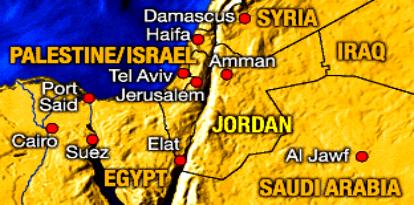
Map:
Amman
Known as Rabbath Ammon in
biblical times and as Philadelphia when it was part of the Roman Empire, Amman
is now a thriving, modern city. It was originally built on a group of seven
hills, but is now spread over a wider area of hilly terrain.
Citadel Hill affords a wonderful view across the Old City, with its Roman amphitheatre in the valley below and the beautiful black and white Abu Darwish mosque on the far horizon at the top of Jebel Ashrafiah. Citadel Hill itself is the site of the ruins of the Temple of Hercules, the remains of Roman walls and an Arab castle, which dates from the Omayyad dynasty of the 7th century. Also on Citadel Hill is the Archaeological Museum, housing antiquities which date from prehistoric times, right through to the 15th century.
The Roman amphitheatre,
which once seated 6,000, is an impressive sight. The theatre has a museum on
each side; the Museum of Popular Tradition and the Folklore Museum.
On the summit of a
pine-forested hill and approached by a steep incline, stands the Martyrs' Memorial.
This is a truncated pyramid structure of white stone covering reinforced
concrete. Near the top a band of basalt can be seen, bearing verses from the
Holy Q'ran. The Memorial is a tribute to Jordan's armed forces and those who
gave their lives in the service of the Kingdom.
Stamp collectors will enjoy
the Philatelic Museum near the main post office on Jebel Weibdeh and for
numismatists there is a good collection of Islamic coins on display at the
Central Bank.
The Jordan National Gallery
houses 1,000 pieces of Islamic art collected from prominent Arab and Islamic
artists throughout the region. The art is mostly modern in style and focuses on
canvas, water colour, ceramics, graphics and sculptures of this century. Many
other private, or semi-private art galleries abound in Amman and further
information about these is available from hotels and tourist bureaux.
In Amman's suburbs the
Museum of Archaeology at the University of Jordan will be of interest to all
who seek to enjoy Jordan's many archaeological treasures.