

Location: Europe
Status: UN Country
Capital City: Zagreb
Main Cities: Split, Rijeka, Osijek
Population: 4,760,000 Area [sq.km]: 56,540
Currency: 1 kuna = 100 lipa
Main Languages: Croatian
Main Religions: Roman Catholic, Serbian Orthodox, Muslim
Croatia (Croatian Hrvatska),
republic in southeastern Europe, on the Balkan Peninsula. Formerly a
constituent republic of Yugoslavia, Croatia declared its independence in June
1991. Civil war broke out in July and for four years ethnic Serbs, backed by
the federal Yugoslav People's Army, battled with ethnic Croats for territory.
By January 1998, when all areas had reverted to Croatian control, hundreds of
thousands of ethnic Serbs had fled the country while corresponding numbers of
ethnic Croats had immigrated from Serbia and Bosnia and Herzegovina. 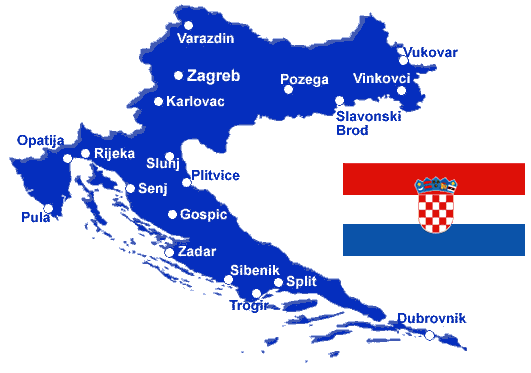
Croatia is bounded on the north by Slovenia and Hungary, on the east and
south by Bosnia and Herzegovina (often referred to simply as Bosnia), and on
the east by Serbia, a constituent republic of the Federal Republic of
Yugoslavia (FRY). In the south, a 20-km (12-mi) wide section of Bosnia extends
to the sea, separating a narrow coastal strip of Croatia from the rest of the
country. The southern tip of this coastal strip has a short border with
Montenegro, the other constituent republic of the FRY. The Adriatic Sea forms
Croatia's long western boundary. Zagreb is the capital and largest city of
Croatia.
The capital
Zagreb (ancient Zagrabia), city and capital, northern Croatia, on the Sava River. One of the largest cities of the country and an industrial center, Zagreb has plants producing chemicals, machinery, leather goods, paper, metals, and textiles. A cultural center as well, the city has a university (1669); an opera house; music, art, and film academies; museums; art galleries; and the Croatian Academy of Sciences and Arts (formerly the Yugoslav Academy of Sciences and Arts). Noteworthy landmarks include an 18th-century palace and remnants of an 11th-century cathedral.
The site of present-day Zagreb was occupied by a settlement in Roman times. In 1093 Zagreb became a bishop's see, and in 1242 it became a free royal city. The city was made the capital of Croatia and Slavonia in 1867 and became part of the Kingdom of the Serbs, Croats, and Slovenes (later renamed Yugoslavia) in 1918. In 1991, Croatia, once a constituent republic of Yugoslavia, became an independent nation. Population (1991) 706,770.
Created by Alexander
Milanov and Svilen Stanev