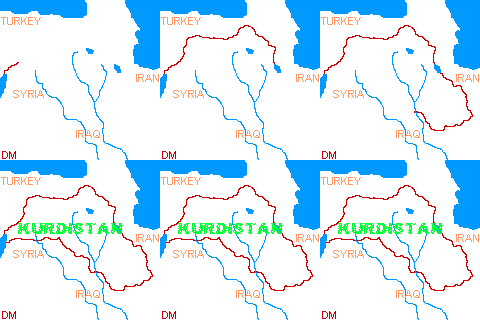
The Kurdish people compose one of the ancient nations of the Middle East. Kurdistan, the land of the Kurds, is spread among several modern states: northwestern Iran, northern Iraq, northeastern Syaria southeastern Turkey, and small parts of Armenia. There is no exact figure to the Kurdish population because each state has tended to downplay the number of Kurds within its own borders. Nevertheless, according to various estimates, the Kurdish population is estimated to range between 30 to 35 million. This makes the Kurds the largest population in the world without its own state. Also Kurds are the fourth largest ethnic people of the Middle East. The Kurds are people of Indo-European origin who live mainly in the mountains and uplands where Turkey, Iraq, Syria, and Iran meet, in an area known as "Kurdistan" for hundreds of years. They have their own language, related to Persian but divided into two main dialect areas. Although the Kurdish people are overwhelmingly Sunni Muslim, they embrace Jews, Christians, Yazidis and other sects.
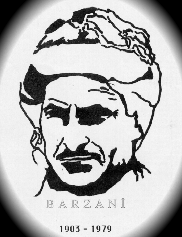
Up to mid-19th century, Kurdistan has known very long periods of de facto and de jure self-rule in the form of autonomous principalities. 1843-1846 � The last of these principalities of Bedr-Khan Bek revolted against Ottoman rule and was one of the lasts to be finally suppressed in 1847. 1849 � The Ottoman Sultan destroyed the autonomous government of Bitlis founded by Hakim ldris. 1878-1881 � Uprising against the Ottomans led by Sheikh Obeidallah. 1892 � The Ottoman Government opened "tribal schools" in Constantinople and Baghdad. 1898 � Kurdistan, the bilingual (Kurdo-Turk) organ appeared in Cairo under the editorship of the Bedr-Khan�s. 1908 � First attempts at organizing a national Kurdish Movement. 1910 � The Hewa (Hope) society was founded in Kurdistan (Northern Iraq). 14.12.1914 � Shiekh Abdul-Salam Barzani, leader of the Kurdish National Movement, was executed by the Ottoman Governor in Mosul. 8.11.1918....read more |