FROM Beriberis aristata AND Coscinium
fenestratum
TOWARDS LEADS FOR DRUG DEVELOPMENT
INTRODUCTION: -
Plants Traditional medicine in India
is centuries old and employs the use of medicinal plants. Over the last decades
there has been resurgence in drug discovery, which has lead to the use of
innovative technologies. The development of cell signaling and understanding
host-pathogen interactions as also provided as a “stepping stone” for drug
discovery projects. Molecular pharmacology has employed this vast knowledge in
cell signaling to design bioactivity-based targets which today has proved
useful in identifying drug leads.
The cell biology and drug discovery
has been involved in utilizing and developing such molecular targets for
understanding immunomodulator activities over the last five years. Several new
molecules using these technologies has been identifies and patented.
The
present study described here will use the plants Beriberis aristata and Coscinium
fenestratum in validating their potentials as immunomodulators; identify
specific fractions that show this purity; examine their purity and bioactivity;
evolve structural elucidation.
This
project aims at identification and isolation of immunomodulator molecular leads
from the above two plants
Beriberis
aristata and Coscinium
fenestratum
DESCRIPTION ABOUT THE PLANT:
PLANT NAME: Coscinium
fenestratum
COMMON NAME: Maramanjal
South
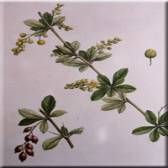
PLANT NAME: Beriberis aristata.
COMMON NAME: Maramanjal North
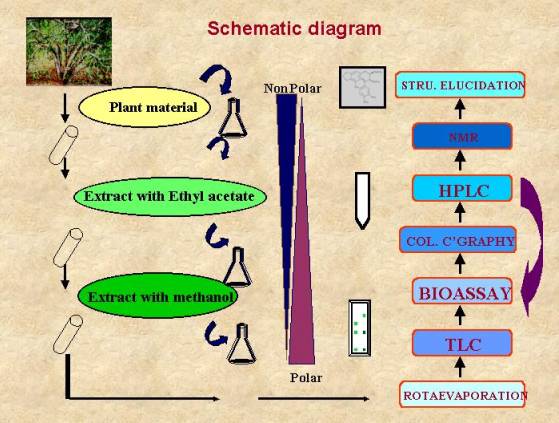
Schematic outline of the process:
1.
The active molecules
from the two plants Coscinium fenestratum and Beriberis aristata
were extracted with ethyl acetate and methanol using conventional methods.
2.
Thin layer
chromatography for both the extracts is performed using different solvent
systems to locate the bioactive molecules.
3.
These extracts were
assessed for immunomodulatory property by in
vitro bio-screening techniques like lymphocyte proliferation assay, nitric
oxide production assay and RT-PCR.
4.
The extract with
maximum activity was fractionated using silica-gel column chromatography.
5.
The fractions were again tested for bioactivity based on
which the fraction that showed maximum activity was selected which was used for
further studies to elucidate the structure of the lead compound.
6.
The bioactivity based
screen involves monitoring bioactivity based on the use of specific cells like
lymphocytes, RAW cell lines and ELI monocytic cells.
7.
If a particular
fraction shows activity on any one of the above parameters a detailed analysis
will be followed.
8.
We will screen the
specific plant extracts obtained during column fractionation on other molecular
targets in imunomodulation (for example) Nitric oxide, cytokine activation, PI3
kinases, activation of cfos, myc etc.
9.
A detailed analysis
of the various molecular activities will be consolidated which may be useful to
explain the over all effectiveness of a specific plant extract or used to
identify specific molecules that can be valuable leads for further development
as a chemical entity.
INNOVATIVE COMPONENTS IN THE DESIGN AND ADVANTAGE
OVER THE PREVIOUS/ EXISTING COMMONLY USED METHOD: -
As
a Ι yr under
graduate student I was involved with the group in the cell biology and drug
discovery laboratory for the last five months. The above two plants were
selected based on the ethnum botanical leads and also based on preliminary
results.
During this period I have implemented
the proposed projected and have highlighted the preliminary results in my project.
·
We have identified
specific fractions that stimulate lymphocyte proliferation.
·
The process of
purification has been established.
·
The pooling of
fractions based on its motility on TLC is in progress.
·
Further purifications
of the active fractions will be studied in detailed.
·
My studies in this
project elucidate the use of bioactivity based screens in monitoring and
identifying immunomodulatory property of active biomolecules from the plants Beriberis aristata and Coscinium fenestratum. The bioactivity
based screens used in this study involves measuring the differential
proliferation of lymphocyte cells using thymidine [H3]
incorporation, MTT assays, searching for novel molecular targets useful in
imunomodulation, specifically targeting cellular markers and also identifying
modulation of cytokines.
ADVANTAGES:
Bioactivity based in vitro screening is rapid, simple and enables to target specific molecules more rapidly than the conventional animal model based studies. The developments in molecular pharmacology has enabled us to use some of the molecular targets identified in immunomodulating cells as sources, that may be useful to identify the specific bioactivity. This bioactivity based screens may be employed for purification and identification of the active fraction.
METHODOLOGY:
SOLVENT EXTRACTION:
Crude plant extracts were prepared by conventional
solvent extraction procedures. Different solvents were used, starting from less
polar ethyl acetate to more polar methanol. By increasing the polarity
regularly, a first separation of the different compounds is effected. Various
compounds present in the crude extract were identified using TLC.
ANALYSIS
OF COMPOUNDS PRESENT IN THE CRUDE EXTRACT BY THIN LAYER CHROMATOGRAPHY (TLC):
In thin layer chromatography (TLC) The sample is
applied near one end of a plate coated with silica or alumina. The plate is
then immersed in appropriate solvent mixture, which rises up the plate by
capillary action. After the solvent is traveled to more than two third the
plate is removed from the TLC chamber, dried and developed with sulphuric acid
by dipping or spraying. It can also be visualized by iodine and observed under
UV light for fluorescent compounds.
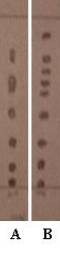
A:
Ethyl acetate extract.
B:
Methanol extract.
Each of these extracted
compounds was dried in rotatory evaporator. 10 mg of the dried powder from each
extracts were reconstituted to 1 ml with the respective solvents and they were
serially diluted to 1:5, 1:20, 1:100 from the original stock solutions and
these dilutions were used to study for immunomodulatory properties by
lymphocyte proliferation assay, nitric oxide production assay, RT-PCR
studies.
Bioassays:
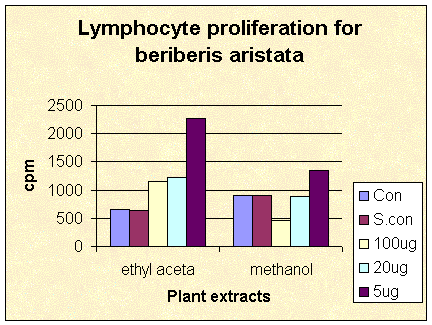
LYMPHOCYTE
PROLIFERATION ASSAY:
Thymidine
incorporation is done to estimate the ability of different plant extracts to
induce or suppress proliferation of PBMC .The effect of different plant
extracts on PBMCs was monitored by [3H]-Thymidine incorporation (1
µCi/well). Cells were grown in 96-well plates and treated with different plant
extracts at various dilutions and the extent of the incorporation of the
tritiated Thymidine was monitored. The incorporation of the label was expressed
as CPM. PBMCs in the presence and absence of plant extracts were maintained for
24hrs and 48hrs and analysed for proliferation by [3H]-Thymidine
incorporation. PHA is used as positive control.
ISOLATION OF
LEAD COMPOUND FROM CRUDE EXTRACTS:
To identify the lead compound which responsible for
particular activity we used silica gel column chromatography to separate the
individual compounds. Column was
packed with hexane using silica gel 100-200 mesh size as a matrix, the dried
plant material was loaded and the column was eluted with increasing
concentration of ethyl acetate and methanol to increase polarities. The ratio
of material loaded and silica gel was 1:20. Then all the fractions were
analyzed by TLC and then according to the profile obtained they were pooled.
ANALYSIS OF
CYTOKINES BY RT-PCR:
Analysis of mRNA expression in PBMC on treatment with different plant
extracts to determine whether these plant extracts have capability to induce or
suppress some of the cytokines like IFN-Gamma, IL6, IL8 and IL2 etc. which play
a main role in many of the immunopathological disorders.
We isolate the PBMC from normal individual and cells
were treated with different plant extracts. After 6 hours of treatment mRNA was
isolated using TriZol reagent followed by chloroform extraction. Immediately
mRNA was converted to cDNA using oligodT and MMLV reverse transcriptase. Using
particular primer sequence in PCR reaction the level of expression of the
specific cytokine was analyzed.
Analysis
of IFN-Gamma in PBMC after 6 hours of treatment
1 2 3 4
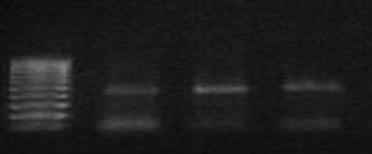
1. DNA ladder
2. Control
3. PHA Positive control
4. Beriberis
aristata
Currently
we are doing RT- PCR for some of other important cytokines and Nitric oxide
production assay for rest of the samples. To pullout the lead molecule we are
going to start second stage column chromatography of the partially purified
crude extracts.
CONCLUSION:
Immune
modulators from medicinal plants are preferred due to the absence of side
effects. Medicinal plants have been a good alternative to the conventional
allotropic medicine because of the side effects produced by chemically
synthesized allotropic medicines.
Medicinal
plants have been screened for immunomodulatory activity for the various
cellular targets and molecular targets with the application of modern
biotechnological tools.
Therefore,
new uses of known medicinal plants and discovery of novel biologically active
chemical molecules will be a boon to the alternative system of medicine so that
the traditional plant resource will be conserved.
With
the availability of biotechnological tools, there is a necessity to pull out
new bioactive lead molecules from plant source, which will be a boon to our
alternate system of medicine.
Submitted
for ,
KVPY,
Indian
Institute of Science
By,
R.
Karthik Venkatesh
Centre for Biotechnology
Anna University
[email protected]