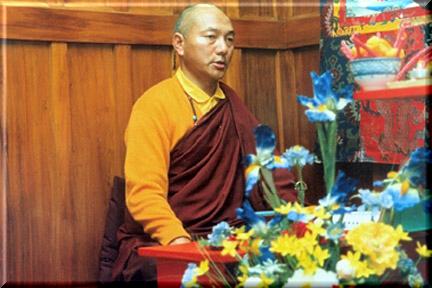
| The Precious Human Body A teaching by Venerable Lama Assi given on Sunday, 29th April 2001 First, it is important to generate the right motivation for listening to these teachings. We should generate the attitude that we are working for the benefit of all sentient beings and that by our listening to the dharma may we quickly reach the state of enlightenment. We should contemplate the value of understanding dharma and examine the reason why we are listening to it. Without listening, it would not be possible to come to an understanding of the dharma, nor would we be able to discriminate between virtuous and non-virtuous actions. This is very necessary if we are to determine what actions to cultivate and what actions to abandon. Only with correct discrimination will we be attain the result of dharma. This talk is based on, �The Torch of Certainty�, a preliminary text composed by the first Jamgon Kongtrul Rinpoche, Yonten Gyatso. I have chosen this text in particular because it is written with very few words and yet it contains the essence of all dharmas. This text, with its emphasis on Karma Kagyu practice, can be seen to be a complete path to enlightenment in itself. It is said that if one follows the teachings of this text faithfully, one is guaranteed to attain enlightenment. Not only is it the essence of Karma Kagyu teachings, it is the essence of all the Buddha�s teachings. The Buddha taught 84 000 teachings, but the essence of these can be reduced to the essence of this text. It should be said that the essence of Kagyu teachings is no different to the essence of any of the four schools of Tibetan Mahayana - Nyingma, Sakya, Geluk and Kagyu. The benefit is the same. Now that we have attained a high rebirth, the way to put it to best use is to use it to cultivate a mind that engages in dharma. We do this by cultivating a conviction in the qualities of the Buddha and by reflecting on the value of our current life situation and the certainty of death. On the one hand, we have tremendous freedom to practise dharma and on the other, we have great fortune and opportunity to cultivate favourable causes and to abandon unfavourable causes. There are eight freedoms conducive to practice and ten supportive conditions. It is extremely rare to attain a human rebirth that has all these conditions. If one is reborn in a Hell Realm, the pain is so intense and constant that it is impossible for one to think of anything outside of that pain. The opportunity to practise dharma at that time, needless to say, is practically non-existent. There are eighteen types of birth in the Hell Realm. Eight of these are characterised by all-pervading pain related to heat and eight with all-pervading pain associated with cold. The experience of one of the Hot Hells is likened to being immersed in a vat of molten metal, yet many times more intense. Once one has taken birth in such a state, one is there for an extremely long period of time. It is very hard to get out. The pain experienced is such that it would be a relief to die, but this is not possible. In one of the Cold Hells, one�s body feels so cold that it cracks and splits causing constant agonising pain. There are two additional Hell states in addition to these sixteen where the suffering is still bad but not quite as intense as it is in the Hot and Cold Hells. Amongst the eight freedoms we now enjoy, the first is the freedom from birth in the Hell Realm. The second is freedom from birth as a Hungry Ghost. Each of the six types of rebirth is characterised by a particular type of affliction. The affliction experienced in the Hell Realm is that of extreme and tormentuous pain. The affliction experienced in the Hungry Ghost Realm is unsatiable and extreme hunger. One�s body in this type of rebirth has a huge stomach and a narrow neck - the girth of a horsehair. One also has a mouth the size of the eye of a needle. The suffering experienced is caused by one�s extreme hunger and the impediments of one�s body. The only way a Hungry Ghost can eat something is if food is dedicated by sentient beings or through the compassion of bodhisattvas. Even then, when the opportunity to eat something arises, the food burns them. Due to their karmic vision, they see water as pus or blood, etc. There are many types of suffering experienced in such states of rebirth. We know from our own experience the pain of hunger; imagine how much more intense it would be in a less fortunate rebirth. The duration of suffering in these realms is for eons. Even if one hears of dharma, one�s own suffering and pain affords one no opportunity or leisure to practice. In our current situation, we are fortunate in that we are presently free from the intense suffering experienced by Hell Beings. The third freedom is freedom from the suffering of birth as an animal. Animals are characterised by ignorance. Unlike the previous two realms, we are presently able to see some of this realm with our own eyes. In general, animals are not free to listen or understand dharma and undergo the suffering of having no freedom of choice. They are often controlled by others and hunted by predators. They experience a lot of fear and uncertainty. In contrast, we are presently free of such a condition. The fourth freedom is the freedom of not being born in to some barbaric country where there is no dharma or where there is opposition to the study and practise of dharma. The fifth freedom is freedom from rebirth as a Long-life God, a Deva. In this type of rebirth, one is so totally absorbed in bliss that one lacks the immediate incentive to practise dharma. The sixth freedom is freedom from the non-belief in causation - karma. This is the belief that virtuous action leads to happiness and non-virtuous action leads to unhappiness. Presently, we are free from such wrong views. The seventh freedom is freedom from being born during a dark period - or a time where there is no teaching of dharma available. The eighth and last freedom is the freedom from an impaired or damaged thought process that makes it extremely difficult to meet with or practise dharma. When we contemplate these eight freedoms, we will see that we have all these factors here and now. Somehow, we have attained a precious human rebirth and the circumstances and freedoms conducive to the practise of dharma. Appreciating the rarity of our situation, we should feel joyful. The most perfect situation for practising dharma requires freedom from a further sixteen limiting factors or impediments. These are as follows: 1/ A limited life with lots of suffering and problems caused by excessive passion, aggression and ignorance. There are five poisons that present obstacles or impediments to one�s dharma practice. 2/ The influence of non-virtuous friends who lead one away from the dharma. 3/ Holding contrary views, such as dharma is of no benefit. 4/ Laziness. 5/ Impediments due to one�s previous non-virtues. 6/ Being something of a slave or under the control of someone else. 7/ Impure motivation, e.g. Practising dharma for worldly gain - such as food, fame, etc. 8/ Pretending to practise dharma for prestige or to impress others. 9/ Attachment to worldly things like, for instance, wealth, possessions, etc. 10/ Aggression, such as rough or bad conduct and anger. 11/ Not taking the suffering of the three lower realms seriously. 12/ Non faith in the teaching of dharma, for instance: causality. 13/ Enjoying the eight non-virtuous activities. 14/ Non-interest in dharma, such as the aversion a dog has for eating grass. 15/ The non-practise of guarding of one�s vows, such as one�s refuge vows, etc. 16/ Breaking one�s samaya against one�s teacher or one�s dharma friends. Should we have any of these, the pure practise of dharma will be difficult or perhaps would not even occur at all and one would take rebirth in one of the three lower realms. We should investigate if we have any of these sixteen factors in our personal situation and, if we do, we should determine to eliminate them. If we are free from these sixteen limiting factors, we should rejoice and safeguard them. Should any of these factors occur, they would affect our ability to practise. The Precious Human Rebirth is distinguished from the ordinary human rebirth by ten factors. These are: 1/ One is born as a human, free from rebirth in the eight unfavourable conditions. 2/ One is born in a country where we are able to meet with the dharma. 3/ All of our senses are intact. 4/ We are free from wrong views and have meet the dharma. 5/ We have faith in the Buddha, Dharma and Sangha. These first five are internal factors. The remaining five are external factors. 6/ We have been born during a period of a Buddha�s teachings. 7/ The Buddha�s teachings are available and have not yet faded out. 8/ There are many followers of the Buddha�s teachings around. 9/ There is the support of other dharma practitioners available. 10/ There are many supporters and benefactors of dharma activity. It is questionable whether this is so in Western countries at this time. We should reflect on our good fortune regarding these matters. Most sentient beings continually engage in non-virtuous activity; those whom engage in virtue are very rare. Amongst the few who do engage in virtuous actions, those who have the good fortune of a precious human rebirth are even rarer still. The cause of a precious human rebirth is the practice of morality - ethics and discipline. Those who are born in to the three lower realms are exceedingly numerous; they are likened to the number of particles of dust in the entire universe. Those who are free from birth in the three lower realms are extremely rare. Amongst the few who have attained a high rebirth, very few have a human rebirth. If you were to count the number of insects that live under just one rock, it would be very difficult because they are so numerous. In comparison, it is much easier to count the number of people who live in a one country. Amongst those who have attained a human rebirth, the number of those interested in studying and practising dharma is very few. They are likened to the number of stars in the mid-day sky. Once a precious human rebirth has been attained, there is no guarantee it will last. The causes of death are many and the factors sustaining life are few. Death can be caused by accident, through fire, poison, etc. Most people die of causes other than old age and sickness. Reflecting on this again makes you appreciate just how fortunate we are. Death is no more than no longer breathing in. Life is as fragile as a water bubble or like the condensation on a window pane that evaporates. Life can end at any moment. Not only is our present set of circumstances very rare but they are easily lost and very hard to get again. It would be extremely unfortunate to let this rare situation slip through our fingers. If we were born as an animal, we could scarcely be able to say so much as one, �OM MANI PEME HUNG�. We would be stuck with non-virtuous tendencies and have no time or opportunity to practise. It would, therefore, be very difficult to be born again in a high realm and we would be continuously creating the causes to be born in lower realms. Because of the difficulty creating the causes for a good rebirth, we should appreciate our current set of circumstances and the opportunity we now have to study and practise dharma and get enlightened. We should generate the thought not to waste this precious opportunity. Just look at the effort and difficulties ordinary people endure just to make temporary gains in this life. In comparison, the difficulties we endure for the long-term gain of enlightenment are few, so we should be brave in our practice and strong in our determination. If not, then this rare and precious opportunity will be lost. This present opportunity of meeting with the teachings and teachers is due to our previous good actions. If we waste this precious opportunity and instead use it for frivolous activity, we will only create unfavorable future conditions. The Buddha outlined ten things that lead one away from the favorable conditions of a precious human rebirth: 1/ Not developing the root of virtuous activity. 2/ Not acquiring merit. 3/ The influence of non-virtuous friends. 4/ To be under the control of one�s emotions. 5/ Not being afraid of what might happen to us after we die. 6/ Following one�s emotions. 7/ Dullness and laziness. 8/ Paying lip service to the dharma. 9/ Following wrong views. 10/ Holding to wrong views. We should be very careful not to come under the influence of any of these. We should also be careful not to be proud of our current situation and judge others who might not appear to be as well off as ourselves. All sentient beings have Buddha-nature, the potential for enlightenment. If you should become proud, you will not achieve your goal in this life and will instead create the cause for birth as a Hungry Ghost or, should you be born a human, you will be looked down on by others. Because we do not have the understanding of Buddhas and Bodhisattvas, we do not know what teachings they employ to help others. Due to our ignorance, we will not know if those whom we judge are in actuality exercising skillful means. Should we denigrate the activity of Buddhas and Bodhisattvas, we risk being born in lower realms for eons. We should not even joke or make fun of others. If we follow faithfully the advice of our teachers and do not come under the bad influence of others, we will cultivate the causes of again meeting the dharma. It is very important to appreciate the preciousness of this human rebirth with all it�s freedoms and opportunities and to remember how very fragile it is. We might think that we do not have the time to practise dharma now, but will we get time to practise if we are born in the three lower realms? We should think about this now. In conclusion, we should dedicate this explanation of this dharma teaching and our reading of it for the benefit of all sentient beings. |
 |
| Feature |