| Buddhism |
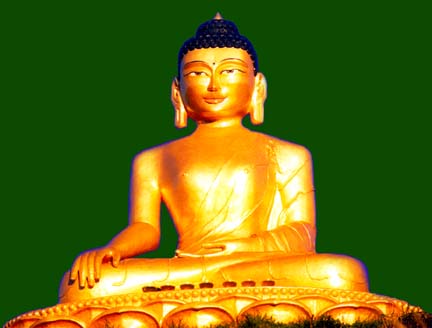 |
| The Buddha Statue at Karma Choeling Buddhist Monastery, N.Z. |
| BUDDHISM DATES IT'S ORIGIN back some 2 500 years to the time of Buddha Shakyamuni. Buddha, whose given name was Siddhartha, was born into a royal family at Lumbini in present day Nepal. When he was a baby, it was prophesied he would either be a great and mighty King or a great Spiritual Master. His father, wanting his son to be a King, shielded him from life's harsh realities, thinking if he was satisfied with his life, he would not renounce it. But this was not to be. The young Prince soon grew dissatisfied and left his palace in search of lasting peace. Siddhartha discarded his worldly possessions and wandered the countryside as a mendicant, studying under the most renowned yogins and gurus of his time. Siddhartha was naturally gifted and quickly mastered the various practices he was taught, but still he was dissatisfied. One day, he realised the path must lie somewhere between the extremes of luxury and austerity and adopted a moderate approach. Then, with a single pointed determination, he sat under the shade of a pipal tree - at present day Bodhgaya - and meditated without distraction on the nature of reality. Finally, he achieved his goal and became free from all delusion. He achieved the deathless state, free of suffering, and became renowned as the Buddha, the Enlightened One. The basic teaching of the Buddha is to avoid actions that harm others and to cultivate actions that bring about their welfare. This involves transcending our ordinary ego by skilful means and an altruistic attitude. He taught that we all have the potential to realise our true nature - our Buddha Nature - and taught the means to bring this about. Buddha taught skilfully according to the level and capacity of his audience. Over time, three broad categories of teachings came about. To those whose immediate situation was intolerable, whose personal suffering was unbearable, he taught a category of teaching characterised by removing oneself mentally and physically from problems. The tradition of monks and nuns draws its inspiration from this category. This became known as the Hinayana, the Modest Vehicle. While not directly resulting in the attainment of Full Enlightenment, the Hinayana does result in a sublime state of bliss called Nirvana. To those of greater capacity, Buddha taught the process of making friends with the world, as opposed to running away from it. This category of teaching involves the cultivation of the Six Perfections or Paramitas. These are Generosity, Moral Discipline, Unshakeable Forbearance, Incessant Diligence, Unwavering Concentration and the Wisdom that Dispels the Darkness of Ignorance. This category of Buddha's teachings is called Mahayana, the Great Vehicle. Through the Cultivation of the Six Perfections over a period of 'three incalculable aeons", one eventually reaches the attainment of a Buddha which is total and everlasting peace. The third category of Buddha's teachings involves a total engagement with the world. Using sophisticated techniques combined with a close working relationship and reliance on a suitably qualified teacher - guru (Tibetan: lama) - it is said to be possible to attain the state of Buddhahood in a comparatively short period of time, even as little as three years. The name of this category of teachings is Vajrayana, or Indestructible Vehicle. It is said that one can cultivate all three categories simultaneously by outwardly following the Hinayana, inwardly by cultivating the Mahayana and secretly by practising the Vajrayana. |