[Watercolor Paintings] [Star Wars] [ Karl's Home Page ]
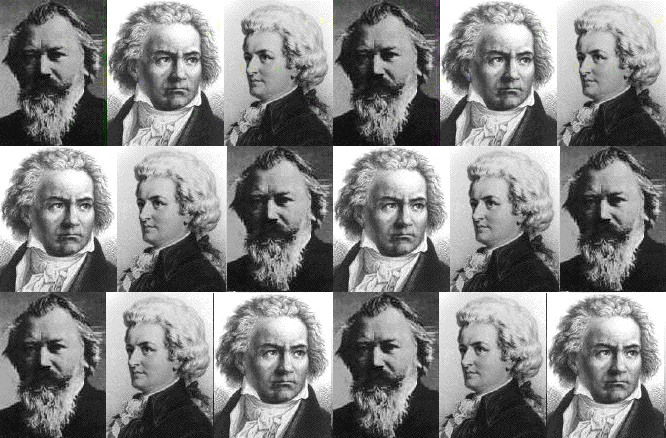
Excellent Classical Music Recordings
from Karl Matsumoto's CD Collection
This is my list of classical CD recordings which I listen to frequently. As the graphic illustration above shows, my tastes are pretty conventional and lean heavily toward the classical/romantic German symphonic tradition. My favorite composers are Brahms, Mozart and Beethoven--in that order. All of the recordings below are of the so-called "warhorses" of the Classical music canon. I also like Dvorak, Tchaikovsky and Schubert (especially his piano music), but strangely enough I always end up returning the Big Three, even when I buy new recordings. Also, I am a big fan of piano music, no matter the form. As this list shows, I love Mozart's late piano concertos and these performances are superb.
1. Brahms Symphony No. 4
Carlos Kleiber/Vienna Philharmonic Orchestra
This is an award-winning performance on the Deutche Grammaphone label. Kleiber's forceful, clipped interpretation is not only distinctive--it's an emotional powerhouse. This piece has a lot of personal meaning for me--each of the four movements is great, but sometimes I just want to listen to the terrifying and tragic 1st Movement and the yearning 2nd movement and stop the CD right there without hearing the 3rd and 4th movements. I would describe this piece as the most accurate expression of the experience of romantic love in the history of art. Brahms explores the darkest parts of the human soul in the first movement without a trace of sentimentality. The 2nd Movement is the purest expression of pathos--that feeling of noble regret and unattainable, desperate yearning--in classical music, second only to the 2nd Movement of Beethoven's "Pathetique" piano sonata. Obviously Brahms loved deeply, and his expression of his feelings through this music is, to my mind, one of the greatest gifts of any artist to humanity.
2. Mozart Piano Concerto No. 22
Sviatoslav Richter/Riccardo Muti/Philharmonia Orchestra
This is a big, bold interpretation of one of Mozart's most satisfying piano concertos, and you know you're in for some fireworks right from the very beginning of the Mannheim-style fanfare. Music purests might contend that Mozart never intended his music to be played in this way, but the genius of Mozart's music is that it can be played and listened to by each successive generation and sound as fresh and original as the latest pop tune. I believe that Mozart should be played as modern music for modern audiences, not as some precious historic artifact. Richter's performance is pure poetry, full of warmth and obvious love for the melody lines. I can tell that Richter is swaying his head through some of the passages, feeling every note of the music. This Angel recording is widely available in re-released versions.
3. Mozart Symphony No. 38 "Prague"
Sir Georg Solti/Chicago Symphony Orchestra
This is a big, overly romantic interpretation--but it works for me. In fact I can't listen to other versions of this piece because they sound limp and listless by comparison. Okay, so, again, it's not Mozart in the classical tradition, but so what? Solti and the CSO bring out the underlying geometric structure of the incredible first movement. The liner notes call this movement a "towering intellectual achievement." I can't argue with that. Whenever I listen to the development section I feel like I've entered the mind of a genius. Actually, the rest of the symphony is anti-climatic for me. For an early 80's disk the sound quality of this London CD is excellent. I crank it up quite often. Mozart rocks.
4. Mozart Piano Concerto No. 21
Ingrid Haebler/Rowicki/London Symphony Orchestra
I've never seen the movie "Elvira Madigan" in which the 2nd Movement of this piano concerto is apparently used as a movie theme, but I can understand why this famous tune may sound a little like muzak to some people. That's unfortunate because this piece is sublime, and as with all of Mozart's music, every single note serves in the structure of the overall design, and Ingrid Haebler plays each with the lightest touch imaginable. The assuredness of her playing is captivating.
5. Mozart Piano Concert No. 23
Vladimir Horowitz/Carlo Maria Giulini/Orchestra del Teatro alla Scala
Is there a pattern here? Okay, so I love the late Mozart piano concertos. This Grammy-award winning Deutche Grammaphone album has an accompanying movie which was widely shown on public television about 10 years ago. Horowitz's performance is relaxed, dynamic, full of brightness (his Steinway has a distinctive sound), and so is the recording quality. Again, the playing may not be in the Viennese classical style--but I think few performances capture the playful spirit of Mozart as this one does. For repeat playability, this disk is one of my favorites.
6. Brahms Symphony No. 1
Gunter Wand/NDR Symphony Orchestra
I have to be in the right mood to listen to Brahms' First in its entirety, but lately I've been listening to the boyant and elegant 3rd Movement by itself whenever I want to hear some of best music ever written. Wand's interpretation is exacting, refined and expansive. Wand brings out details in the music that are overlooked in other performances, and his attention to detail is what makes this recording the most satisfying I have heard of this piece.
7. Brahms Piano Concerto No. 1
Alfred Brendel/Claudio Abbado/Berlin Philharmonic
I saw Brendel play a Schubert piano sonata live in San Francisco many years ago, and his authoritative intellectual playing style was apparent even then. Brendel's approach is to bring out the melody lines clearly into focus and follow them through to their conclusions. He does just that with in this lucid reading of one of Brahms' earlier "tragic" pieces. The ambition of Brahms as a young man is evident in this piece.
8. Beethoven Piano Sonatas 8, 14, 23, and 26
Frederich Gulda
Like the "Elvira Madigan" piano concerto, Beethoven's most famous piano sonatas seem cliched from over-popularization. But I think it all depends on the interpretation. Gulda manages to avoid sentimentality in the "Pathetique" sonata, and plays the piece in a way Beethoven would have approved of. For the "agitato" 3rd movement of the "Moonlight Sonata" he brings out the "reedy" sound of a period fortepiano in the lower registers on a modern instrument--a neat trick.
9. Brahms Piano Concerto No. 2
Emil Gilels/Fritz Reiner/Chicago Symphony Orchestra
This is the opposite approach to playing Brahms from Brendel--big, bold, romantic, and a little sloppy. But Gilels' style is well-suited to this piece, which should be played as a romantic concerto, not as a classical one. Reiner's fast, no-nonsense tempo is also refreshing for those moments when I feel like classical music is just one big bore. The one drawback is the poor 1950's mono sound.
10. Rachmaninoff Piano Concerto No. 2
Sviatoslav Richter/Radio Symphony of the U.S.S.R.
Wait a minute, how did a Russian composer get on this list? Well, for pure romance nothing beats this famous concerto, as cliched as the yearning melodies may sound. The sound is terrible on this 1950s Soviet Melodiya recording, but Richter's spectacular performance is one which could only happen in the land of Rachmaninoff. This is the stuff of legends.
[Watercolor Paintings] [Star Wars] [ Karl's Home Page ]
Comments to:
[email protected]