
Environmental Sociology:
Trinidad and Tobago
You are Visitor:

About This Site
This site is intended to share information on the field of Environmental Sociology and to compile as much information as possible on Trinidad and Tobago. Any information will be welcomed.
What is Environmental Sociology
Environmental Sociology is a distinctive area of sociology which looks at the study of the environment in different ways from that of traditional sociology. The field has been defined as "the study of interaction between the environment and society" (Catton and Dunlap, 1978). Catton and Dunlap have argued that traditional sociology has neglected to include nature and the environment in its theorizing.
Earth Facts
Earth's population today is in excess of six billion people. This population is projected to be approximately 8 billion by 2020. Population is increasing at a very fast pace which is placing extreme pressures on Earth's resources. Since resources are finite, and exist in categories such as renewable and non-renewable resources, much of the Earth's non-renewable resources are in danger of being used up without any hope of ever being renewed. On the other hand, the renewable resources are being used up at a rate which is much faster than the rate at which they are being renewed, and if we are not careful, we would use up these resources pretty soon and there would be none left for our children and their children.
Environment Facts
Man depends on the physical and biological environment for:
 |
basic necessities |
|
for his livelihood, and |
|
leisure. |
Together, the physical and biological environment determine the state of man's health and well-being. Pollution and other forms of environmental degradation in one part of the Earth is not confined to that region or sphere, but can be dispersed to other regions of the Earth, both far and wide.
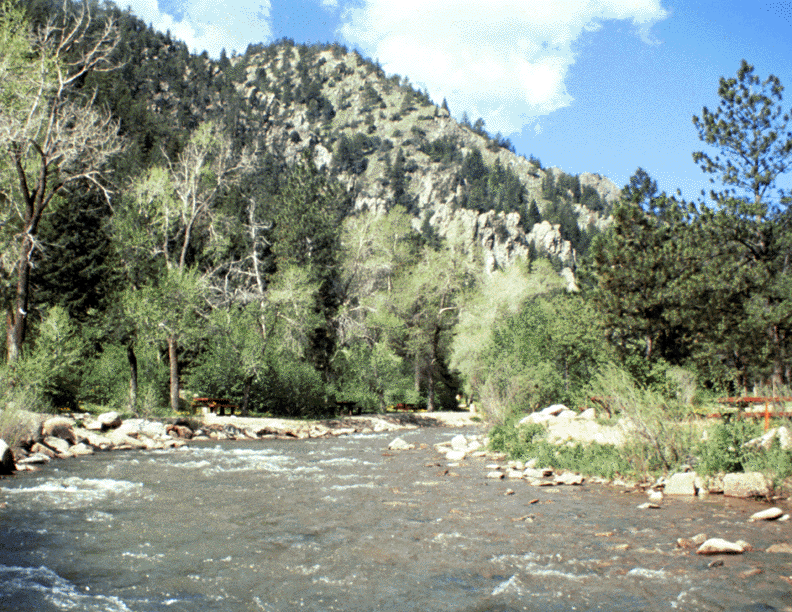
Nature's Beauty
Source: Broderbund, Print Shop Photo Folios: Life and Leisure
Links and Resources:
http://encarta.msn.com/find/Concise.asp?z=1&pg=2&ti=04654000
http://nssdc.gsfc.nasa.gov/photo_gallery/photogallery-earth.html
Earth Pictures:
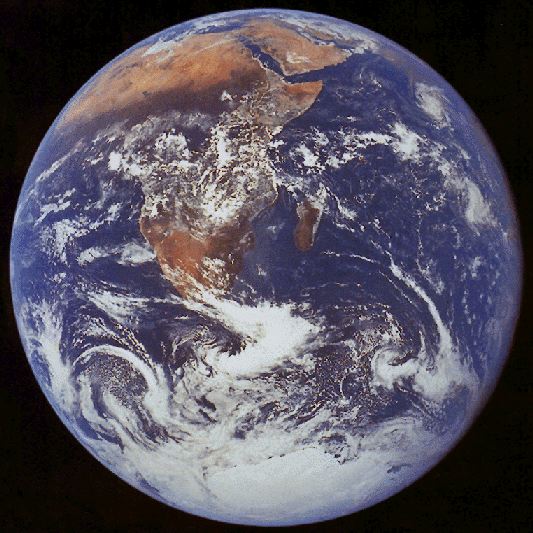
This is one of the most popular pictures of the Earth, and was taken from the Apollo 17 on December 1972 (NSSDC Photo Gallery).
Trinidad and Tobago:
Trinidad and Tobago are the two most southerly of the Caribbean Islands. The two islands comprise a twin-island state with a population of 1.3 million people. Statistics for Trinidad indicate that approximately 70% of the population are currently resident in urban areas (CSO, 1997). This rapid urban population growth has been accompanied by a growth in the problems which plague not only the environment but also the population, and failure to manage these problems is threatening not only the quality of the environment but also human health.
Edward Shumaker, U.S. Ambassador, recently indicated that Trinidad and Tobago ranked fifth in the world with regard to per capita emissions of carbon dioxide (TV6 News, March 3, 1998). These emissions are largely as a result of the high concentration of industrialisation in the country.
Developing countries such as Trinidad and Tobago are destitute and deficient in data and statistics, so this makes any research and links difficult to corroborate in the said regions.
A history of pollution in Trinidad and Tobago, prior to the 1960s, reveals that the major problems facing the country consisted of wastes from the sugar industry. This waste was discharged untreated into the air and water. The problem was further compounded by the wastes from the petroleum and cement industries (The EHS, 1978). From the 1960s with the growth in industrialization, The Environmental Health Strategy (1978) reveals that new sources of pollution were introduced. These included pollution from sources such as from food and drink processing, manufacturing of cosmetics, pharmaceuticals, fertilisers, and batteries.
The "Environmental Health Strategy" continues "There is a serious lack of information in this area, on, for example, the toxicity of some organic compounds such as the pesticides in trade effluents. The introduction of chemical effluents can cause an upsetting of the oxygen balance resulting in fish deaths and eventually the impairment of the use of a river as a source of water supply for domestic, industrial and agricultural purposes."
Even though these observations have been made in several instances, very little has been done to safeguard Trinidad and Tobago's environment. Trinidad has a series of 'visible' problems such as the threat of lead poisoning , water pollution from sewage and industrial effluent (De Leon, 1996; Gobin, 1988; Khan and Ganpat, 1988; UWI, 1990) and air pollution from diesel smoke (Bernard, 1989; Rajkumar, 1995). The map indicates some of the environmental problems which are being experienced by Trinidad at the present time.

Pollution in Trinidad*
*as identified by the Environmental Management Authority. Source: Internet Express
Bibliography:
Catton and Dunlap Environmental Sociology in "The International Handbook of Environmental Sociology"
Central Statistical Office (CSO) 1997. Annual Statistical Digest 1995 Office of the Prime Minister, CSO. Trinidad and Tobago
Environmental Health Strategy "In Compliance With Resolution No. 11 of the Second Conference of Ministers Responsible for Health" Caribbean Community Secretariat PAHO/WHO Cmmonwealth Secretariat. Grenada. 9-13 October 1978.
Contact Me At:
This page is maintained by Karima Mohammed
Note: This page is always under construction and is constantly being updated
Last Updated: Sunday, July 08, 2001 08:17:01 AM
