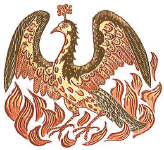
The phoenix was a fabulous mythical Arabian bird, said to be as large as an eagle, with brilliant scarlet and gold plumage and a melodious cry. It was said that only one phoenix existed at any one time, and it was very long-lived-- no anicent sources gave it a life-span of less than 500 years. As its end approached, the phoenix made a nest of aromatic branches and spices, set it on fire, and was consumed in the flames. From the ashes (or from the flames, according to some sources) miraculously sprang a new phoenix.
The ancient Egyptians linked the myth of the phoenix with the longins for immortality that were so strong in their civilization and from there its symbolism spread around the Mediterranean world of late antiquity.
At the close of the first century, Clement of Rome became the first Christian to interpret the myth of the phoenix as an allegory of the resurrection and of life after death. The phoenix was also compared to undying Rome, and it appears on the coinage of the late Roman Empire as a symbol of the Eternal City.
In Chinese mythology, the phoenix is the symbol of high virtue and grace, of power and prosperity. It represents the union of yin and yang. It was thought to be a gentle creature, alighting so gently that it crushed nothing, and eating only dewdrops. It reflected the empress, and only she could wear the phoenix symbol. Jewelry with the phoenix design showed that the wearer was a person of high moral values, and so the phoenix could only be worn by people of importance. The Chinese phoenix was thought to have a large bill, the neck of a snake, the back of a tortoise, and the tail of a fish. It carried two scrolls in its bill, and its song included the five whole notes of the Chinese scale. Its feathers were of the five fundamental colors: black, white, red, green, and yellow. |