
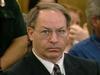
Robert Yates
At
6.30am on April 18, Robert Lee Yates Jr, 47, a married father of five,
was arrested for the murder of 16 year old Jennifer Joseph .
As
Yates sat at the police station more charges of murder were added to the
initial murder charge after a taskforce closed it trap around Yates. A task
force had been mobilized to track the serial killer. Yates became a prime
suspect when witnesses described seeing Yates' 1977 white corvette in the area
on the nights that the women disappeared. Last spring, Yates was questioned
and detectives found enough evidence from Jennifer Joseph in the car, which
led to his initial arrest.
Detectives begun round-the-clock surveillance of Yates for the two days
preceeding his arrest. After he returned from a two-week Army National Guard
camp where he has continued to his service as a helicopter pilot in the 66th
Aviation Brigade of the Washington Army National Guard, which is headquartered
at Gray Army Airfield, which is located on the base at Fort Lewis near Tacoma.
It
appears Spokane's Serial Killer grew bolder with each murder he committed. At
first he relied on time and distance to separate himself from the crimes.
Later
on the gunman grew confident in his abilities dumping his victims were they
could be easily be found.
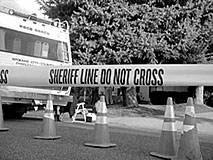 In
the beginning, serial killer victims were turning up miles from where they
worked here along Sprague Avenue. Late in august of 1997, a farmer found
Jennifer Joseph's body underneath this pine tree in the Mt. Spokane foothills.
In
the beginning, serial killer victims were turning up miles from where they
worked here along Sprague Avenue. Late in august of 1997, a farmer found
Jennifer Joseph's body underneath this pine tree in the Mt. Spokane foothills.
The
remote location is 12 miles from Sprague Avenue.
The
next known serial killer was Darla Scott. Her body was also discovered in a
rural area of the Hangman Valley. But in this case, the gunman had cut the
distance from Sprague Avenue in half.
The
killer's comfort zone would be cut in half again with the discovery of Shawn
McClenahan and Laurie Wason at 14th and Carnahan.
Their
bodies were found just three miles from Sprague Avenue's "Red Light
District".
More
than a half year later, in the serial killer's boldest execution, Michelyn
Derning died just a few blocks from where she entered the serial killer's
vehicle.
It
appears the gunman had become quite comfortable with attacking and disposing of his targets even in this very urbanized area.
Task
Force officials won't comment on concentric pattern of killings.
However
they do believe that as their investigation turned up the heat, Robert Yates
gave up his alleged campaign of murder.
The 47-year-old Spokane resident is currently employed as a replacement worker
at Kaiser Mead, where he was hired in December 1998 as a strikebreaker after
workers at the plant walked off the job.
Yates
would cruise a well known prostitution strip just a short drive from his
average suburban home from August 1997 to July 1998.
His main objective was to find prostitutes to murder. Most of the victims were
white, with only one being asian, and they were all involved in prostitution
or drugs or both.
Yates' style was to shoot the victims in the head with a .25-caliber gun after
covering their heads in several plastic grocery bags. Investigators suggest
that the bags were a "signature" -- things serial killers do to
their victims that are not necessary for murder. He would them dump the bodies
where they would be found in remote locations but near well-traveled roads and
in close proximity to each other. Almost all the victims had been killed
elsewhere before being transported to "dump sites" where they were
found.
Semen was found on eight of the bodies. Three of the victims' bodies were
within 50 yards of each other, and two of the bodies were touching. Three
victims were found with vegetation from Yates' own home on top of their
bodies, which also assisted in linking Yates to the crimes.
On October 26, 2000 after many appalling plea bargains Yates was finally
sentenced to 408 years in prison for 13 killings. Yates was then transferred
to Pierce County where he is to face two further counts of first-degree murder
of Melinda Mercer and Connie LaFontaine Ellis.
At present he is pleading not guilty to the final two charges.
The Murders
 Susan
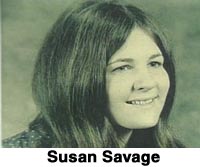
Savage, 22, and Patrick Oliver, 21 were the
Susan
Savage, 22, and Patrick Oliver, 21 were the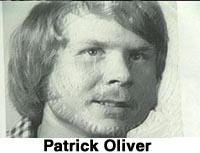 first to cross paths with the Robert Yates. In 1975 the young couple were
picnicking on Mill Creek, near Walla Walla, when Yates happened upon them
while practicing his target shooting in the same area.
first to cross paths with the Robert Yates. In 1975 the young couple were
picnicking on Mill Creek, near Walla Walla, when Yates happened upon them
while practicing his target shooting in the same area.
Patrick
Oliver was shot three times in the head before Yates turned on Susan and shot
her twice. Yates buried the couple's bodies under a pile of brush where the
were found within days. Yet it took a further 25 years before the families of
the couple would find out they were the first victims of a serial killer, when
Yates admitted he was responsible for the murders.
 Twenty-three
year old Stacy Elizabeth Hawn from Seattle was the first prostitute known to
be killed by Yates around July 7, 1988. Her skeletal remains were found five
months later in Skagit County outside of Mount Vernon. Stacy had been shot
once in the head.
Twenty-three
year old Stacy Elizabeth Hawn from Seattle was the first prostitute known to
be killed by Yates around July 7, 1988. Her skeletal remains were found five
months later in Skagit County outside of Mount Vernon. Stacy had been shot
once in the head.
Initially
Hawn was listed as a possible victim of the Green River Killer, however Yates'
finally admitted to her murder and was able to pinpoint the location she was
found as well as her injuries. His confession was part of a plea bargain so he
could avoid the death penalty.
Jennifer
Joseph, aged 16, was found on August 26, 1997. Her body was found in an
advanced state of decomposition in a small secluded spot at the corner of
Forker and Judkins Roads on the Peone Prairie. She had been killed by a
close-range gunshot to the chest. DNA was able to be extracted from semen
swabs and were undeniably matched to Yates. A sleeve button found in the white
Corvette formerly owned by Yates was matched to the shirt worn by Joseph at
the time of her death. The analysis of blood smears found in the Corvette
produced a match with a DNA profile generated through samples from Joseph's
parents.
 The
decomposed body of twenty-nine year old prostitute Darla Sue Scott, was found
on November 5, 1997 by a man walking his dog off Hangman Valley Road. Two
plastic bags that had been covering her head were also found in her shallow
grave. Her cause of death was two gunshots to the head. DNA found on Darla's
body was matched to Yates.
The
decomposed body of twenty-nine year old prostitute Darla Sue Scott, was found
on November 5, 1997 by a man walking his dog off Hangman Valley Road. Two
plastic bags that had been covering her head were also found in her shallow
grave. Her cause of death was two gunshots to the head. DNA found on Darla's
body was matched to Yates.
On
December 7, 1997 the body of twenty-four year old Melinda L. Mercer, 24 was
found on S. 50th St. in Tacoma. She had four plastic bags covering her head
and she had been shot three times.
 The
body of Shawn L. Johnson, aged 36, was found on December 18, 1997. Her
decomposing remains were found off Hangman Valley Road with two plastic bags
covering her head. The cause of death was two gunshots to the head. Semen
samples taken from her body were matched to Yates' DNA.
The
body of Shawn L. Johnson, aged 36, was found on December 18, 1997. Her
decomposing remains were found off Hangman Valley Road with two plastic bags
covering her head. The cause of death was two gunshots to the head. Semen
samples taken from her body were matched to Yates' DNA.
Thirty
one year old Laurel Wason's body was found on December 26, 1997, in a gravel pit near the Hangman Valley Road. Her head was covered
with three plastic bags cover her head and she had died from two gunshot
wounds to the head. Foreign vegetation, peanut shells, packing Styrofoam and
chips of broken concrete were found covering her body that matched debris
found in Yates' backyard. Semen found in her body matched Yates.
26, 1997, in a gravel pit near the Hangman Valley Road. Her head was covered
with three plastic bags cover her head and she had died from two gunshot
wounds to the head. Foreign vegetation, peanut shells, packing Styrofoam and
chips of broken concrete were found covering her body that matched debris
found in Yates' backyard. Semen found in her body matched Yates.
Shawn
A. McClenahan, 39 was also found December 26, 1997, next to the body of Laurel
Wason. Three plastic bags covered her head and the cause of death was two
gunshots to the head. DNA evidence from semen was matched to Yates as well as
a fingerprint on one of the plastic bags. Foreign matter covering her body was
also from Yates' backyard. Semen found in her body was matched to Yates.
 Sunny
G. Oster, aged 41, was found on February 8, 1998. Her remains are found in a
wooded area in Western Spokane County and have all the hallmarks of a Yates'
murder. Her head is covered with three plastic bags and she ahs two
gunshot wounds to the skull. Yates' semen was also found on her body.
Sunny
G. Oster, aged 41, was found on February 8, 1998. Her remains are found in a
wooded area in Western Spokane County and have all the hallmarks of a Yates'
murder. Her head is covered with three plastic bags and she ahs two
gunshot wounds to the skull. Yates' semen was also found on her body.
Thirty-four
year old Linda Maybin's decomposed body is found on April 1, 1998. Her shallow
grave is only 50 yards from the site of Wason and McClenahan's gravesite.. Two
plastic bags cover the victim's head. Cause of death is one gunshot to the
head. Semen in her body was matched to Yates' DNA. Non-indigenous plant
trimmings covering her body were matched to vegetation in Yates' backyard.
 The
next victim was found on July 7, 1998. Forty seven year old prostitute
Michelyn Derning was found under a bath cover by a transient in an area
frequented by prostitutes in Spokane's East Central neighborhood. Cause of
death is gunshot wound to the head. Unlike all of the other victims, she was
seen alive a week before her body was discovered. The others were found weeks,
or sometimes months, after they disappeared. Derning was not raped and was
murdered where she was found.
The
next victim was found on July 7, 1998. Forty seven year old prostitute
Michelyn Derning was found under a bath cover by a transient in an area
frequented by prostitutes in Spokane's East Central neighborhood. Cause of
death is gunshot wound to the head. Unlike all of the other victims, she was
seen alive a week before her body was discovered. The others were found weeks,
or sometimes months, after they disappeared. Derning was not raped and was
murdered where she was found.
 Connie
LaFontaine Ellis, 35, was found October 13, 1998, in a ditch near the 1700
block of 108th Street South in Tacoma. Her decomposed body has three plastic
bags covering her head and she had suffered only one gunshot wound to the
head.
Connie
LaFontaine Ellis, 35, was found October 13, 1998, in a ditch near the 1700
block of 108th Street South in Tacoma. Her decomposed body has three plastic
bags covering her head and she had suffered only one gunshot wound to the
head.
Melody
Ann Murfin, 43, who disappeared in 1998 and was always regularly included in
the Spokane Serial Killer victim list. Her body was found October 18, 2000,
buried in the side yard under the bedroom window of Yates' home. Although
authorites thoroughly searched the yard after his arrest, they found Murfin's
body after Yates provided them with a man pinpointing its location.
Christine
L. Smith, 32, was robbed and assaulted by a man in his van on August 1, 1998.
Smith was grazed by the gunshot to her head but managed to escape and report
the attack to police.
Smith
had agreed to perform oral sex for $40 in the back of Yates' van in a secluded
parking lot in Spokane on Aug. 1, 1998. According to Smith, Yates was driving
a black van with a bed and mattress in the back. Smith asked Yates
if he was the "psycho killer." that had been killing prostitutes at
the time, Yates responded by saying "he was not the killer because
he had five kids and would not do that."
After
several minutes when Smith had failed at arousing Yates with oral sex Yates
shot her in the head - (Smith had thought she had been hit rather than shot),
nearly causing her to lose consciousness however Smith struggled to stay awake
and keep her wits about her as she fell backwards. Luckily the bullet
had only scraped the side of her face. Smith did not know she had been shot
until a later x-ray showed fragments in her face and skull.
She
contacted police again on April 18 after recognizing Yates as her attacked
from his mugshot published in The Spokesman-Review. Police found blood stains,
a .25-caliber bullet casing and a bullet encrusted in the roof of a van
similar to the one described by Smith that was once owned by Yates. The
fragments of bullet were later removed from her head for ballistic comparison
to other bullets from Yates' victims.
THE
MAN
Robert
Lee Yates Jr. is an Army veteran who served nearly two decades as a helicopter
pilot for the U.S. Army. He is the married father of four daughters and a son,
ranging from age 11 to 25.
He
grew up in nearby Oak Harbor, Wash., a Puget Sound community where the quiet
calm is often punctuated by the rumbling of jet engines from strike aircraft
and patrol planes in the flight pattern at nearby Whidbey Island Naval Air
Station.
After
dropping out of college in the early 1970s, Yates married and enlisted in the
Army on Oct. 4, 1977. Within 3 years, Yates was a warrant officer attending
flight school at Fort Rucker, Ala., the home of Army aviation. He graduated
with a pair of flight wings authorizing him to fly helicopters.
Yates
flew the OH-58 Kiowa, the military version of the Bell Jet Ranger helicopter.
Sleek, fast and highly maneuverable, the scout helicopter served as a
battlefield commander's eyes and ears.
Yates
was stationed overseas in Germany during the height of Cold War tensions
between Western Europe and the former Warsaw Pact. His decorations included
three Meritorious Service Medals, three Army Commendation Medals, three Army
Achievement Medals and a Humanitarian Service Medal for participating in a
relief mission to South Florida to help clean up the devastation left by
Hurricane Andrew in 1992.
He
also received two Armed Forces Expeditionary Medals one for each tour he
had spent flying in peacekeeping missions with the Unified Task Force in
Somalia in 1993 and in Haiti during Operation "Uphold Democracy" in
1994.
"It's
real gutsy he would go out there and look for the enemy with no
weaponry," said Chief Warrant Officer-3 Jay Enders, who would later fly
with Yates in the Washington Army National Guard. "He [Yates] was a true
professional when he was out here, very proficient."
Yates
ended his career as a chief warrant officer-4, the highest rank a warrant
officer could attain in the Army. He had amassed more than 5,000 hours of
flight time in helicopters without a single mishap and had been awarded the
title of Master Army Aviator.
After
18 years as a career military aviator, Yates was almost within sight of the
coveted 20-year mark, when servicemen are eligible for retirement benefits.
Instead, Chief Warrant Officer Yates retired from the Army in March 1996.
He
was a civilian again, finally settling with his family into a beige two-story
rancher on Spokane's South Hill. Within months of retiring, however, Yates was
looking to get back into the cockpit. In April 1997, the Washington Army
National Guard granted his request.
But
Yates was unable to fly. A performance evaluation report filed by his
commanding officer in May 1998 noted that his "morale and dedication
remained high" despite not being able to fly "due to delays in
processing [his] medical examination."
While
Chief Warrant Officer Yates was grounded, detectives were working to unravel
the mystery behind a growing number of bodies that were being discovered
across Washington State.
Bibliography: News articles from time of the trial
Written
by Korey Sifuentes
Copyright
© 2002 by [The Crime Web].
Except
as provided by the Copyright Act 1968, no part of this publication may be
reproduced, stored in a retrieval system or transmitted in any form or by
any means without the prior permission of the author.
Original Written: January
30, 2002
Updated:
January 30, 2002


