
Edmund Kemper
 Twenty-five
year old Edmund Kemper got out of his car in Pueblo, Colorado and called the
police in Santa Cruz. He told them he had killed six women.
Twenty-five
year old Edmund Kemper got out of his car in Pueblo, Colorado and called the
police in Santa Cruz. He told them he had killed six women.
The
officer on the line didn't believe him and told him to call back later, so he
did, and he still didn't have any success in convincing the cop on the other
end of the line.
So
he called again and again. Each time he gave more details on how he had killed
each victims and what he had done with the bodies.
Finally
Santa Cruz police sent Colorado police to pick him up. Kemper sat and waited
for his arrest. The Police could not believe that Big Eddie who drank with
them at the bar across from the police station was responsible for the murders
which had taken place.
Looking
back into Kemper's past gave many clues to how he would become a killer.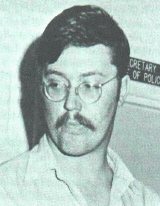
Edmund
Kemper II and Clarnell had an extremely stormy marriage and Ed's father walked
out on the family when he was only 9.
According
to Kemper, he was then traumatized by his mother at an early age. Clarnell
Kemper raised her son and two daughters on her own, and little Edmund was
subjected to severe discipline.
Clarnell
Kemper, Ed's mother began locking her son in the basement once he had started
puberty in fear he may molest his sisters. Kemper spent alot of time thinking
about murdering his mother while he sat in the still, dark damp cellar. Left
alone for hours and days at a time, the boy did not know what he had done.
 He
claims he was constantly put down by both his sisters and his mother,
especially about his mammoth height. His personality became withdrawn and he
had very little social skills. In his early teens, Kemper killed two of the
family cats. Clarnell found the remains of one, minus the head, and in the
garbage can, while remaining dismembered pieces were in Edmund's closet.
His animal dismemberments where also combined with his fantasies of sex and
violence.
He
claims he was constantly put down by both his sisters and his mother,
especially about his mammoth height. His personality became withdrawn and he
had very little social skills. In his early teens, Kemper killed two of the
family cats. Clarnell found the remains of one, minus the head, and in the
garbage can, while remaining dismembered pieces were in Edmund's closet.
His animal dismemberments where also combined with his fantasies of sex and
violence.
Clarnell
grew sick of Edmund, so she shipped him off to his father and step-mother. Who
in turn decided he should live under the strict discipline of Ed and
Maude Kemper, Ed's paternal grandparents. So in August 1963 when Edmund was 14
, he went to live with his grandparents. His grandmother did not want to have
to deal with the boy. Little did she know they would be together for such a
short time.
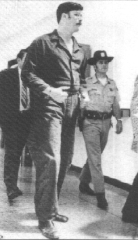 On
August 27, 1964 as Maude Kemper sat at the kitchen table Edmund was
loading a rifle to go out onto the farm for some target practice. His
grandmother hissed a warning at him, and Kemper just stopped in the doorway.
Something inside him snapped/ He turned towards his grandmother, levelled the
rifle at her head and shot her.
On
August 27, 1964 as Maude Kemper sat at the kitchen table Edmund was
loading a rifle to go out onto the farm for some target practice. His
grandmother hissed a warning at him, and Kemper just stopped in the doorway.
Something inside him snapped/ He turned towards his grandmother, levelled the
rifle at her head and shot her.
After
wrapping the head in a towel, he moved her body up to the bedroom where he
slashed and stabbed her with a knife. Before too long, Ed Kemper I pulled into
the driveway. According to Kemper, to save his grandfather the torment
of seeing his dead wife, Ed quickly met him at the door and also shot him
dead. Kemper cleaned the kitchen as best he could before calling his mother in
a state of confusion, she told him to call police. So Kemper rang the
authorities and waited.
A
court-appointed psychiatrist diagnosed Edmund as paranoid and psychotic, and
the Youth Authority committed him to Atascadero State Hospital. He entered the
facility on December 6, 1964. He was not yet sixteen years old.
Kemper
stayed at Atascadero for a little over five years. During his time he was
taken under the wing of the research director Dr Frank Vanasek and became a
trusted inmate among staff.
During
his sessions with psychiatrists and psychologists, Kemper began to get an
understanding of the science and was quick to learn what the doctors wanted to
hear. Not what he was really thinking about or feeling. This new gift enabled
him to dupe authorities later during his killings.
The
only problem seemed to be he also became an eager listener of serial sex
offenders to. He would spend most nights fantasizing about their crimes, and
noted that the only way they were caught was by being identified by the
victim. So Kemper decided the victim must not be allowed to live.
He
was soon allowed to rejoin society ,doctors believing he was no longer a
threat - even though there was certainly a chance that his explosiveness may
resurface.
But
mainly it was due to his tempestuous relationship with his mother. Even though
it was suggested the two be kept apart for their own safety. Kemper moved back
in with Clarnell after a short stay with California Youth Authority.
Kemper was now 21.
The
Kempers now lived in an apartment in Aptos and Kemper's mother had an
administration job with University of California. Ed's associations in the
detention centre made him rather envious of those in authority and wished to
later join the police force. Unfortunately his height made him ineligible.
However it did not stop him hanging out and drinking with local police at the
bar called the Jury Room across from Aptos Courthouse. He was known to all as
"Big Eddie" and was well liked by all as a gentle giant.
The
closest job he could get to law enforcement was as a flagman on the highways,
this meant with the money he was receiving he could leave his mother's
apartment. He moved in with a friend in Alameda and purchased a 1969 Ford
Galaxy sedan, in black and yellow.
He
would often spend his spare time cruising the highways, thinking about the sex
crimes of his fellow inmates at Atascadero. Kemper then started to act out his
fantasies by picking up young women hitch-hikers, and using his knowledge of
psychology, would get them to quickly trust him.
He also got a sticker from his mother's job at the University for his car, the
girls quickly would accept rides from fellow students. After about 150
hitch-hiker pickups, Kemper knew he was ready for the next step.
On Sunday May 7, 1972, Kemper prepared for murder. He placed a hunting knife,
rope, a plastic bag, handcuffs and a Browning 9mm automatic pistol under
his car seat and set out to find victims. By 4 pm he thought he would need to
try again later, but then saw two teenage girls thumbing a ride.
Mary Ann Pesce and Anita Luchessa, happily accepted Kemper's offer for a lift,
they were on their way to see a friend at Stanford University and wasn't sure
of the way. Kemper used this to his advantage. He drove them away from
where they were headed, both girls unaware of their fate, until Kemper drove
down a side road. Mary suddenly knew something was wrong. She asked Kemper
"What do you want?"
Kemper
stopped the car, pointed the pistol at the scared eighteen year old women and
replied coolly, "You know what I want."
Mary
tried to keep her wits about her and used the skills taught at school about
talking to your attacker. Kemper knew the skills too and quickly changed it
around. He forced the terrified Anita into the boot of the car, and then
returned his attentions to Mary. He cuffed her hands behind her back and then
tried to suffocate her with the bag. She fought him, and bit holes through the
bag to allow her to continue breathing, Kemper soon overpowered the woman by
stabbing her twice in the back and once in the chest. Kemper grabbed her by
the chin and slashed her throat.
Knowing that Anita would've heard the struggle from the car's trunk, he
decided to kill her post haste. He opened the boot and began stabbing her,
while she screamed in horror.
Knowing
his flatmate was out, Kemper took the bodies back to his room in Alameda.
He undressed both bodies and took many Polaroid photos before dissecting them
and decapitating the bodies. He took down their details from their student ID
cards and destroyed all the possessions they had with them, before burying the
body parts in the bush around Santa Cruz. The heads he kept as trophies.
Once they had begun to decay he took them and through them into a ravine
- which also helped to defy identification of the bodies he had buried
earlier.
However
no-one was looking for the two girls. For now they were just assumed to be
roaming the country as some teenagers are known to do.
The
photos Kemper had taken where enough for the next few months to satiate his
sexual urges. A broken arm he suffered after a motorcycle accidence also
prevented him from killing for now.
By
September though, Kemper's homicidal urges where beginning to surface.
Late
in the afternoon of September 14, 1972, Aiko Koo was trying to get a ride on
University Avenue Berkeley. When the friendly looking Kemper offered her a
lift she was relieved. Until she saw they were heading away from her
destination of San Francisco. She began screaming, so Kemper thrust the pistol
into her ribs and told her to stop it. He used the ruse that he was suicidal
and need to desperately to talk to someone because he was so lonely.
Once
he had her at a secluded clearing in the woods he successfully suffocated the
tiny framed woman into unconsciousness before raping her and strangling her.
Kemper
bundled the body into the boot, and drove to a nearby bar for a beer and sat
and savoured the killing.
Late
that same night he took the body up to his room disguised in a bundle of
blankets. He dissected the corpse and again scattered the remains around Santa
Cruz woods, and kept the head with him in the boot of the car.
On
September 15, Kemper had a follow-up evaluation by a board of juvenile
psychiatrists, where he was declared mental stable and had his record of the
double homicide of his grandparents sealed. Little did the experts know,
Aiko's head was in the car.
But
Kemper saw this as the freedom he was waiting for, He could now buy his own
gun. The only problem now was that because his broken arm prevented him
from working he moved back to his mother's apartment with great reluctance.
The
quarrelling between the two of them began almost instantly.
Kemper
had now bought himself a .22 Ruetgers automatic with six inch barrel and
wanted to try it out. In January, 1973 the wet weather had mean there were
very few woman to pick up. But on January 8, he was giving up hope, when he
spotted a young girl thumbing a ride. Cindy Schall was a short shapely
eighteen year old girl on her way to an evening class at the near by College.
As
soon as she sat in the car, Kemper produced the gun and used the suicide story
again. He drove on for three hours, until he reached the township of Freedom.
He persuaded the frightened woman to get into the boot of the car, where he
shot her dead.
He
took the body home and with some difficulty (with his arm still in a cast)
took it to the bathroom - his mother was out. He cut the body into pieces and
placed them in plastic garbage bags and again tossed the remains into a
ravine. He kept her shirt and a ring as trophies and put her head in the
closet.
The
following day reports claimed that the body of Cindy had be found. So to avoid
incrimination, Kemper took her head and buried it in the front garden looking
towards the house. He later told authorities, that his mother always wanted
people to look up to her, Kemper though that the head was then appropriate.
Just a part of his morbid sense of humour I suppose.
Another
row a month later, between Kemper and Clarnell sent him out onto the road in a
rage, he took his gun with him. Rosalind Thorpe was coming out of a lecture
and contemplating how to get home when Kemper drove by. It was too wet for her
to ride her bike home.
Seeing
the campus sticker on his car, Rosalind gladly accepted Kemper's offer a lift.
Then as they were chatting Kemper spotted Alice Lui hitch-hiking further
along. Alice jumped into the backseat of the car, and the trio continued on
their way.
As
the car came over a hill, Kemper reached into his jacket and grabbed the gun,
instantly he put it to Rosalind temple and fired. In terror Alice began
screaming, Kemper leaned over the seat and fired at Alice twice, missing both
times before shooting her in the head. She stopped moving but soon began a
guttural moan, that drove Kemper mad. He was beginning to feel weak and sick.
The reality of his murders where beginning to take their toll.
He
stopped the car once more, to shoot Alice. This time she was dead.
When
he arrived home around 11pm, his mother was still up, so he said he would
return later, after getting some cigarettes. He grabbed his hunting knife and
drove to a secluded spot and hastily decapitated both bodies.
The
following day he transported Alice's body to his room where he had sex with
the headless corpse. He then cut off the hands and threw both bodies into the
ravine. And threw the heads and hands into canyon called Devil's Slide.
Another
serial killer, Herbert Mullins was also killing in the same area, and Kemper
was getting cautious, he did not want to be blamed for any murders of Mullins.
By
April, 1973 Kemper's life was falling apart. He packed up all the evidence of
the murders into a case, along with his gun and tossed the case into ocean.
The stress was becoming too much, he was suffering intense pain from stomach
ulcers. He knew the killings had come to a climax. He thought maybe a
murderous rampage maybe the way to go out in a blaze of glory, but that
thought soon subsided.
On
April 20, Good Friday, Kemper sat drinking beer beside his mother, wondering
what he should do. By 4am, he decided what he had to do. Kemper crept into his
mother's room, she was awake and asked if he needed to talk, even Clarnell
knew something was deeply disturbing her son. He said no, but reappeared
shortly, a hammer and knife in his hands.
She
was asleep, as Ed brought the hammer down onto her skull with full force.
Anger raged through his body. Blood began to pour from the wound and Kemper
knew she was still breathing. Turning her onto her back he sawed into her
throat, until she was decapitated. He took out her larynx and tried to destroy
it in the garbage disposal, but it jammed. He told police later, that still in
death she was still yelling at him.
He
was no longer in control, the killing had not calmed him at all. He went out
for some beers before coming home to decide what to do next. He called a
friend of Clarnell's, Sally Hallett, and said he was doing a surprise dinner
for his mother and would like her to attend.
Her
final words when she sat down at the table was, "let's sit down, I'm
dead". Kemper strangled her and decapitated Sally's lifeless body. He had
come to the end. He could go on no longer.
After
this murder he left on his last car ride as a free man, the drive took him to
Pueblo, Colorado. Nobody had been searching for him the whole time he was
driving.
Ed's
confession was long, articulate and complete in every detail. He had spent
many hours fantasizing about each and every detail of the killings.
As
a child Kemper had fantasized about his own execution. Often he would enact
his death, by asphyxiation.
Kemper
was charged with eight counts of first degree murder on October 25, 1973.
On
November 8, 1973 he was found guilty of his crimes and sentenced to life
imprisonment in California Medical Facility at Vacaville. (No death penalty
was available at the time in California).
Bibliography:
Encyclopedia of Serial Killers: Nigel Blundell, PRC, 1997
CRimes and Victims: Frank Smyth, Blitz Editions, 1992
Written
by Korey Sifuentes
Copyright
© 2002 by [The Crime Web].
Except
as provided by the Copyright Act 1968, no part of this publication may be
reproduced, stored in a retrieval system or transmitted in any form or by
any means without the prior permission of the author.
Original Written: January
30, 2002
Updated:
January 30, 2002