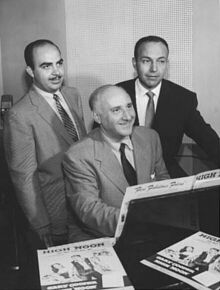
"Allo, Harry? We Gehts? You veel do for me a favor? Yes? You veel arrange tickets for me and Albertina for preview Lost Horizon? Good.
Fine."
Dmitri Tiomkin wanted tickets to the picture for which he did the musical score. But they were difficult to obtain. A hurried call from his office on the Columbia lot to Harry Cohn, the producer, did the trick. A little later he spoke by telephone to Albertina Rasch, the dancer, his wife.
"Allo, Albertina? You vant to see preview Lost Horizon? No? You are rehearsing, yes? No, I veel not go tonight to party. I veel to to gefilte fish...museecians. I veel call you later. Goodbye."
DESCRIPTION
Dmitri Tiomkin, composer, conductor, concert pianist, and pioneer in the realm of motion picture music, is tall, rather portly, and
still has a bit of difficulty with English.
He bows his head, snaps his fingers, says a word in Russian, maybe French or German until he hits on the American equivalent. It makes his way of speaking charming and interesting, but a bit difficult to quote.
It was said before that Mr. Tiomkin is a pioneer. Lost Horizon which opens March 10 at the Four Stars Theater, proves it. For eight
months he worked with Frank Capra, the director, during actual production. He studied each shot, the sets, the actors, the lines, the story, the background.
He discussed with Capra the needs the music must satisfy, the technical problems of recording, the combination of music and dialogue. He composed, made necessary changes, solved problems of orchestration until he was satisfied with the final result.
In one musical sequence Mr. Tiomkin's score calls for voices -- a delicate passage in which he treats them as orchestral instruments. The Hall Johnson choir was used, and their singing had to be recorded separately and than recorded with the rest of the orchestra. Are you beginning to grasp the magnitude of the problem? Forget the technical difficulties -- timing instruments, recording. Forget the painstaking efforts involved in actual composition.
Even after discounting these items there still remains the problem of writing music which will be good music, which will be an integral part of the picture, which will capture its mystic, dreamy, imaginative, and utopian mood, but which will not detract attention from the screen.
LONG TIME
For eight months Mr. Tiomkin worked at it, and in seven days it was recorded. Did he conduct the orchestra? He did not. Max Steiner wielded the baton while Mr. Tiomkin paced nervously in the background.
A new field is opening in musical development, and Mr. Tiomkin feels that more and more young people are becoming interested in fine music, it will not be long before he hopes to see his friends, already established as outstanding composers, drawn to Hollywood. And among them will be Ravel, Stravinsky and Prokofiev.
St. Petersburg was Mr. Tiomkin's birthplace, and his mother, a noted teacher, was his first mentor. Later, in America, Tiomkin met George Gershwin, encouraged him to engage in serious composition and himself presented Gershwin's "Concerto in F" before audiences in Paris.
He was the first of contemporary musicians to come to Hollywood and wrote the music for Broadway Melody, The Rogue Song, and just recently adapted the music for Life of Johann Strauss.