 |
|
|
|
|
|
|
|
|
|
|
|
|
|
|
|
|
|
|
|
|
|
|
|
|
|
|
|
|
|
 |
|
|
Sidney Poitier |
|
|
|
 |
|
|
|
|
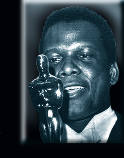
Sidney Poitier was born in Miami, Florida during 1927 but grew up on the small village of Cat Island, Bahamas.(1) He later migrated to the United States with no money and no prospects. He worked as a janitor for the American Negro Theater where he was given acting lessons in exchange for work. Sidney learned first hand about the different forms of discimination when he tried out for a role. Not only was he discriminated againtst because of his color but also for his thick Bahamian accent.(2) As he struggled to get rid of it, the end result was a distinctive speech pattern that later became a trademark. His first starring role was in "No Way Out", a 1950 classic as a young doctor. Poitier carefully established his career by refusing to accept roles that lowered his dignity as a human being. |
|
|
|
|
|
|
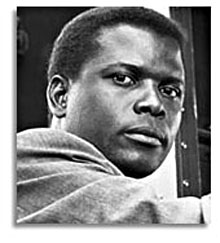
Sidney Poitier 1927-
Courtsey of Colored Reflections |
|
|
|
|
|
�If you apply reason and logic to this career of mine, you're not going to get very far... The journey has been incredible from its beginning. So much of life, it seems to me, is determined by pure randomness." |
|
|
|
|
 |
|
|
|
|
|
|
The parts that he chose were strategic enough to take advantage of the few opportunities that arose during the 1950s. The films that added to his success were the Oscar winning "Lilies of the Field�, "The Bedford Incident" (1965), "A Patch of Blue" (1965), and "To Sir, With Love" (1967).(2) Poitier eventually became mainstream with his acclaimed role in "Guess Who's Coming to Dinner" (1967), even though he received criticism by members of the Black community for integration roles.(2) Guess Who's Coming to Dinner was the first film about an interracial relationships that did not end in tragedy. |
|
|
|
|
Sidney Poitier
Courtsey of Colored Reflections |
|
|
|
|
|
|
Poitier gave a grand performance as Walter Lee in Lorraine Hansberry's play "A Raisin in the Sun". This was the first play by a black playwright to show up on Broadway. The reflection of black family life was insightful and it had great appeal. He took a break from acting following the assination of Dr. Martin Luther King Jr. as black americans began to target him for playing certain roles.(1) Sidney returned to the screen a decade later for the film Shoot to Kill (1988).(1) This film addressed the problems with apartheid in South Africa. Poitier received the role of Nelson Mandela, a speaker for racial equality. |
|
|
|
 |
|
|
|
|
|
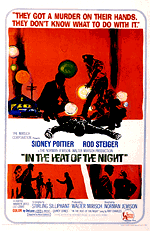
Poster of film In the Heat of the Night
Courtsey of SeparateCinema |
|
|
 |
|
|
|
|
|
|
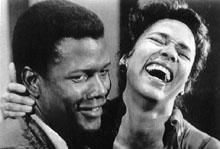
Sidney Poitier and Dorothy Dandridge
Courtsey of Phillip Oliver |
|
|
|
1. Sidney Poitier. American Masters. PBS. <http://www.pbs.org/wnet/americanmasters/database/poitier_s.html>
2. Sidney Poitier. Colored Reflections. <http://classicfilm.about.com/gi/dynamic/offsite.htm?site=http://www.coloredreflections.com/decades>
|
|
|
|
 |
|