 |
|
|
|
|
|
|
|
|
|
|
|
|
|
|
|
|
|
|
|
|
|
|
|
|
|
|
|
|
|
|
|
|
|
|
|
 |
|
|
Early Casting Preferences |
|
|
|
"First the mulatto inherits the vices of both races and none of the virtues; second, any achievement of a Negro is to be attributed to the White Blood in his veins. The logic runs that even inheriting the worst from Whites is sufficient for achieving among Negroes�The mulatto is a victim of a divided inheritance; from his White blood come his intellectual strivings, his unwillingness to be a slave; from his Negro blood come his baser emotional urges, his indolence, his savagery." Sterling A. Brown, literary critic (1) |
|
|
|
|
|
 |
|
|
|
 |
|
|
|
 |
|
|
|
|
|
|
|
|
|
Major Producers in 19th Century: Hollywood, United Artists, and MGM (Metro Goldwyn Mayers Studios Inc)) |
|
|
|
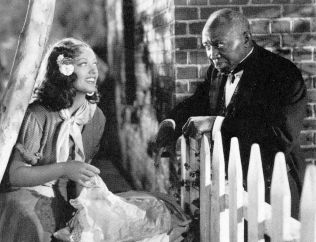
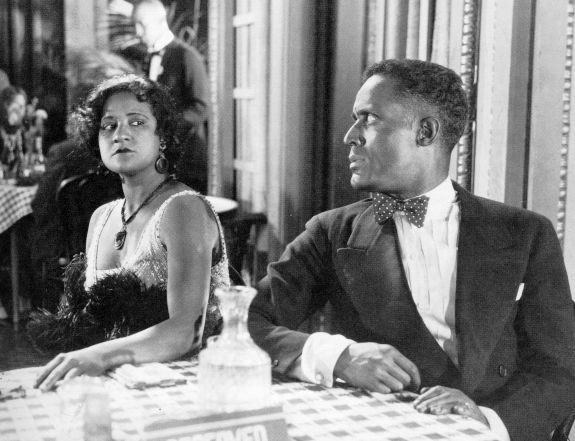
Hollywood producers and others were uninterested in developing positive movie images about African-Americans and considered them as "risky" undertakings (little belief in black talent outside of servitude).(2) Therefore the only available roles to black actors were maids, tragic mulatto/a, butlers, brutes, ect. Any other roles that required an african american were portrayed by a white person who painted their face black. With the reduction of white actors in blackface, the entertainment industry turned to the usage of more "suitable" African-Americans for black character roles. This action was prominent in romance scenes for both actors/actresses. Traditional romantic roles with African-Americans were given to either fair skinned individuals or white women. The opposite image is seen with men. For example dark skin was a sign of masculinity and associated with sexuality. |
|
|
 |
|
|
|
|
|
White actress Marion Davis in blackface and Bill Robinson as a house servant in this MGM film, Operator 13 (1934)
Courtesy of Micheal Mills |
|
|
|
|
|
 |
|
|
|
|
|
 |
|
|
|
|
|
Two white actors in blackface in this Paramount Pictures film, Melancohly Dame (1929)
Courtesy of Micheal Mills |
|
|
|
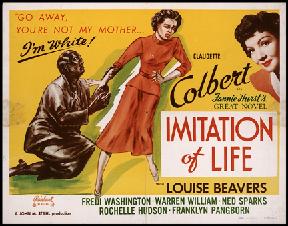
Imitation to Life was created in 1934 about a mulatta trying desperately to �pass� as white to escape her tormenting life.(3) The popular mulatta Fredi Washington was chosen to play the role along with Louise Beavers. The fair girl grows up in a white home where her best friend is the daughter of the white woman her mother works for. The fair girl abandons her dark skin mother scene after scene as she attempts to blend into European culture. Washington�s character realizes her mistakes and tries to apologize to her mother but it is too late, Beavers dies. The film was such a success that it was later remade in 1959 but white actress Susan Kohner was chosen instead. |
|
|
|
|
Theories for the preferences of mulatta characters:(5)
A:The veil of resentment
Appreciation developed by the fact that the �beauties� died so tragically in the movies. By the deaths of the mulatta, an unspoken rule was made that stated anyone engaged in miscegenation would have a tragic ending. Even though the society was becoming an integrated one, the predetermined downfall helped soothe the anxieties about the �unchecked mixing of the races� (Color complex 136). The image of this �mystical beauty� had to be tainted as a means to show that full acceptance into European society would never be permitted.
B: The assumption that racially mixed blacks were worthy of a white audience
Universal assumption about the inability of African Americans to perform a task such as acting. It was believed that pure Africans could not act and were not deserving of an all Caucasian audience. The history surrounding the creation of the mulatta was a scandal in itself and proved to be far more interesting to viewers. |
|
|
|
|
|
|
"The bias in casting roles occurred regardless of whether the films' writers, producers, and directors were white or black. In essence, everyone was fostering a caste system based on shades of specific colors." (4) |
|
|
|
|
|
C: The use of adjectives
Various words were created to describe the racially mixed group with more focus on the women than men. For example the word octoroon was used to describe a woman with one eighth of Negro blood (Color complex 136). In several plays by George Washington Cable, he would use this word to classify the beautiful mistresses of the white men. |
|
|
|
|
|
1. The Color Complex, p. 137.
2. Blacks in American film. <www.AfricanAmericans.com/film.htm>
3. The Color Complex, p. 147.
4. Hollywood Eras and Errors. Young African Americans Against Media Stereotypes (YAAAMS). <www.yaaams.com/hollywooderas.shtml>
5. The Color Complex, p.136. |
|
|
|
 |
|