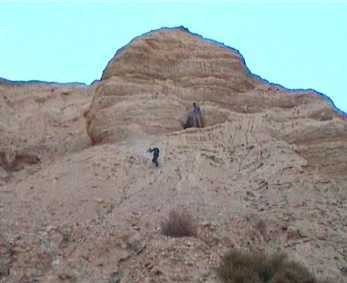
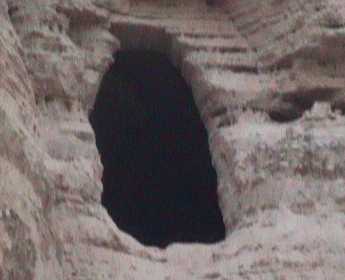
If distant photos of both are looked at, they do look similar, but that's all. I had the job of trying to carry a video camera up to the scroll caves, and that was painful. The material was alluvium. Hard, nasty, cutty-type rocks,in a great jumble with sandy dirt holding it together.
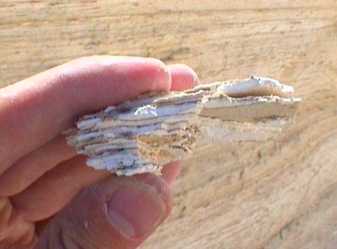
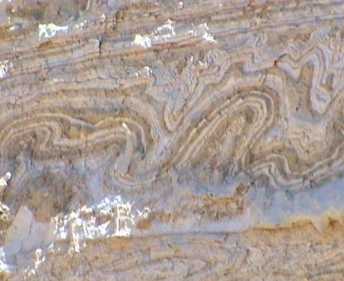
If these alternating fine layers were lake deposits, there has to be a source for each layer, I am not aware of any. The layers are very clearly different, and with each layer being about 2mm to 20mm thick, over a total height of more than 20 metres, ( check wyattmuseum.com for update ) there simply wasn't enough time between the flood, and Lot for this to be lake deposits.
From a scientific point of view, these layers could not have been put there in water, because the white sulphate material reacts with water to form a hard material, plaster of paris, and the only place I found it hardened, was where rain had reacted with it.
Now think about where these cities got their water from, and why they lived there. ( Gen 14:10 and 13:10 ) ...And Lot lifted up his eyes, and beheld all the plain of Jordan, that it was well watered everywhere, before the Lord destroyed Sodom... Before these cities were burnt, the water permeated out from the Jordan River, through the limestone, and watered everywhere. The ground was well watered, like the land the Hebrews had in Egypt, and the Garden of Eden. When the Kings of the cities went to war, they joined together in the Vale of Siddim, which was full of slimepits. There was no Dead Sea then. It formed after the cities where burnt, because the fire from Heaven went deep, and made chemicals that set hard when in contact with water, sealing the ground....the smoke of the country went up as the smoke of a furnace.... The Lisan is one big hydro dam!
Destroy the cities and the whole plain with great heat, and throw in some brimstone, so that all that is left is just ash. Leave it to sit and erode for about 3900 years, and then take a look at what is left.
Some people would prefer to find a few charred logs and a statue of a woman made of salt. I prefer what I found, which is the ash of limestone and sulphur, obsidian, fired clay, melted rocks, a few little bits of charcoal, and some monoclinic sulphur.