Mothers
of Feminism
In England
………….
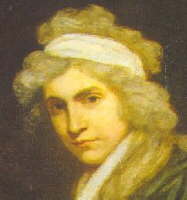
Mary
Wollstonecraft*
(1759-1797)
Mary
Wollstonecraft is considered to be one of the most influential mothers of
feminism because of all of the work she did towards the rights of women. In
1792, Wollstonecraft wrote one of her most famous works, the A
Vindication of the Rights of Woman. She argued that through education of
women, would come emancipation.
Mary Wollstonecraft was born on April 27, 1759. Her father had inherited
wealth, but squandered his entire fortune, so the Wollstonecraft family moved
place to place as her father made attempts to make a living.[5]
When the family was living in Hoxton, a suburb of London, Mary met her closest
friend Fanny Blood.
At
the age of nineteen, Mary went out to earn her own living as an aid to an
elderly woman. In 1783, she helped her sister Eliza, whose mental health was
deteriorating, escape a miserable marriage by hiding her from her brutal husband
until a legal separation was arranged. The two sisters, along with Fanny Blood,
established a school at Newington Green for girls. [5]
Later, after some
financial problems, the school had to be closed. Mary then decided to make her
living as a writer promoting the emancipation of women.
Wollstonecraft
accepted the idea that a woman belonged at home as many others did at her time,
but she did not view the home and the public life as two separate entities. The
home is important, as it creates the foundation for a person’s social and
public life. Both men and women have responsibilities to both the family and the
state.
So, Wollstonecraft argues that a woman has the right to be educated, because as her duty to the state, she is required to raise the future citizens. By doing so, she should be educated, so she will be better equipped to raise her children well.
“Strengthen the female mind by enlarging it,
and there will be an end to blind obedience” [6]
Wollstonecraft
also argues that educating women will strengthen the marriage relationship. A
stable marriage, she believes, is a partnership between a husband and a wife. A
woman needs to have equal knowledge to maintain the partnership. A stable
marriage also provides for the proper education of children. She also mentions
that fact that both men and women should be required to be chaste and faithful,
and not just women as culture had previously employed.
“Make women rational creatures, and free citizens, and they will quickly become good wives;
- that is, if men do not neglect the duties of husbands and fathers” [6]
Self-absorption
in activities like beauty and fashion, in Wollstonecraft’s opinion, are
detrimental to a woman as it makes her less able to maintain her part in her
partnership, and also reduces her effectiveness as an educator to her children.
By doing (or not doing so in this case) the woman will be a less dutiful
citizen.
But
Wollstonecraft, in her A Vindication of
the Rights of Woman, makes clear her position: There will only be true
freedom when both men and women are equally dutiful in the exercise of
responsibilities to the family and state.
“I do not wish [women] to
have power over men;
but over themselves”
In
March of 1797, Mary found herself in a dilemma; she was pregnant with the
child of William Godwin. Mary and William had written openly about their
belief against the idea of marriage because at that time, it was a legal
institution where the woman lost legal existence and became subsumed legally
in their husband's identity. But because she was pregnant, Mary and William
were married on March 29,1797. The baby was born Mary Wollstonecraft Godwin on
August 30, 1797. On September 10, Mary died of septicimia, a blood poisoning
known as “childbed fever”.