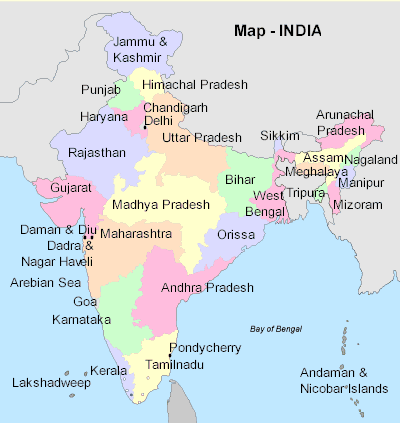
Facts at a Glance
Full country name: Republic of India
Area: 3,287,000 sq km (1,281,900 sq m) (several disputed international borders)
Population: 968 million (growth rate 2.1%)
Capital city: New Delhi (pop 10.1 million)
People: 72% Indo-Aryan, 25% Dravidian, 3% Mongoloid
Languages: Hindi and English, plus 15 main languages and over 700 dialects
Religion: 82% Hindu, 11% Muslim, 2% Christian, 2% Sikh, 0.7% Buddhist and 0.7% Jain
Government: Democracy
Prime Minister: Atal Bihari Vajpayee
Environment
India is a large, triangular-shaped country in southern Asia, buttressed by the long sweep of the Himalaya in the north and protruding into the Indian Ocean in the south. It's bordered by Pakistan to the north-west, China, Nepal and Bhutan to the n
orth, and Bangladesh and Myanmar to the east. Sri Lanka is the teardrop-shaped island hanging off its southern tip. India covers a land area of some 3,287,000 sq km (1,281,930sq mi), though disputed borders with Pakistan and China make this figure somewha
t arbitrary. It is the seventh largest country in the world.
Northern India contains the snow-bound peaks and deep valleys of the Himalaya and the vast Gangetic Plain, which separates the Himalayan region from the southern peninsula and stretches from the Arabian Sea to the Bay of Bengal. South of the plains, th
e land rises up into a triangular-shaped plateau known as the Deccan, which ranges in altitude from 300m (985ft) to 900m (2950ft). The plateau is bordered by the Eastern and Western ghats, ranges of hills which run parallel to India's eastern and western
coasts and separate the fertile coastal strips from the interior.
Wildlife in India is often purported to have enjoyed a privileged and protected position thanks to the religious ideals and sentiments of Hindus, Jains and Buddhists, but much of this tradition has been lost. Extensive hunting by the British and the In
dian rajahs, large-scale clearing of forests for agriculture, poaching, pesticides and the ever-increasing population have had disastrous effects on India's environment. Only around 10% of the country still has forest cover, and only 4% is protected withi
n national parks and reserves. In the past few decades the government has taken serious steps to improve environmental management and has established over 350 parks, sanctuaries and reserves.
The highlights of India's fauna are its lions, tigers, leopards, panthers, elephants and rhinoceroses, but the country is also home to a rich variety of deer and antelope, wild buffaloes, massive Indian bisons, shaggy sloth bears, striped hyenas, wild
pigs, jackals and Indian wild dogs. Monkeys include rhesus macaques, bonnet macaques and long-tailed common langurs. The reptilian world boasts magnificent king cobras, pythons, crocodiles, large freshwater tortoises and monitor lizards, while the diverse
birdlife includes large hornbills, serpent eagles and fishing owls, as well as the elegant national bird, the peacock.
Climate varies greatly, from the arid deserts of Rajasthan to the cool highlands of Assam, allegedly the wettest place on earth. But basically India has a three-season year - the hot, the wet and the cool. The heat starts to build up on the northern pl
ains around February and by April it becomes unbearable. The first signs of the monsoon appear in May with high humidity, short rainstorms and violent electrical storms. The monsoon rains begin around 1 June in the extreme south and sweep north to cover t
he whole country by early July. The monsoon doesn't really cool things off, but it's a great relief - especially to farmers. The main monsoon comes from the south-west, but the south-eastern coast is affected by the short and surprisingly wet north-easter
n monsoon, which brings rain from mid-October to the end of December. The main monsoon ends around October and India's northern cities become crisp at night in December. In the far south, where it never gets cool, the temperatures are comfortably warm rat
her than hot.
 History History
India's first major civilisation flourished for a thousand years from around 2500 BC along the Indus River valley. Its great cities were Mohenjodaro and Harappa (now in Pakistan) where a complex civilisation ruled by priests and bearing the rudiments o
f Hinduism flourished. Aryan invaders swept south from central Asia between 1500 and 200 BC and secured control of northern India as far as the Vindhya hills in what is now Madhya Pradesh. They pushed the original Dravidian inhabitants south.
The invaders brought their own gods and cattle-raising and meat-eating traditions, but were absorbed to such a degree that by the 8th century BC the priestly caste had succeeded in reasserting its supremacy. This became consolidated in the caste system
, whose hierarchy was maintained by strict rules designed to secure the position of the Brahmin priests. Buddhism arose around 500 BC and presented Brahmanical Hinduism with its greatest challenge by condemning caste. Buddhism began to drive a radical swa
the through Hinduism in the 3rd century BC when it was embraced by the Mauryan Emperor Ashoka, who controlled more of India than any subsequent ruler prior to the Mughals.
A number of empires rose and fell after the collapse of the Mauryas, but the most impressive was the Gupta Empire, which lasted from the 4th century AD until 606. This was a golden age of poetry, literature and art, with some of the finest work being d
one at Ajanta, Ellora, Sanchi and Sarnath. Hinduism underwent a revival during this period, and Buddhism began its decline. The invasion of the Huns signalled the end of the Guptas and the north of India broke into a number of separate Hindu kingdoms; it
was not really unified again until the coming of the Muslims.
The far south of India was unaffected by the rising and falling of kingdoms in the north, and Hinduism in this region was never threatened by Buddhism or Jainism. The south's prosperity was based upon long-established trading links with the Egyptians,
Romans and South-East Asia. Great empires that rose in the south included the Pandyas, Cheras, Chalukyas, Pallavas and Cholas.
While the Hindu kingdoms ruled in the south and Buddhism was fading in the north, Muslim power was creeping towards India from the Middle East. In 1192 Muslim power arrived on a permanent basis and within 20 years the whole of the Ganges basin was unde
r Muslim control. The Muslim Sultans of Delhi were, however, an inconsistent bunch and Islam failed to penetrate the south, where the Hoysala Empire ruled from 1000 to 1300 AD. Two great kingdoms then developed in what is now Karnataka: the mighty Hindu k
ingdom of Vijayanagar, whose beautiful capital was at Hampi, and the Bahmani Muslim kingdom which fragmented into five separate domains centred on Berar, Ahmednagar, Bijapur, Golconda and Ahmedabad.
The Mughal emperors are the giants of Indian history. They marched into the Punjab from Afghanistan, defeated the Sultan of Delhi at Panipat in 1525, and ushered in another golden age of building, arts and literature. Their rise to power was rapid, but
their decline was equally quick and there were really only six great Mughal emperors. The Maratha Empire grew during the 17th century, thanks to the larger-than-life exploits of the lower-caste Shivaji, and gradually took over more of the Mughals' domain
. The Marathas consolidated control of central India until they fell to the last great imperial power, the British.
British power in India was initially exercised by the East India Company, which established a trading post at Surat in Gujarat in 1612. The British were not the first or the only European power with a presence in India in the 17th century: the Portugue
se had been in control of Goa since 1510 (before the Mughals had even arrived in India) and the French, Danes and Dutch also had trading posts. Britain's power gradually spread from the time that Clive retook Calcutta in 1757 until the British victory in
the fourth Mysore War in 1799. The long-running British struggle with the Marathas was finally concluded in 1803, which left almost the entire country under the control of the British East Company.
The British perceived India principally as a place to make money, and its culture, beliefs and religions were left strictly alone. The British expanded iron and coal mining, developed tea, coffee and cotton plantations, and began construction of India'
s vast rail network. The British encouraged absentee landlords because they eased the burden of administration and tax collection, creating an impoverished and landless peasantry - a problem which is still chronic in Bihar and West Bengal today. The India
n Mutiny in northern India in 1857, led to the demise of the East India Company, and administration of the country was belatedly handed over to the British government. The next 50 years were the golden years of the empire on which 'the sun never set'.
Opposition to British rule began in earnest at the turn of the 20th century. The 'Congress' which had been established to give India a degree of self-rule now began to push for the real thing. Outside the Congress, hot-blooded individuals pressed for i
ndependence by more violent means. Eventually, the British mapped out a path towards independence similar to that pursued in Canada and Australia. In 1915, Gandhi returned from South Africa, where he had practised as a lawyer, and turned his abilities to
the question of independence, adopting a policy of passive resistance, or satyagraha, to British rule.
WWII dealt a deathblow to colonialism and the myth of European superiority and Indian independence became inevitable. Within India, however, the large Muslim minority began to realise that an independent India would be Hindu-dominated. Local elections
began to reveal an alarming growth of communalism, with the Muslim League, led by Muhammad Ali Jinnah, speaking for the overwhelming majority of Muslims, and the Congress Party, led by Jawaharlal Nehru, representing the Hindu population. Jinnah's egotisti
cal bid for power over a separate Muslim nation proved to be the biggest stumbling block to Britain granting independence.
Faced with a political stand-off and rising tension, the viceroy, Lord Louis Mountbatten, reluctantly decided to divide the country and set a rapid timetable for independence. Unfortunately, the two overwhelmingly Muslim regions were on opposite sides
of the country - meaning the new Muslim nation of Pakistan would have an eastern and western half divided by a hostile India. When the dividing line was announced, the greatest exodus in human history took place as Muslims moved to Pakistan and Hindus and
Sikhs relocated to India. Much of the migration was accompanied by acts of barbaric violence. By the time the chaos had run its course, over 10 million people had changed sides and even the most conservative estimates calculated that 250,000 people had b
een slaughtered. The final stages of Independence had one last tragedy to be played out. On 30 January 1948, Gandhi, deeply disheartened by Partition and the subsequent bloodshed, was assassinated by a Hindu fanatic.
Following the trauma of Partition, India's first prime minister Jawaharlal Nehru championed a secular constitution, socialist central planning and a strict policy of nonalignment. Although India maintained generally cordial relations with its former co
loniser and elected to join the Commonwealth, it actually moved towards the former USSR - partly because of conflicts with China and partly because of US support for arch-enemy Pakistan, which was particularly hostile to India because of its claim on Musl
im-dominated Kashmir. There were clashes with Pakistan in 1965 and 1971, one over the Kashmir issue and the other over Eastern Pakistan/Bangladesh.
India's next prime minister of stature was Nehru's daughter Indira Gandhi, who was elected in 1966. She is still held in high esteem, but is remembered by some for meddling with India's democratic foundations by declaring a state of emergency in 1975.
Mrs Gandhi was assassinated by her Sikh bodyguards in 1984 as a reprisal for her ill-considered decision to use the Indian Army to flush out armed Sikh radicals from the Golden Temple in Amritsar. The Gandhis' dynastic grip on Indian politics continued wh
en her son, Rajiv, an Indian Airlines pilot with no interest in politics, was swept into power.
Rajiv brought new and pragmatic policies to the country. Foreign investment and the use of modern technology were encouraged, import restrictions were eased and many new industries were set up. These measures certainly projected India into the 1990s an
d woke the country from its partially self-induced isolationism, but they did little to stimulate India's mammoth rural sector. Rajiv suffered a similar fate to his mother when he was assassinated on an election tour of Tamil Nadu by a supporter of Sri La
nka's Tamil Tigers. India has had three leaders since Rajiv Gandhi, each of whom have shown a determination to continue dragging India kicking and screaming into the world's global economy.
The dangers of communalism in India were clearly displayed during the Ayodhya fracas in 1992, when a Hindu mob stormed and destroyed a mosque they believed had been built on the site of Rama's birth. The Hindu nationalist Bharatiya Janata Party (BJP) h
as been keen to exploit such opportunities. Corruption in the Congress party has hampered supporters of a secular, tolerant India from offering a creditable political alternative. The BJP was excluded from power by an unlikely coalition of smaller parties
, known as the United Front (but dubbed the 13 losers), who had the backing of Congress. In November 1997, Congress withdrew that support, the Lok Sabha was dissolved and elections were called for February 1998.
The elections were won by a coalition led by the BJP and Atal Bihari Vajpayee became Prime Minister for the second time. Despite the dangers of playing communalist politics, the BJP's traditionalist Hindu stance has attracted voters concerned about ret
aining traditional values during the sudden onslaught of modern global influences. When you see Baywatch dubbed into Hindi and beamed into India by satellite, you'll understand what they're concerned about. It was assumed that the more extreme poli
cies of the BJP would be mellowed by their reliance on a broad range of coalition partners. This assumption proved false when they followed through on a promise to make India a nuclear weapons power only weeks after the election. Despite international out
rage, the nuclear tests were met with widespread jubilation in India and caused a groundswell of support for the BJP.
But proving the adage that a week is a long time in politics, by April 1999 Vajpayee had lost majority support in parliament and was forced into a vote of confidence which he preceeded to lose by one critical vote. There was widespread expectations tha
t Sonia Ghandi, Rajiv Ghandi's widow, would revive the Ghandi political dynasty by leading the Congress Party to victory after its three years in the political wilderness. But in the factional and fractitious way of India's parliament she was unable to se
cure a coalition with majority seats and India was forced to the election polls for the third time in as many years.
The ruling Bharatiya Janata Party (BJP) was returned to government but with a significant decrease in support, forcing the BJP to rely more heavily on its allies. The victory was not so much won by Vajpayee and BJP as lost by the opposing parties and t
heir inability to control the fractured monster that is Indian politics. The world is holding its breathe to see what action Vajpayee will take, if any, over the bloodless coup in Pakistan that occured only days after India's election. His strong-man stan
ce against Pakistan in the past may well have accounted for the popular vote and he may be tempted into a bit of arm wrestling to prove his leadership credentials.
 Economic Profile Economic Profile
GDP: US$1,250 billion
GDP per head: US$350
Annual growth: 5%
Inflation: 5%
Major industries: Agriculture (rice, wheat, tea, rubber), textiles, coal, steel
Major trading partners: CIS, US, Japan and EU
 Culture Culture
Religion seeps into every facet of Indian life. Despite being a secular democracy, India is one of the few countries on earth in which the social and religious structures which define the nation's identity remain intact, and have continued to do so for
at least 4000 years despite invasions, persecution, European colonialism and political upheaval. Change is inevitably taking place as modern technology reaches further and further into the fabric of society but essentially rural India remains much the sa
me as it has for thousands of years. So resilient are its social and religious institutions that it has absorbed, ignored or thrown off all attempts to radically change or destroy them.
India's major religion, Hinduism, is practised by approximately 80% of the population. In terms of the number of adherents, it's the largest religion in Asia and one of the world's oldest extant faiths. Hinduism has a vast pantheon of gods, a number of
holy books and postulates that everyone goes through a series of births or reincarnations that eventually lead to spiritual salvation. With each birth, you can move closer to or further from eventual enlightenment; the deciding factor is your karma. The
Hindu religion has three basic practices. They are puja or worship, the cremation of the dead, and the rules and regulations of the caste system. Hinduism is not a proselytising religion since you cannot be converted: you're either born a Hindu or
you're not.
Buddhism was founded in northern India in about 500 BC, spread rapidly when emperor Ashoka embraced it but was gradually reabsorbed into Hinduism. Today Hindus regard the Buddha as another incarnation of the Hindu god Vishnu. There are now only 6.6 mil
lion Buddhists in India, but important Buddhist sites in northern India, such as Bodhgaya, Sarnath (near Varanasi) and Kushinagar (near Gorakhpur) remain important sites of pilgrimage.The Jain religion also began life as an attempt to reform Brahminical H
induism. It emerged at the same time as Buddhism, and for many of the same reasons. The Jains now number only about 4.5 million and are found predominantly in the west and south-west of India. The religion has never found adherents outside India. Jains be
lieve that the universe is infinite and was not created by a deity. They also believe in reincarnation and eventual spiritual salvation by following the path of the Jain prophets.
There are more than 100 million Muslims in India, making it one of the largest Muslim nations on earth. Islam is the dominant religion in the neighbouring countries of Pakistan and Bangladesh, and there is a Muslim majority in Jammu & Kashmir. Musl
im influence in India is particularly strong in the fields of architecture, art and food. The Sikhs in India number 18 million and are predominantly located in the Punjab. The religion was originally intended to bring together the best of Hinduism and Isl
am. Its basic tenets are similar to those of Hinduism with the important modification that the Sikhs are opposed to caste distinctions. The holiest shrine of the Sikh religion is the Golden Temple in Amritsar.
India is as close as the world comes to Babel. There's no 'Indian' language per se, which is partly why English is still widely spoken almost half a century after the British left India. Eighteen languages are officially recognised by the constitution,
but over 1600 minor languages and dialects were listed in the 1991 census. Language is a heavily politicised issue, not least because many state boundaries have been drawn on linguistic lines. Major efforts have been made to promote Hindi as the national
language and to gradually phase out English. A stumbling block to this plan is that while Hindi is the predominant language in the north, it bears little relation to the Dravidian languages of the south. In the south, very few people speak Hindi. The Ind
ian upper class cling to English as the shared language of the educated elite, championing it as both a badge of their status and as a passport to the world of international business. In truth, only about 3% of Indians have a firm grasp of the language. <
/P>
Indian art is basically religious in its themes and developments, and its appreciation requires at least some bacground knowledge of the country's faiths. The highlights include classical Indian dance, Hindu temple architecture and sculpture (where one
begins and the other ends is often hard to define), the military and urban architecture of the Mughals, miniature painting, and mesmeric Indian music. The latter is difficult for visitors to appreciate since there is no sense of harmony in the Western se
nse, but don't be put off by this.
Indians love the cinema and the Indian film industry, centred on Bombay, is one of the largest and most glamorous in the world. The vast proportion of films produced are gaudy melodramas based on three vital ingredients: romance, violence and music. Yo
u'll know what to expect from the fantastically hand-painted cinema billboards that dominate many streets. Imagine Rambo crossed with The Sound of Music and a Cecil B De Mille biblical epic, and you're halfway there. It's cheap operatic esca
pism, extremely harsh on the ears, and should not be missed.
Contrary to popular belief, not all Hindus are officially vegetarians. Although you'll find vegetarians everywhere, strict vegetarianism is most prevaslent in the south (which has not been influenced by meat-eating Aryans and Muslims) and in the Gujara
ti community. There are considerable regional variations from north to south, partly because of climatic conditions and partly because of historical influences. In the north, much more meat is eaten and the cuisine is often 'Mughal style', which bears a c
loser relationship to food of the Middle East and Central Asia. The emphasis is more on spices and less on chilli; grains and breads are more popular than rice. In the south, more rice is eaten, there is more vegetarian food, and the curries tend to be ho
tter. Another feature of southern vegetarian food is that you do not use eating utensils; just scoop the food up with your fingers - though not with those of your left hand.
 Events Events
India is blessed with a huge number of festivals, and several are so spectacular that you would be a fool to miss them if you were remotely within spitting distance. They start with the secular Republic Day Festival in Delhi each January, which
includes elephants, a procession, and plenty of military might and Indian princely splendour. Holi in February is one of the most exuberant Hindu festivals in the north of India. It marks the end of winter and basically involves throwing coloured w
ater and red powder over as many people as you can in one day.
The 10-day Shi'ite Muharram festival commemorates the martyrdom of Mohammed's grandson. It's marked by a grand parade and dedicated penitents scourge themselves with whips in religious fervour. It's best seen in Lucknow, the principal Indian Shi
'ite city and takes place in April/May for the next couple of years. The massive Kumbh Mela festival commemorates an ancient battle between gods and demons for a pitcher (kumbh). During the fight for possession, four drops of nectar fell fro
m the pitcher and landed in Allahabad, Haridwar, Nasik and Ujjain. The mela is held every three years rotating through these four cities. The next festival takes place in Haridwar from 1 February to 11 May, 1998.
Don't mistake the great car festival Rath Yatra for a rally race. This spectacle in Puri in June/July involves the gigantic temple car of Lord Jagannath making its annual journey, pulled by thousands of eager devotees. One of the big events of t
he year in Kerala is the Nehru Cup Snake Boat Races on the backwaters at Alappuzha (Alleppey), which take place on the second Saturday of August.
The festival of Ganesh Chaturthi in August/September is dedicated to the popular elephant-headed god Ganesh. It's celebrated widely, but with particular enthusiasm in Maharashtra. Shrines are erected, firecrackers let off, clay idols are immerse
d in rivers or the sea, and everyone tries to avoid looking at the moon. September/October is the time to head for the hills to see the delightful Festival of the Gods in Kullu. This is part of the Dussehra Festival, which is at its most spe
ctacular in Mysore and Ahmedabad.
November is the time for the huge and colourful Camel Festival at Pushkar in Rajasthan. Diwali (or Deepavali) is the happiest festival of the Hindu calendar and is celebrated over five days in November. Sweets, oil lamps and firecrackers
all play a major part in this celebration in honour of a number of gods. It may be a tired old scene, but a beach party in Goa is still the only place to be for Christmas.
 Facts for the Traveller Facts for the Traveller
Visas: Virtually everybody needs a visa to visit India. They come in a variety of flavours ranging from 15 days to six months and include single and multiple-entry versions. Only six-month tourist visas are extendable. Be careful to check whethe
r your visa is valid from the date of entry or the date of issue.
Health risks: Cholera, dengue fever, dysentery, hepatitis, malaria, meningitis (trekking areas only) and typhoid. Many of India's larger cities are highly polluted and travellers with respiratory ailments may wish to take pre
cautionary measures.
Time: GMT/UTC plus five hours 30 minutes
Electricity: 230-240V, 50 HZ
Weights & measures: Metric (see conversion table)
Tourism: 2 million visitors per year
 Money & Costs Money & Costs
Currency: Indian rupee
Relative costs:
- Budget meal: US$1
- Moderate restaurant meal: US$2-5
- Top-end restaurant meal: US$10 and up
- Budget room: US$3-10 (double)
- Mid-range hotel room: US$15-25 (double)
- Top-end hotel room: US$100-200
If you stay in cheap hotels, always travel 2nd class on trains and learn to subsist on dhal and rice, you could see India on just US$10 a day. If you prefer a few more creature comforts, like a simple private room with a bathroom, a varied diet, and oc
casional 1st class rail travel on long journeys, count on around US$20-25 a day. Staying in mid-range hotels, eating in decent restaurants, and occasionally hiring a car and driver will cost around US$30-35 a day. If you don't want to trespass beyond conv
erted maharaja's palaces, and five-star international hotels, budget as if you were travelling comfortably in the West.
You are not allowed to bring Indian currency into the country, or take it with you when you leave. The rupee is fully convertible so there's not much of a black market, even though you'll constantly be haunted by offers to 'change money'. In cities you
can change most major foreign currencies and brands of travellers' cheques - but you'll widen your options and save yourself hassles if you stick to US dollars or pounds Sterling and either Thomas Cook or American Express travellers cheques. In fact it's
wise to bring a couple of different brands of cheques in different currencies since some branches of some banks have particular idiosyncrasies, such as refusing to handle X-brand of travellers' cheques in pounds Sterling denomination or Y-brand in US dol
lars.
When changing money at a bank you'll need the patience of a saint and the paperwork skills of a ledger clerk, especially in smaller towns. The secret is to change money in large amounts as infrequently as possible and preferably in big banks in big cit
ies. You are supposed to be given an encashment certificate when you change money at a bank or an official moneychanger. Some hotels insist you show an encashment certificate before accepting payment in Indian rupees. If you stay in India more than four m
onths, you'll need to keep a handful of these certificates to get income tax clearance.
Credit cards are widely accepted in Indian cities and larger towns, particularly American Express, Diners Club, MasterCard and Visa. Credit cards can also be used to get cash advances in rupees. The Bank of Baroda seems to be the most efficient bank at
handling such transactions.
Indian currency notes circulate far longer than in the West and the small notes in particular become very tatty - some should carry a government health warning. You may occasionally find that when you try to pay for something with a ripped or grubby no
te that your money is refused. You can change old notes for new ones at most banks or save them and use them creatively as tips. Don't let shopowners palm grubby notes off on you as change - simply hand them back and you'll usually be given a note slightl
y higher up the acceptability scale.
Tipping is virtually unknown in India, except in swanky establishments in the major cities. Baksheesh, on the other hand, a term which encompasses tipping and a lot more besides, is widespread. You 'tip' in India not so much for good service but in ord
er to get things done. Judicious baksheesh will open closed doors, find missing letters and perform other small miracles. In tourist restaurants or hotels a 10% service charge is often added to bills. In smaller places, where tipping is optional, you need
only tip a few rupees, not a percentage of your bill.
 When to Go When to Go
India has such a wide range of climatic factors that it's impossible to pin down the best time to visit weather-wise with any certainty, though broadly speaking October to March tend to be the most pleasant months over much of the country. In the far s
outh, the monsoonal weather pattern tends to make January to September more pleasant, while Sikkim and the areas of north-eastern India tend to be more palatable between March and August, and Kashmir and the mountainous regions of Himachal Pradesh are at
their most accessible between May and September. The deserts of Rajasthan and the north-western Indian Himalayan region are at their best during the monsoon.
The trekking season in the Indian Himalaya runs roughly from April to November, though this varies widely depending on the trek, altitude and region. The ski season is between January and March. The dates of particular festivals which may determine the
timing of your visit are listed in the Events section.
 Warning Warning
India and Pakistan continue to trade insults and, occasionally, bullets across the disputed Kashmiri border. Indian armed forces and Kashmiri separatists have also been involved in violent clashes in the state. Lonely Planet advises that travellers do
not visit the western part of Jammu & Kashmir state, especially Jammu, Srinagar and the Kashmir Valley, and Kishtwar in the Zanskar region. Foreign travellers in this area have been targeted by Kashmiri separatist groups and several have been k
idnapped or killed.
Civil unrest is also occurring in the north-eastern states. Terrorists in Assam have bombed trains, buses and bridges and there have been political killings in Nagaland and Manipur. Travellers require permits from the Indian government to visit the sta
tes of Sikkim, Arunachal Pradesh, Manipur, Mizoram and Nagaland in the north-east. In the Indian Himalaya, parts of Kullu District and Spiti District of Himachal Pradesh, and areas of Uttar Pradesh, also require authorisation. Other areas requiring permit
s include the Pakistan-India border region west of National Highway No 15 in Rajasthan, the Andaman and Nicobar Islands, and the Lakshadweep Islands.
Piracy and armed robbery of ships in the seas around the Indian coast is becoming a regular occurence. Crews of all ships need to exercise extreme vigilance.
 Attractions Attractions
Delhi
Your first impression of Delhi is unlikely to be a good one, particularly if it's also your first impression of India. You'll most likely notice the pollution, the crowds, the smell, the noise and the ceaseless hassles long before you notice the city's
charms. But it's worth persevering: the history of this city is fascinating, and it's all around you; the bazaars of Paharganj are a wonderful introduction to India's backpacker trail; the city's monuments are among the most architectuarally striking in
the country; and the food here is great.
Delhi is the capital of India, and it's also the travel hub of northern India. It's an excellent base for visiting Agra and the Taj Mahal, and the Rajasthani colour of Jaipur is less than five hours away. If you're heading north to the
Himalaya or east to the ghats of Varanasi, you'll probably pass through Delhi. So you might as well grit your teeth, hold your breath and dive on in.
Mumbai
Mumbai is the glamour of Bollywood cinema, cricket on the maidans on weekends, bhelpuri on the beach at Chowpatty and red double-decker buses. It is also the infamous cages of the red-light district, Asia's largest slums, communalist politics and powe
rful mafia dons. This tug of war for the city's soul is played out against a Victorian townscape more reminiscent of a prosperous 19th century English industrial city than anything you'd expect to find on the edge of the Arabian Sea.
Goa
It's a shame Goa comes burdened with a history of louche living, because there's so much more to it than sun, sand and psychedelia. The allure of Goa is that it remains quite distinct from the rest of India and is small enough to be grasped and explore
d in a way that other Indian states are not. It's not just the familiar remnants of European colonialism or the picture-book exoticism that make it seem so accessible, it's the prevalence of Roman Catholicism and a form of social and political progressive
ness that Westerners feel they can relate to. Although Hindus outnumber Catholics, skirts far outnumber saris, and the people display a liberality and civility which you'll be hard pressed to find elsewhere in India.
Calcutta
The capital of West Bengal sprawls shapelessly along the eastern bank of the Hooghly River. Once the glorious capital of British India, its urban horror story of squalor and starvation only began with Partition and a resulting massive influx of refugee
s. This plucky city, however, is keen to promote itself as the 'City of Joy' and, given half a chance, it reveals itself to be one of the country's most fascinating and congenial cities, the intellectual capital of the nation, and a thriving political and
arts arena.
The city's 'lungs' is the Maidan, an enormous open expanse used by Calcuttans for recreation, cricket and football matches, political assemblies, yoga sessions, and grazing flocks. The area is large enough to engulf the massive Fort William, still in use today, although visitors are only allowed inside with special permission (rarely granted). At the southern end of the Maidan stands the huge white-marble Victoria Memorial, fronted by a statue of a frumpy Queen Victoria, which hold
s an extensive collection of British-Indian historical objects.
Calcutta's administrative centre is BBD Bagh (Dalhousie Square). The square holds both the whimsical and the brutal: on one side is the Writers' Building where 'writers' (a quaint euphimism for clerks) beaver away in the Kafkaesque labyri
nth of corridors and vast chambers while quintuplicate forms and carbon copies pile up along the walls; on the other side is the GPO which was built on the site of the legendary 'black hole of Calcutta'. It was here that, on an uncomfortably humid night i
n 1756, over 140 British inhabitants were forced into an underground cellar causing many to die overnight of suffocation.
According to legend, when Siva's wife's corpse was cut up, one of her fingers fell at the site of what is now the Kali Temple and it remains a spectacularly grubby, place of pilgrimage. In the morning, goats have their throats slit here to satis
fy the goddess' bloodlust. The city's other attractions include: the excellent Indian Museum, the largest and probably the best museum in the country (but dusty and worse for wear due to lack of funds); the Botanical Gardens, home to a 200-y
ear-old banyan tree, claimed to have the second-largest canopy in the world (the largest is in Andhra Pradesh); and the iconic, cantilevered Howrah Bridge, considered to be the busiest bridge in the world.
Budget accommodation, cheap eateries and bars are thick on the ground in Chowringhee, south of the Howrah Bridge. Sudder St, off Chowringhee Rd, is the focal point for budget travellers. There are also lots of cinemas in this area, screening Calcuttan
arthouse fare, new release Hollywood movies and their Bollywood cousins. Calcutta is no shopper's paradise, especially since a clean-up campaign has forced hawkers off the pavements, but New Market, north of Sudder St, is a good place for arguing the pric
e of goods from clothing to caneware.
Calcutta is on the international loop and you can sometimes pick up cut price tickets at the airlines offices around Chowringhee. Calcutta's Indian Airlines offers frequent domestic flights to major Indian destinations including Delhi, Bangalore, Chenn
ai, Mumbai, and Lucknow. Generally speaking, it's better to travel by train rather than bus but if it's a bus you're after you'll be looking at catching the dubiously named 'Rocket Service' from the Esplanade bus stand. For outbound trains, go to either H
owrah station on the west bank of the Hooghly river which handles trains going to the city, or Sealdah station on the opposite side which takes you in the direction of Darjeeling and other northern regions.
Agra
The Taj Mahal, described as the most extravagant monument ever built for love, has become the de facto tourist emblem of India. This poignant Moghul mausoleum was constructed by Emperor Shah Jahan in memory of his second wife Mumtaz Mahal, whose
death in childbirth in 1631 left the emperor so heartbroken that his hair is said to have turned grey overnight. Construction of the Taj began in the same year and was not completed until 1653.
Although the Taj is amazingly graceful from almost any angle, it's the close-up detail which is really astounding. Semiprecious stones are inlaid into the marble in beautiful patterns using a process known as pietra dura. The precision and care
which went into the Taj Mahal's design and construction is just as impressive whether you view it from across the river or from arm's length. Note that the Taj is closed on Monday.
The city's other major attraction is the massive red sandstone Agra Fort, also on the bank of the Yamuna River. The auricular fort's colossal double walls rise over 20m (65ft) in height and measure 2.5km (1.55mi) in circumference. They are encir
cled by a fetid moat and contain a maze of superb halls, mosques, chambers and gardens which form a small city within a city. Unfortunately not all buildings are open to visitors, including the white marble Pearl Mosque, regarded by some as the most beaut
iful mosque in India.
Other worthwhile Moghul gems include the Itimad-ud-daulah, many of whose design elements were used in the construction of the Taj, and Akbar's Mausoleum at Sikandra which blends Islamic, Hindu, Buddhist, Jain and Christian motifs, much li
ke the syncretic religious philosophy Akbar developed attempted to do.
Agra is near enough to Delhi - 200km (125mi) - to be done as a day trip. It's on the major tourist circuit so you can take your pick of transport; plane, bus, or train.
Varanasi
For over 2000 years, Varanasi, the 'eternal city', has been the religious capital of India. Built on the banks of the sacred Ganges, it is said to combine the virtues of all other places of pilgrimage and anyone who ends their days here, regardless of
creed and however great their misdeeds, is transported straight to heaven. The easternmost city in Uttar Pradesh, Varanasi is an important seat of learning, and is the home of novelists, philosophers and grammarians. This has been reflected in its role in
the development of Hindi - the closest thing to a national language in India.
Varanasi has over 100 bathing and burning ghats but the Manikarnika Ghat is the most sacred of them all. This is the main burning ghat and one of the most auspicious places that a Hindu can be cremated. Corpses are handled by outcasts known as <
I>chandal, and they are carried through the alleyways of the old city to the holy Ganges on a bamboo stretcher swathed in cloth. You'll see huge piles of firewood stacked along the top of the ghat, each log carefully weighed on giant scales so that th
e price of cremation can be calculated. There are no problems watching cremations, since at Manikarnika death is simply business as usual, but leave your camera at your hotel.
The best ghat to hang out at and absorb the riverside activity is Dasaswamedh Ghat. Here you'll find a dense concentration of people who come to the edge of the Ganges not only for a ritual bath, but to do yoga, offer blessings, buy paan, sell f
lowers, get a massage, play cricket, have a swim, get a shave, and do their karma good by giving money to beggars. It's also the best place to arrange a boat trip since there's plenty of competition among boatmen.
Apart from the many ghats lining the river, the city's other highlights include the Golden Temple, built in a roofed quadrangle with stunning gilded towers; shopping at markets famous for their ornamental brasswork, lacquered toys, shawls, silks
and sitars (yes, Ravi Shankar does live here); losing yourself in the impossibly narrow labyrinthine alleyways which snake back from the ghats; visiting the nearby Buddhist centre of Sarnath; and taking the compulsory dawn river trip slowly down t
he Ganges.
Varanasi is on the major tourist loop, about 580km (360mi) east of Agra, and 780km (485mi) southeast of Delhi, and can be eached by plane, bus or train.
Shimla
The 'summer capital' of British India sprawls along a crescent-shaped ridge at an altitude of over 2100m (6890ft) in southern Himachal Pradesh. This was the most important hill station in India before Independence, and the social life here in the summe
r months when the Brits came to escape the torrid heat of the plains was legendary - balls, bridge parties and parades went hand in hand with gossip, intrigue and romance. Today, the officers, administrators and lah-di-dah ladies of the Raj have been repl
aced by throngs of holidaymakers, but echoes of Shimla's British past remain strong. The famous main street, The Mall, still runs along the crest of the ridge and is lined with stately English-looking houses. Christ Church, Gorton Castle and
the fortress-like former Viceroyal Lodge reinforce the English flavour.
When you've done the obligatory stroll along The Mall dreaming of Kipling, Burton and Merchant-Ivory, it's worth exploring the narrow streets which fall steeply away from the ridge to colourful local bazaars. There's also an interesting walk to Jakh
u Temple, dedicated to the monkey god Hanuman. It's located near the highest point of the ridge and offers fine views of the town, surrounding valley and snow-capped peaks. Other scenic spots nearby include the 70m (230ft) high Chadwick Falls,
the picnic spot of Prospect Hill, and Wildflower Hall - the site of the former mansion of Lord 'Your-Country-Needs-You' Kitchener. The ski resort of Kufri is just 15km (10m) east, although snowfalls have been so paltry recently that t
here are plans to suspend tourist operations. If there is snow, the slopes are suitable for beginners and anyone with a decent plastic bag and a thick pair of trousers. Snow is most likely between January and February.
Shimla is not as well connected by air as other destinations in the Himalayas althouth there are a couple of companies that will fly you out. The lack of air power is more than compensated for by the number of trains and buses. Three types of buses - p
ublic, private, and those from the Himachal Pradesh Tourist Development Company (HPTDC) - connect Shimla to Delhi and they run pretty much every day. Shimla's so-called toy train is still big enough to get you to Kalka in the north, after which you can ch
ange to the relatively large and comfortable New Delhi Queen which runs on down into New Delhi.
Jaipur
The capital of Rajasthan is popularly known as the 'pink city' because of the ochre-pink hue of its old buildings and crenellated city walls. The Rajputs considered pink to be a colour associated with hospitality, and are reputed to have daubed the cit
y in preparation for the visit of Britain's Prince Alfred in 1853. This tradition and Jaipur's welcoming, relaxed air continue to this day.
Jaipur owes its name, its foundation and its careful planning to the great warrior-astronomer Maharaja Jai Singh II (1699-1744), who took advantage of declining Moghul power to move his somewhat cramped hillside fortress at nearby Amber to a new site o
n the plains in 1727. He laid out the city, with its surrounding walls and six rectangular blocks, according to principles of town planning set down in the Shilpa-Shastra, an ancient Hindu treatise on architecture.
Today Jaipur is a city of broad avenues and remarkable architectural harmony, built on a dry lake bed surrounded by barren hills. It's an extremely colourful city and, in the evening light, it radiates a magical warm glow. The city now
has 1.5 million inhabitants and has sprawled beyond its original fortified confines, but most of its attractions are compactly located in the walled 'pink city' in the north-east of the city. All seven gates into the old city remain, one of which leads in
to Johari Bazaar - the famous jewellers' market.
The most obvious landmark in the old city is the Iswari Minar Swarga Sul (the Minaret Piercing Heaven) which was built to overlook the city, but the most striking sight is the stunning artistry of the five-storey facade of the Hawa Mahal,
or Palace of the Winds. The palace was built in 1799 to enable ladies of the royal household to watch street life and processions, and is part of the City Palace complex which forms the heart of the old city.
Numerous international airlines are based in Jaipur Towers, while for domestic flights it's easier to book through any of the big travel agents. Daily flights to Delhi are availble and most continue on to Mumbai via Jodhpur, Udaipur and Aurangabad. The
Rajasthan State Transport System covers Rajasthan's major cities, as do the privately owned deluxe services. Most of these places can also be reached by train.
Udaipur
The most romantic city in Rajasthan, built around the lovely Lake Pichola, has inevitably been dubbed the 'Venice of the East'. Founded in 1568 by Maharana Udai Singh, the city is a harmonious Indian blend of whitewashed buildings, marble palaces, lake
side gardens, temples and havelis (traditional mansions). It boasts an enviable artistic heritage, a proud reputation for performing arts and a relatively plentiful water supply, all of which have helped make it an oasis of civilisation and colour
in the midst of drab aridity.
Lake Pichola is the city's centrepiece and it contains two delightful island palaces - Jagniwas and Jagmandir - that are the very definition of Rajput whimsy. The former is now an exquisite luxury hotel. The huge City Palace towers
over the lake and is bedecked with balconies, towers and cupolas. It contains a museum, some fine gardens and several more luxury hotels. Other attractions include the gates to the old walled city and its lovely alleyways; the fine Indo-Aryan Jagdish
Temple, dating from the mid-17th century; and the lakeside Bagore ki Haveli, once a royal guesthouse, but now a cultural centre.
Despite the long list of sights and attractions, the real joy of Udaipur is finding a pleasant lakeside guesthouse, scrambling up to the roof and watching the activity at the ghats, listening to the rhythmic 'thwomp!' as washerwomen thrash the life out
of their laundry, and sensing the gentle changes of light on the water as the slow days progress.
Indian Ailines has daily flights to Delhi, Jaipur, Mumbai and Aurangabad. Freqent state owned buses run from Udaipur to other regional centres as well as to Delhi and Ahmedebad. If you bus it, choose the express other wise it will take forever to reach
your destination. Lines into Udaipur are currently metre gauge only. They are scheduled to be converted to broad gauge but nobody is really sure when this will happen. It's quicker in most cases to catch a bus. Taxi's can take you to regional areas, but
practice your negotiation skills and haggle down the price a bit before you jump in.
Mysore
This charming, easy-going city has long been a favourite with travellers since it's a manageable size, enjoys a good climate and has chosen to retain and promote its heritage rather than replace it. The city is famous for its silk and is also a thrivin
g sandalwood and incense centre, though don't expect the air to be any more fragrant than the next town.
Until Independence, Mysore was the seat of the maharajas of Mysore, a princely state covering about a third of present-day Karnataka. The Maharaja's Indo-Saracenic Palace is the town's major attraction, with its kaleidoscope of stained glass, or
nate mirrors, carved mahogany ceilings, solid silver doors and outrageously gaudy colours.
The Devaraja Fruit & Vegetable Market, in the heart of the town, is one of the most colourful markets in India. The other major attraction is the 1000-step climb up nearby Chamundi Hill, which is topped by the huge Chamundeswari templ
e. The stairway is guarded by the famous 5m (16ft) high Nandi (Siva's bull) carved out of solid rock. The 10-day Dussehra Festival in early October culminates in a spectacular procession of richly caparisoned elephants, liveried retainers, cavalry,
brass bands and flower-bedecked images of Hindu deities.
There are no flights to Mysore, leaving the bus and train as the only other options. Every 15 minutes a bus to Bangalore hurtles out of the starting blocks like a bat out of hell, as do a number of other services going to regional areas including the B
andipur National Park. A number of private buses wil take you at a far more sedate pace to Mumbai, Goa, Chennai and Hyderabad. There are rarely long queues to book a fare at Mysore station and there are four daily express trains to Bangalore, plus the air
-con high-speed Shatabdi Express which departs at 2.10 pm daily except Tuesday. The Shatabdi continues on to Chennai.
Kochi (Cochin)
The port city of Kochi is located on a cluster of islands and narrow peninsulas. The older parts of the city are an unlikely blend of medieval Portugal, Holland and an English country village grafted onto the tropical Malabar Coast. Here, you can see t
he oldest church in India, winding streets crammed with 500-year-old Portuguese houses, cantilevered Chinese fishing nets, a Jewish community whose roots go back to the Diaspora, a 16th-century synagogue, a palace containing some of India's most beautiful
murals, and performances of the world-famous Kathakali dance-drama. Ferries scuttle back and forth between the various parts of Kochi and dolphins can often be seen in the harbour. Most of the historical sights are in Fort Cochin or Mattancherry. Budget
accommodation can be found in mainland Ernakulam.
Indian Airlines has daily flights to Bangalore, Mumbai, Delhi, Goa, and Chennai. If flying is outside your budget, there's a whole bevy of buses that leave Kochi at regular intervals and fan out in every direction except seaward. You can easily get to
any of the outlying regions either by state-owned or privately-owned bus but there are no advance reservations. Turn up, join the scrum, and hope for the best which in this case would be a seat. Failing this, try the railway station which has trains zippi
ng up the coast to major destinations on a daily basis.
 Off the Beaten Track Off the Beaten Track
Darjeeling
Straddling a ridge at an altitude of over 2100m (6890ft) in the far north of West Bengal, Darjeeling has been a favourite hill station of the British since they established it as an R 'n' R centre for their troops in the mid-1800s. The town remains as
popular as ever and offers visits to Buddhist monasteries, tours to tea plantations, shopping in bustling bazaars and trekking in high-altitude spots to the north. Like many places in the Himalaya, half the fun is in getting there and Darjeeling has the u
nique attraction of the famous miniature train, which loops and switchbacks its way from the plains up to Darjeeling in a 10-hour grind of soot and smoke.
Among the town's highlights is the Passenger Ropeway, the first chairlift to be constructed in India, which connects Darjeeling with Singla Bazaar on the Little Ranjit River far below. It's a superb excursion, though not an obvious choice for ve
rtigo sufferers. Unfortunately, the ropeway is not always in use - phone in advance to see when it's running. Nearby is the Zoological Park, which houses Siberian tigers and rare red pandas in less than ideal conditions. The animals are prey to Ind
ian tourists who show-off by teasing and spitting at them mercilessly. The precious snow leopards are kept in a separate enclosure and get a much better deal. If you're interested in learning about the complex tea-producing process, call in at the Happ
y Valley Tea Estate; you can also savour some of the crop at the impressive Gymkhana Club, once the playpen of the Raj and now slouching reluctantly towards the 20th century.
Flying is the easiest and most comfortable way to reach Darjeeling, although this will still only get you to within 90km (55km) of the city. The airport is situated on the flat plains near Siliguri, at Bagdogra, but there is a connecting bus from the a
irport to Darjeeling. Several bus lines also operate out of Darjeeling.
Jaisalmer
This desert fortress close to Rajasthan's border with Pakistan is straight out of an Arabian fairy tale. Founded in the 12th century as a staging post for camel trains travelling between India and Central Asia, Jaisalmer is a golden sandstone city with
crenellated city walls, a magnificent fortress and a number of exquisitely carved stone and wooden havelis. Seen at sunset from afar, it glows with the luminescence of a mirage.
Jaisalmer's impressive fort crowns an 80m (260ft) high hill, and about a quarter of the city's 40,000 inhabitants reside within its walls. Little has changed here for centuries, and if ever a record-breaking effort were made to pack as many houses, tem
ples and palaces into a confined space, this would be the result. The fort is honeycombed with winding lanes, and has formidable gateways, a maharaja's palace, a ceremonial courtyard and beautifully carved Jain temples. The most beautiful of the havelis b
uilt by Jaisalmer's wealthy merchants are Patwon ki Haveli, Salim Singh ki Haveli and Nathmal ki Haveli.
Despite its incredible picturesqueness, you don't have to look very hard to realise that Jaisalmer is crumbling at an alarming rate. Its disintegration has finally brought local, governmental, tourist and archaelogical interest groups together and a 'J
aisalmer in Jeopardy' campaign has been launched in the UK.
Camel trekking is big business in Jaisalmer and it's a great way to experience the desert. Make sure you know exactly what you're getting for your money, because there's ample opportunity to be disappointed. Most treks last three to four days. The best
time to go is between October and February.
Rajasthan has a reasonably reliable bus system and a fairly extensive railway system so getting to the city of Jaisalmer isn't too much of a hardship. You may find that some of the railway lines have been disrupted by recent track works designed to get
you from point A to point B faster, so check local timetables for updates and changes. If you want to experience how the other half lives, you can book yourself onto the Palace on Wheels which passes through Jaisalmer on its regal route. It's a mobile ho
tel on wheels decked out like a traditional maharaja's state carriage. Expensive but luxurious. Jaisalmer is 795km (490mi) from Delhi.
Leh
Leh, a one-time departure point for yak trains travelling into Central Asia, is located in a small valley just to the north of the Indus Valley. These days it is part strategic military centre and part tourist town. It's main claim to fame is the Le
h Palace. It was built in the 16th century but is now deserted and badly damaged, a legacy of Ladakh's wars with Kashmir in the last century. The main reason for making the climb up to the palace is for the superb views from the roof. The Zanskar moun
tains, across the Indus River, look close enough to touch. The palace was sold to the Archaeological Survey of India by the Ladakhi royal family and an ambitious renovation project is under way. Try to get a monk to unlock the preserved, but now unused, c
entral prayer room; it's dusty and spooky, with huge masks looming out of the dark. It's worth escaping from the handicraft shops and backpacker restaurants to stroll around the meandering laneways of the Old Quarter and catch a glimpse of what the
town used to look like before it began to accommodate tourists.
A popular day trip from Leh is the 20km (10m) excursion to the Tikse Gompa, which is picturesquely sited on a hilltop overlooking the Indus River. It has an important collection of Tibetan-style books and some excellent artwork. It's also a good
place to watch religious ceremonies. The Hemis Gompa, 45km (30m) from Leh, is the largest and most important in Ladakh. It is famous for its Hemis Festival, which usually takes place in the second half of June or in early July. It features
two days of elaborate masked dances watched by crowds of eager spectators. For those who haven't pumped enough adrenalin simply getting to Ladakh (see Getting There & Getting Around), white-water rafting trips on the Indus River can be organised throu
gh several agencies operating from Leh, and there are trekking opportunities in the Markha and Indus valleys.
Getting to and from Leh can be a matter of timing: flying up there between the months from June to September is usually not a problem but come the winter months it may be a different story. If the weather conditions are right you can fly to and from De
lhi, Jangmur, and Srinagar. There are only two bus routes out of Leh and both suffer from the uncetainty principle: buses may not turn up so you can't buy tickets until the evening before departure. If planes can't fly and buses don't turn up, there's alw
ays the long-distance jeeps and taxis which are more expensive then the buses but have the advantage of being there.
Khajuraho
This quiet, genial, dusty village in northern Madhya Pradesh is awash with temples. Temples for everything - sun gods, sacred bulls and, more memorably, sex. Stone figures of apsaras or 'celestial maidens' pout and pose like Playboy pin-ups whil
e mithuna, erotic figures, run through a whole Kama Sutra of positions and possibilities. It's highly salacious stuff and one reason why the temples of Khajuraho are famous throughout the world. The other reason is that they are liberally embellish
ed with some of the finest handiwork of the Chandela period, a dynasty which survived for five centuries before falling to the onslaught of Islam. Visitors are also drawn to a dance festival, celebrated in March, which attracts some of the best classical
dancers in the country - the floodlit temples provide a spectacular backdrop during the event.
The largest and most important temples are in the attractively landscaped Western Group. Externally, the temples consist of curvilinear towers with clusters of lesser turrets clinging to them, suggestive of rising mountain peaks (ahem) converging round
a great central peak. Round the exterior walls are two, sometimes three, superimposed rows of gods, goddesses, kings and heroes, courtesans, couples in carnal embrace and, in some cases, friezes depicting various forms of bestiality. The interiors are ju
st as ornate, with an open portico leading into a main hall, then a vestibule beyond which is an inner sanctum containing the free-standing cult image. In fact, the sculpture and architecture blend so perfectly that each building appears to have been conc
eived by a single - and highly sexed - mastermind.
Getting to Khajuraho can be a major problem. It's really on the road to nowhere and involves long bus trips over small country roads. Flying is a better option: Air Indian Airlines have a daily Delhi-Agra-Khajuraho-Varanasi flight but it's usually book
ed solid so book as far in advance as possible. Buses run from Agra, Ghansi, and Jhansi, and if going by rail you'll need to get off at Jhansi and continue by bus to Khajuraho.
Kerala Backwaters
The complex network of lagoons, lakes, rivers and canals fringing the coast of Kerala forms the basis of a distinct regional lifestyle, and travelling by boat along these backwaters is one of the highlights of a visit to the state. The boats cross shal
low, palm-fringed lakes studded with Chinese fishing nets, and along narrow, shady canals where coir (coconut fibre), copra and cashews are loaded onto boats. Stops are made at small settlements where people live on carefully cultivated narrow spits of la
nd only a few metres wide, and there's the chance to see traditional boats with huge sails, and prows carved into the shape of dragons. The most popular backwater trip is the eight-hour voyage between Kollam and Alappuzha, but most of your fellow passenge
rs on this route will be Western travellers. If you want a local experience, or you simply feel like a shorter trip, there are local boats from Alappuzha to Kottayam and Changanassery.
 backwater mentality backwater mentality
Kollam is on the well-serviced Thiruvananthapuram-Ernakulum bus route, as well as being fortuitously placed on no less than four different railway lines. Getting there from any number of the major southern city is no problem but it's a long, long way f
rom Delhi; 2756km (1708mi) to be exact.
Andaman & Nicobar Islands
This string of 300 richly forested tropical islands lies in the Bay of Bengal between India and Myanmar and stretches almost to the tip of Sumatra. Ethnically, the islands are not part of India and, until fairly recently, they were inhabited only by in
digenous tribal people. The majority of the Andaman & Nicobar Islands are uninhabited, surrounded by coral reefs, and have white sandy beaches and incredibly clear water. This is an excellent place for snorkelling, scuba diving and lazing on the beach
. Indian tourists may roam freely, but foreigners are constrained by a 30-day permit, allowing only limited travel. There are regular flights to Port Blair on South Andaman from Calcutta and Chennai (Madras); permits are issued at the airport on arrival.
Infrequent boats from Calcutta and Chennai take four days to reach the islands; permits must be obtained in advance if arriving by boat.
Kanha National Park
Kanha is one of India's largest and most remote national parks, covering 1945 sq km of forest and lightly wooded grasslands supported by an extensive network of rivers and streams. The setting of Kipling's Jungle Book, there's an excellent varie
ty of wildlife in the park including leopards, chital, sambar and, most famously, the tiger. It's possible to make elephant-back excursions into the park in the early morning and evening, though opportunities to see tigers may be decreasing because of the
work of poaching gangs. Although wildlife can be seen throughout the season, sightings increase during the hotter months of March and April, because the animals move out of the tree cover in search of water. The park is closed from 1 July to 31 October.
There are direct state transport buses from Jabalpur, twice daily. They are ramshackle old buses with space being at a premium (at least until after Mandla) so don't overload yourself with baggage. The nearest railway station is just under two hours by
bus away, but if you're a rail enthusiast the trip is worth it.
 Activities Activities
The number of trekkers visiting the Indian Himalaya is small compared to those tramping the tracks in Nepal, so if you want to peacefully experience the world's greatest mountain range, try trekking in Himachal Pradesh or Uttar Pradesh. The trek
king season runs roughly between April and November, but this varies widely and some routes are only open for a couple of months each year. India's main trekking centres are Lahaul, Spiti and the Kullu and Kangra valleys in Himachal Pradesh; north of Rish
ikesh in northern Uttar Pradesh; Darjeeling in West Bengal; Yuksam in Sikkim; and Leh in Ladakh.
The ski season runs from January to March, and there are resorts at Narkanda in Himachal Pradesh and Auli in Uttar Pradesh. Facilities are rudimentary but that makes it all the more fun. There's usually one lift in working order and a place to h
ire gear. Après-ski consists of chapatis and a nice cup of ginger tea.
India is not renowned for its beaches, but there are popular beach centres with acceptable swimming in Goa, just across the Karnataka border in Gokarna and at Kovalam in Kerala. There are also beaches at Diu, and at Puri in Orissa. The Andaman &
amp; Nicobar Islands in the Bay of Bengal have good beaches and boast India's only diving and snorkelling opportunities.
Camel treks can be arranged in the deserts around Jaisalmer and Pushkar in Rajasthan. Treks last anywhere between a few hours and a few days. The best season is between October and February. If camel trekking leaves you feeling scorched and sore
, try white-water rafting on the Indus. Trips can be organised in Leh.
Recommended Reading
- For an insider's perceptive account of India's most colourful state, check out Royena Grewal's In Rajasthan, part of Lonely Planet's Journeys series.
- Colonial literature includes Rudyard Kipling's Kim and Plain Tales from the Hills, and EM Forster's A Passage to India.
- The post-colonial Indian novel par excellence is Salman Rushdie's Midnight's Children, though Vikram Seth's suitcase-sized A Suitable Boy runs a close second. In the past decade, a swag of Indian authors writing in English have achieved
international recognition. They include Rohinton Mistry, Shashi Tharoor and Arundhati Roy. The delightful novels of RK Narayan are evidence that Indian literary talent in English is nothing particularly new.
- Worthy travelogues include seminal texts like Eric Newby's Slowly Down the Ganges, Paul Theroux The Great Railway Bazaar and Alexander Frater's delightful Chasing the Monsoon. William Dalrymple explored Delhi in City of Djinns<
/I> and Geoffrey Moorhouse took the plunge in Calcutta in Calcutta - a city revealed.
- Commentaries on India almost form a publishing sub-genre of their own, and provide travellers with some of the best insights. They include VS Naipaul's acerbic An Area of Darkness and India - A Wounded Civilisation and the more mature A Million Mutinies Now; James Cameron's insightful An Indian Summer; Mark Tully's No Full Stops In India; and John Keay's Into India.
- The two-volume Pelican History of India is a dry but comprehensive historical treatment. More readable accounts of specific chapters of Indian history include Christopher Hibbert's The Great Mutiny - India 1857, Plain Tales from the R
aj edited by Charles Allen, Tariq Ali's The Nehrus & the Gandhis and the sensationalist potboiler Freedom at Midnight by Larry Collins & Dominique Lapierre.
- The Hindu holy books, The Upanishads and The Bhagavad Gita are available in English translations. Hinduism by KM Sen is a blissfully brief and to-the-point introduction to India's major religion. A Classical Dictionary of Hindu
Mythology & Religion will help unravel who's who in the Hindu cosmology. Anyone tempted to don a dhoti and go looking for spiritual salvation will save themselves a lot of heartache by reading Gita Mehta's witty Karma Kola.
|
|