
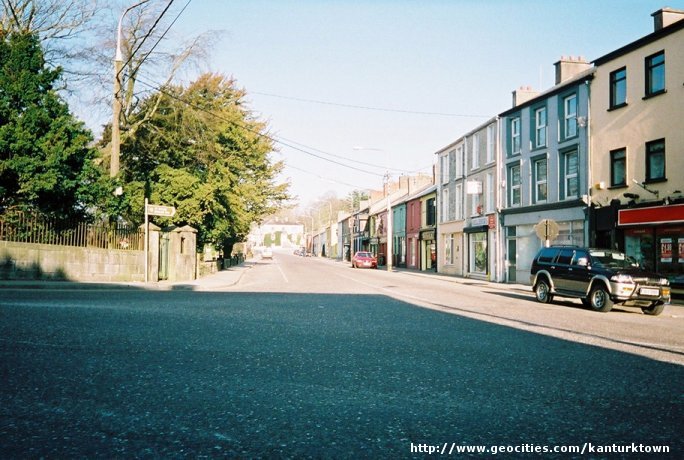
O'Brien street (formaly part of Egmont Place) is an interesting 18th century landlord development; facing the river Dalau, yet it was shut off from it by a plantation which in a normal society would have been a pleasant retreat for the residents. The little plantation was for many years forbidden territory. As the local poet, John C. Deady wrote:
These public walls he has shut with locks
The "he" was Lord Egmont. In 1978 the "retreat" was spoiled by the felling of trees.
The William O'Brien street was originally known as Sraidin(Shradeene) which may indicate that is was the original Irish-speaking settlement here, which grew up around the original Kanturk Castle (situated on the Freemount Road near Bolsters house). Dermot MacOwen MacCarthy got a grant of a fair (on 24 June and the following day) and a Saturday market, on June 6, 1615.
A short street of private houses, Earl Street, and a mordern garage, leads to St. Peters Church. The church itself is situated on high ground among some lovely beech trees. Originally built in 1858 (to replace an older 1792 church in Bluepool), St. peters was acquired in 1977 as a publicmuseum. Not the (three) chancel windows, with borders based on designs from the Book of Kells.
To the west of the church are the outlines of an ancient ringfort, Lios na Marbh, fort of the dead). It is of interest theat in the Nicholson Museum in Sydney, Australia, is a late bronze age gold collar found in the neighbourhood of Kanturk" in 1857 and described as the only specimen of it's kind ever found in Ireland and is dated, provisionally, as c.700 B.C
Church Street is an area of the town which has changed considerably since "Black '47". This is particularly true of the western side of the street. The present Convent primary school is located on the site of the old Parish Charch (1802-1867). On either side of the church there were (in 1840) various houses and dwellings, stretching from what is now he Granary right up to the Courthouse. Between this lins of houses and the eastern side of the street there existed a detached portion and D.C. Dalys was known as Small Chapel Lane which derived from an 18th century Church of St. Mark (c. 1750-1801) of which there is no longer any trace.
Just off Market Square, the street is snmall and narow and leads to Dalua Bridge. Note Fordes house with its upper story projecting window. Bourkes shop and dwelling house, taller than the others adds further variety to the street. About half way, on the right hand side, near Cotters shop, was a large stone slab (since disappeared) inscribed: Welcome Ya All to Ye Old Town Hall.
Noteable personalities of the time, such as John Philpott Curran(1750-1817) and Barry Yelverton (1736-1805) later Viscount Avonmore, were frequent visitors to the Town Hall. Their boyhood and almost lifelong friendship was to be broked in a disagreement about the trial of Lord Edward Fitzgerald and later about the act of Union. In an emotional speech in 1805 before Yelverton, then Chief baron, Curran referred to "those Attic noghts and refections of the gods which we have partaken with those respected and beloved companions who have gone before us; over whose ashes the most precious tears of Ireland have been shed' and went on to recall their youthful days:
We spent them not in toys or lust or wine
But search of Deep philosophy
Wit, eloquence and poesy;
Arts, which i loved, for they, my friend were thine
After the court rose, they met and were reunited with each other.
Strand Street��
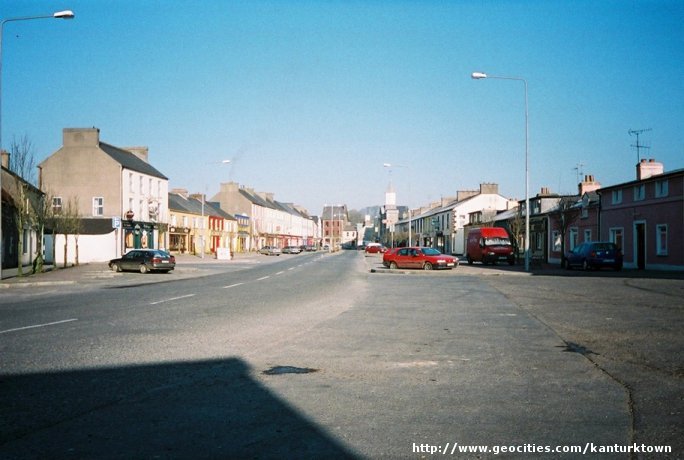
Strand Street is a long, wide thoroughfare, business and shopping area. The shops on the south side were built after the Purcell interest in the demense lands of Kanturk ended in 1864. The street widens to 140ft. at the southern end. The shops on the west side were built in 1864 on what has been the lane of Kanturk House (demolished 1853). The granary for which house was the present clock house (dated 1838 on clockface) which subsequenttly had a varied career as reading rooms and a vacational school.The three private houses to the north of the clockhouse were originally the first national schol in Kanturk.
Strand Street takes its nome from the strand or the bank of the river Dalua the name originally applied to the northern section of the street.
The Clock House 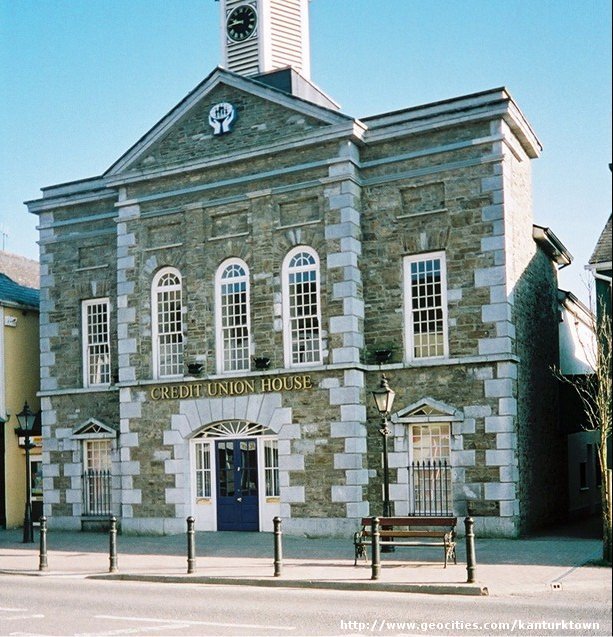 was commerated by Deady:
You see the mansion of great expansion
That soars so proudly o'er the national school
With its Grecian windows and tower so splendid
There lives the town Clock, serene and cool
The merry clock keeper did not always attend to this duties:
But when the clock, sir, goes on the batter
Its wild vagaries would raise your gall
For a 12 p.m. it would oft strike ten
And if far gone in Liquor it won't strike at all.