Southeast Asia...The Philippines
The Republic of the Philippines (Pilipino: Republika �g Pilipinas) is an archipelago consisting of some 7,100 islands and islets lying about 500 miles off the southeast coast of Asia. The total land area of the Philippines is 115,800 square miles (300,000 square kilometres). It is bounded by the Philippine Sea to the east, the Celebes Sea to the south, and the South China Sea to the west and north. The Philippines takes its name from Philip II, who was king of Spain during the Spanish colonization of the islands in the 16th century. Manila is the biggest city and the national capital. It is located on Luzon, the largest island, which has a land area of 40,420 square miles.
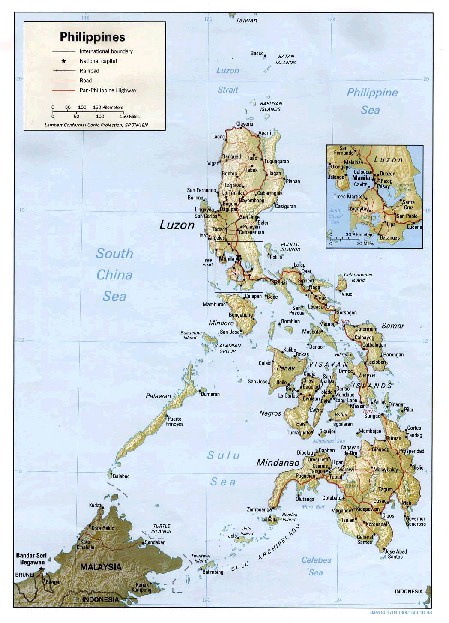
The archipelago spreads out in the form of a triangle, with the islands south of Palawan, the Sulu Archipelago, and the island of Mindanao forming (west-east) its southern base and the Batan Islands, in the north, its apex. The islands stretch for about 1,150 miles (1,850 kilometres) from north to south and for about 700 miles from east to west at their widest extent. Only about two-fifths of the islands and islets have names, and only some 350 have areas of one square mile or more. The large islands fall into three groups: (1) the Luzon group in the north and west, consisting of Luzon, Mindoro, and Palawan; (2) the Visayan group in the centre, consisting of Bohol, Cebu, Leyte, Masbate, Negros, Panay, and Samar; and (3) Mindanao in the south.
Because it was under Spanish rule for 333 years and under U.S. tutelage for a further 48 years, the Philippines has many cultural affinities with the West. It is, for example, the fourth most populous country in which English is an official language and the only predominantly Roman Catholic country in Southeast Asia. Its peoples, however, are Asian in consciousness and in aspiration. In many ways Filipino society is composed of paradoxes, perhaps the most apparent being the great extremes of wealth and poverty in the nation. The Philippines is a country of rich resources, but it is in the process of developing its full potentialities. It is primarily agricultural, although a high degree of domestic and foreign investment has spurred the rapid development of its industrial potential. Educationally, it is among the most advanced of Asian countries, having a high literacy rate.
The climate of the Philippines is divided mainly in two seasons: The Dry Season and The Rainy Season. The cool dry season extends from December to February and is followed by the hot dry season which is from March to May. The rainy season begins in June and continues to November. In Manila, the annual mean temperature is 80 degrees, the January mean is 77 degrees, and the June mean is 82 degrees. The highest recorded temperature is a little over 100 degrees and the lowest a little under 60 degrees. Oscillations in temperature occur more often in points farther north of the equator than they do in points nearer the equator. At high altitudes the temperature is much lower. In the city of Baguio, a summer resort and the summer capital of the country, located at an altitude of about 5,000 feet, the annual mean temperature is 65 degrees, the mean maximum is 77 degrees and the mean minimum is 53 degrees.
The mean annual rainfall varies from less than 40 inches to more than 120 inches. The country is divided into three zones, as far as rainfall is concerned. The first zone covers the places with very definite dry and rainy seasons, mainly the western coast of Northern and Central Luzon, western coasts of Mindoro and Panay and the Calamian Group. The second zone includes the southeastern end of Luzon, the Eastern Visayas, Eastern and Southern Negros and Panay, the eastern and southern coasts of Mindanao and the Jolo Group}.
The typhoon season is generally from July to September although occasionally there have been typhoon as late as November and December and very rarely, in January. These cyclonic winds, (called bagyos locally) cause great destruction to growing crops, shipping and buildings. The more severe winds are accompanied by heavy rains and these flood the streams and the lowlands causing loss of lives and property. Southern Mindanao and the Jolo Group are particularly free from these typhoons which generally originate from the east and southeast of the archipelago and follow a general northwest trend.
100 Years of Philippine Independence

June 12, 1898 - June 12, 1998
back to culture shock