 |
| Plot Synopsis Mexican-born, New York-based filmmaker Alfonso Cuaron directed this Mexican box-office smash hit about a pair of randy upper-class buddies that sparked some controversy for its frank depiction of drug use and sexual exploration. With their respective girlfriends away in Europe, Julio (Gael Garcia Bernal) and his upper-class friend Tenoch (Diego Luna) are looking forward to a summer full of drink, drugs, and cheap meaningless sex. During a wedding, they meet Luisa (Maribel Verdu) - the 28-year-old wife of Tenoch's scholarly cousin - and try to convince her to go on a road trip to Heaven's Mouth, a made-up beach paradise the two claim is on the Oaxacan coast. To their surprise, Luisa - who is looking to escape her troubled life for a spell - agrees to go along. Two days into the trip, tension starts to build between the two friends: Luisa has had sex with each, and now both lads are not-so-quietly vying for her affection. Soon simmering jealousies boil over into savage arguments, threatening to completely destroy their friendship. After an enormously successful run in Mexico and Guatemala, this film was screened to much acclaim at the 2001 Venice, Toronto, and New York Film Festivals. - Jonathan Crow, All Movie Guide Reviews DEREK ARMSTRONG AMG Y Tu Mam� Tambi�n has been casually referred to as a Spanish-language American Pie, perhaps because both films include footage of taboo body fluids floating in liquids they don't usually call home - a swimming pool here, a beer there. But that comparison doesn't nearly do justice to Alfonso Cuaron's bold, sexually explicit yet artistically justified coming-of-age piece, which climbs outside the box at every turn. More generous films to associate it with are Run Lola Run and Amelie; both share Mam�'s curiosity about the interrelationship of seemingly unlike people and places, and contemplate the pasts and futures of bit players in a manner that seems essential, not superfluous. Yet it's not as glossy as those films, either. Mam� retains a documentary-style realism that's less dependant on set pieces, preferring the messy yet basically benign continuum of life. Mam�'s illuminating narration is never intrusive, even though it cuts off the soundtrack in a way that sounds like abrupt speaker failure; it contextualizes the action while leaving the deeper profundities to the viewer's own thoughts. Cuaron's fascinating decisions are as regular as the free-flowing bull sessions so naturally performed by lead actors Diego Luna and Gael Garcia Bernal in and around Mexico City, and on their road trip to self-discovery. Cuaron, seeming more comfortable in his element than in a Hollywood release like the Gwyneth Paltrow vehicle Great Expectations, challenges the actors' talents in a handful of takes that last minutes on end, many of which include the camera moving seamlessly through the environment. Even with all these accomplishments, it's still as funny and as titillating as anything out there - maybe because it doesn't have to try so hard to do either. ROGER EBERT Chicago Sun-Times "Y Tu Mama Tambien" is described on its Web site as a "teen drama," which is like describing "Moulin Rouge" as a musical. The description is technically true but sidesteps all of the reasons to see the movie. Yes, it's about two teenage boys and an impulsive journey with an older woman that involves sexual discoveries. But it is also about the two Mexicos. And it is about the fragility of life and the finality of death. Beneath the carefree road movie that the movie is happy to advertise is a more serious level--and below that, a dead serious level. The movie, whose title translates as "And Your Mama, Too," is another trumpet blast that there may be a New Mexican Cinema a-bornin'. Like "Amores Perros," which also stars Gael Garcia Bernal, it is an exuberant exercise in interlocking stories. But these interlock not in space and time, but in what is revealed, what is concealed, and in the parallel world of poverty through which the rich characters move. The surface is described in a flash: Two Mexican teenagers named Tenoch and Julio, one from a rich family, one middle class, are free for the summer when their girlfriends go to Europe. At a wedding they meet Luisa, 10 years older, the wife of a distant cousin; she's sexy and playful. They suggest a weekend trip to the legendary beach named Heaven's Mouth. When her husband cheats on her, she unexpectedly agrees, and they set out together on a lark. This level could have been conventional but is anything but, as directed by Alfonso Cuaron, who co-wrote the screenplay with his brother Carlos. Luisa kids them about their sex lives in a lighthearted but tenacious way, until they have few secrets left, and at the same time she teases them with erotic possibilities. The movie is realistic about sex, which is to say, franker and healthier than the smutty evasions forced on American movies by the R rating. We feel a shock of recognition: This is what real people do and how they do it, sexually, and the MPAA has perverted a generation of American movies into puerile masturbatory snickering. Whether Luisa will have sex with one or both of her new friends is not for me to reveal. More to the point is what she wants to teach them, which is that men and women learn to share sex as a treasure they must carry together without something spilling--that women are not prizes, conquests or targets, but the other half of a precarious unity. This is news to the boys, who are obsessed with orgasms (needless to say, their own). The progress of that story provides the surface arc of the movie. Next to it, in a kind of parallel world, is the Mexico they are driving through. They pass police checkpoints, see drug busts and traffic accidents, drive past shanty towns, and are stopped at a roadblock of flowers by villagers demanding a donation for their queen--a girl in bridal white, representing the Virgin. "You have a beautiful queen," Luisa tells them. Yes, but the roadblock is genteel extortion. The queen has a sizable court that quietly hints a donation is in order. At times during this journey the soundtrack goes silent and we hear a narrator who comments from outside the action, pointing out the village where Tenoch's nanny was born and left at 13 to seek work. Or a stretch of road where, two years earlier, there was a deadly accident. The narration and the roadside images are a reminder that in Mexico and many other countries a prosperous economy has left an uneducated and penniless peasantry behind. They arrive at the beach. They are greeted by a fisherman and his family, who have lived here for four generations, sell them fried fish, rent them a place to stay. This is an unspoiled paradise. (The narrator informs us the beach will be purchased for a tourist hotel, and the fisherman will abandon his way of life, go to the city in search of a job and finally come back here to work as a janitor.) Here the sexual intrigues which have been developing all along will find their conclusion. Beneath these two levels (the coming-of-age journey, the two Mexicos) is hidden a third. I will say nothing about it, except to observe there are only two shots in the entire movie that reflect the inner reality of one of the characters. At the end, finally knowing everything, you think back through the film--or, as I was able to do, see it again. Alfonso Cuaron is Mexican but his second and third features were big-budget American films. I thought "Great Expectations" (1998), with Ethan Hawke, Gwyneth Paltrow and Anne Bancroft, brought a freshness and visual excitement to the updated story. I liked "A Little Princess" (1995) even more. It is clear Cuaron is a gifted director, and here he does his best work to date. Why did he return to Mexico to make it? Because he has something to say about Mexico, obviously, and also because Jack Valenti and the MPAA have made it impossible for a movie like this to be produced in America. It is a perfect illustration of the need for a workable adult rating: too mature, thoughtful and frank for the R, but not in any sense pornographic. Why do serious film people not rise up in rage and tear down the rating system that infantilizes their work? The key performance is by Maribel Verdu as Luisa. She is the engine that drives every scene she's in, as she teases, quizzes, analyzes and lectures the boys, as if impatient with the task of turning them into beings fit to associate with an adult woman. In a sense she fills the standard role of the sexy older woman, so familiar from countless Hollywood comedies, but her character is so much more than that--wiser, sexier, more complex, happier, sadder. It is true, as some critics have observed, that "Y Tu Mama" is one of those movies where "after that summer, nothing would ever be the same again." Yes, but it redefines "nothing." MARK CARO Chicago Tribune Alfonso Cuaron's "Y Tu Mama Tambien" is raunchy, smart, ebullient, melancholy, insightful, surprising, funny, frank and sexy as all get-out. Rarely in recent years has the big screen felt so alive. In outline this Mexican feature is a teen road movie, but in execution it's a completely different species from the dumbed-down, crassed-up American teen comedies that have been defining the genre in recent years. Although Tenoch (Diego Luna) and Julio (Gael Garcia Bernal, the pale-eyed, dog-fighting romantic of "Amores Perros") are as testosterone-filled as any of their American counterparts, the movie doesn't view their coming of age as a smutty joke but rather as a natural part of life. If your sensibilities are offended by the explicit depiction of 17-year-old boys' sexual activities - as well as their drinking and pot-smoking - consider yourself forewarned. For the rest of us, "Y Tu Mama" is exhilarating in the candor and humor with which it explores an intense male friendship, one set against the specific backdrop of 1990s Mexico at the tail end of the ruling party's uncontested reign. The movie opens in Mexico City with both friends partaking in frenzied last grasps with their respective girlfriends before the girls depart together on a European vacation. These couples enjoy the rushed love of the young, extracting desperate promises of fidelity from one another even though, once they're at the airport, the guys can't wait for the girls' plane to take off. Tenoch is the "preppie" but not in any stereotypical way: His hair is in a ragged bowl cut, and he slouches and mumbles, yet as the son of a rich, corrupt politician, he carries himself with an authority not shared by Julio, who's always bumming Tenoch's cigarettes. Their friendship, defined in part by a shared "manifesto" of rules, is one in which they don't acknowledge, yet ultimately can't escape, the differences between them. The pair find a purpose for their aimless summer after meeting Luisa (Maribel Verdu), a spindly beauty married to one of Tenoch's distant cousins, and impulsively inviting her on a road trip to an idyllic - and imaginary - beach they call Boca del Cielo ("Heaven's Mouth"). To their surprise, Luisa, who's about 10 years their elder, takes them up on the offer. Already a record-breaking hit in Mexico, "Y Tu Mama" represents a stylistic about-face from Cuaron's previous two movies: the wonderful "A Little Princess" (1995), in which the highly stylized production design enhanced the film's potent emotions, and the less successful "Great Expectations" (1998), in which the production design upstaged the story. With "Y Tu Mama Tambien" (the title means "And Your Mother, Too," an insult in a game of one-upsmanship), Cuaron and his longtime cinematographer, Emmanuel Lubezki ("Ali"), are less concerned with the color palettes of the backgrounds than the naturalness of the settings and performances. The movie feels shot on the fly, with much handheld camerawork and many long, unbroken takes. The relative lack of cutting adds to the sense of intimacy: Scenes of lovemaking and conflict take place in real time, and at times you feel almost embarrassed to be sharing the same room with the characters. Yet despite the loose vibe, Cuaron, who wrote the screenplay with his brother Carlos, has taken great care with the details. Almost every plot point and piece of dialogue has an eventual payoff, and the movie is packed with indelible images: Julio and Tenoch, at a tense moment, swimming underwater in a leaf-filled pool; Luisa dancing seductively toward the camera; various trysts that manage to be both erotic and hilarious. The dynamic of two young men in the thrall of a more worldly woman recalls Francois Truffaut's "Jules and Jim" (1962), and Cuaron has taken other inspiration from the French New Wave as well, particularly in the sheer filmmaking verve. But "Y Tu Mama" is anything but backward-looking. Like "Jules and Jim," the film features an omniscient narrator, but Cuaron finds a new way to employ this device: The moment before the narrator begins speaking, the rest of the soundtrack goes completely silent, an effect so startling that the first few times you think the projector has gone on the fritz. The narration, with its matter-of-fact pronouncements about the characters and political backdrop, seems to float outside of time and place, as if the Earth's spinning has been halted for a cosmic update from the Almighty. The film's breezy surface is deceptive. The movie catches Julio and Tenoch when they're still carrying out their escapades from inside a youthful bubble, but the real world is looming closer and closer, whether in the trucks of soldiers they pass on the road or just their having to define themselves as adults. The overall sense of exuberance is balanced by what the boys - and nation - are losing over time. A second viewing of the movie reveals how certain somber plot turns are telegraphed the whole way through. Little of this would work without such spot-on performances: Luna and Bernal capturing not only Tenoch and Julio's energy but also their incomprehension over the complicated feelings being stirred up; Verdu bringing just the right exotic, out-of-reach quality to the otherwise warm Luisa, a woman among boys. The guys make all the noise, but she's in control. With last year's "Amores Perros," Mexico has produced two of the most exciting movies of the past two years. The films have different pedigrees: "Perros" was the first film from commercials director Alejandro Gonzalez Inarritu, while the veteran Cuaron has been based in New York City for years. "Y Tu Mama" may dig deeper into emotions, but both films communicate a joy of cinematic storytelling - one that we should be only too happy to share. Awards 2001 -Berlin Film Festival Best Screenplay (win) -Alfonso Cuar�n Best Young Actor or Actress (win) -Diego Luna Best Young Actor or Actress (win) -Gael Garc�a Bernal 2002 Academy Best Original Screenplay (nom) -Alfonso Cuar�n Other Awards Screen International European Film Award (nom) - -2001 -European Film Academy Best Foreign Language Film (nom) - -2001 -Golden Globes Best Foreign Film (nom) - -2002 -Broadcast Film Critics Association Best Foreign Film (nom) - -2002 -IFP Independent Spirit Award Best Foreign Film (win) - -2002 -L.A. Film Critics Association #2 Foreign Film of the Year (win) - -2002 -National Board of Review Best Foreign Film (win) - -2002 -National Society of Film Critics Best Picture (Runner-up) (win) - -2002 -National Society of Film Critics Best Foreign Film (win) - -2002 -New York Film Critics Circle |
 |
 |
 |
 |
|
|
 |
 |
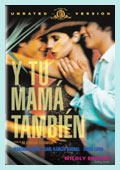
| Y TU MAMA TAMBIEN 2001 - Mexico - 105 min. - Feature, Color AKA -And Your Mother Too Director -Alfonso Cuar�n |
| Genre/Type -Sex Comedy, Road Movie, Coming-of-Age, Comedy Drama Flags -Adult Humor, Nudity, Profanity, Strong Sexual Content, Drug Content MPAA Rating -NR Keywords -friendship, jealousy, love-triangle, Mexico, road-trip, sexual-awakening, teenagers, class-system, coming-of-age, summer-vacation Themes -Class Differences, Faltering Friendships, Love Triangles, Voyage of Self-Discovery, Age Disparity Romance Tones -Sexy, Witty, Compassionate, Humorous, Irreverent, Earthy, Bittersweet Set In -Mexico City, Mexico, Oaxaca, Mexico, on the road Sound by -Dolby Digital Produced by -Besame Mucho Pictures / Good Machine / Producciones Anhelo Release -Mar 15, 2002 (USA- Limited) Released by -20th Century Fox / IFC Films Cast Maribel Verdu -- Luisa Cortes Gael Garc�a Bernal -- Julio Zapata Diego Luna -- Tenoch Iturbide Diana Bracho -- Silvia Allende de Iturbide Emilio Echeverria -- Miguel Iturbide Veronica Langer -- Mar�a Eugenia Calles de Huerta Arturo Rios -- Esteban Morelos Martha Aura -- Enriqueta 'Queta' Allende Daniel Gimenez Cacho - Narrator |
|
 |
 |
 |
 |
|
 |
|
 |