 |
| Plot Synopsis Mexican-born, New York-based filmmaker Alfonso Cuaron directed this Mexican box-office smash hit about a pair of randy upper-class buddies that sparked some controversy for its frank depiction of drug use and sexual exploration. With their respective girlfriends away in Europe, Julio (Gael Garcia Bernal) and his upper-class friend Tenoch (Diego Luna) are looking forward to a summer full of drink, drugs, and cheap meaningless sex. During a wedding, they meet Luisa (Maribel Verdu) - the 28-year-old wife of Tenoch's scholarly cousin - and try to convince her to go on a road trip to Heaven's Mouth, a made-up beach paradise the two claim is on the Oaxacan coast. To their surprise, Luisa - who is looking to escape her troubled life for a spell - agrees to go along. Two days into the trip, tension starts to build between the two friends: Luisa has had sex with each, and now both lads are not-so-quietly vying for her affection. Soon simmering jealousies boil over into savage arguments, threatening to completely destroy their friendship. After an enormously successful run in Mexico and Guatemala, this film was screened to much acclaim at the 2001 Venice, Toronto, and New York Film Festivals. - Jonathan Crow, All Movie Guide Reviews LUCIA BOZZOLA AMG High Production Values, High Artistic Quality Ang Lee's breakthrough film, The Wedding Banquet puts a different, multicultural spin on family and romantic comedy with winning results. Taking a low-key approach to a set-up that is potentially the stuff of slapstick farce, Lee still finds the humor as the intended marriage of convenience between a gay Taiwanese immigrant in New York and an infatuated female tenant in need of a green card is thrown into chaos by the arrival of the groom's proud parents. The elaborately staged eponymous party becomes a comically tense drunken mess, but the characters' underlying expectations and dashed hopes ultimately render The Wedding Banquet a subtle and sensitive study of Chinese cultural pressures (even on far-flown expatriates) and the ingrained homophobia that makes the burden of tradition even heavier. A film festival success and critical darling, The Wedding Banquet became an art house hit, and the New York-based Lee's first Best Foreign Film Oscar nomination. PERRY SEIBERT AMG DVD Review Ang Lee's charming comedy The Wedding Banquet arrives on DVD with a widescreen transfer that preserves the original theatrical aspect ratio of 1.85:1. English and Mandarin soundtracks are rendered in Dolby Digital Mono. English, French, and Spanish subtitles are accessible. Supplemental materials include a making-of featurette starring the director and his longtime production partner James Schamus. The original theatrical trailer rounds out this fine release from MGM/UA. JAMES BERARDINELLI Wai-Tung (Winston Chao) has a problem. Living in New York with a well-paying job, a nice home, and a stable relationship (with Simon, played by Mitchell Lichtenstein), everything appears to be going his way. But his parents, unaware of his homosexual proclivities, are expecting a marriage and grandchildren, and Wai hasn't been able to get up the courage to tell them that he's gay. Meanwhile, Wei Wei (May Chin), a tenant in a building owned by Wai, has to find a way to obtain a green card or be deported. A solution to both problems is proposed: a marriage of convenience. Once agreed to by both parties, the arrangements are made, and everything seems to be working out well until Wai's parents arrive from China to plan the wedding banquet. What at first seems like a simple romantic comedy is actually a deceptively perceptive look at cultural, sexual, and generational differences. And, despite The Wedding Banquet's often-light, occasionally-playful tone, a forceful dramatic structure underlies the film. Of course, this is what usually makes for the best kind of comedy -- a movie that cares more about its story and characters than making people laugh. Chinese-American writer/director/producer Ang Lee displays a remarkable aptitude for presenting a balanced view of issues while avoiding the dangerous trap of cliches and stereotypes. All the characters have their own unique identities. While there isn't anything revolutionary in the story, and some of the "twists" are easy to predict, it's never clear until the end how everything is going to be resolved. And, although it deals with potentially-weighty issues and some very powerful emotional impulses, The Wedding Banquet never becomes bogged down by its own seriousness. Lee manages to keep the production buoyant by including scenes that are often riotously funny. The actors are uniformly good. May Chin, a huge pop star in Taiwan, gives a complex rendering of Wei Wei, conveying the churning emotions of the one person in this film who really has no one. Although this is his screen debut, Winston Chao doesn't show any obvious chinks in his performance. Mitchell Lichtenstein's Simon could easily have slipped into obscurity, but the actor maintains a strong enough presence to avoid such an ignominious fate. Stately and dignified, Sihung Lung and Ah-Leh Gua breathe life into Mr. and Mrs. Gao, Wai's parents. It's understandable why The Wedding Banquet won the Golden Bear award at the 1993 Berlin Film Festival and the Best Film and Best Director citations at the 1993 Seattle International Film Festival. There is enough depth in this picture to fill up several movies, yet The Wedding Banquet shortchanges none of its interwoven storylines. While I won't go so far as to say that this is a magical motion picture, it certainly serves as excellent entertainment on more than one level. � 1993 James Berardinelli ROGER EBERT August 27, 1993 To the degree that one can fashion a life that is completely satisfying, Wai-Tung believes he has done so. A young Chinese man from Taiwan, gay, in his late 20s, he lives with his American companion Simon in a comfortable brownstone in New York, and manages some loft buildings he has purchased. All is well - except for the letters and phone calls from his parents, who wonder, with increasing urgency, when he is going to marry a nice Chinese girl and present them with a grandchild. They do not guess he is homosexual. Nor can he bring himself to tell them. One day his friend Simon devises an ingenious plan to make everyone happy. In one of Wai-Tung's lofts there lives a young Chinese woman, Wei-Wei, an artist who can cannot pay her rent. In despair she plans to return to China. She likes Wai-Tung very much. Why, asks Simon, shouldn't Wai-Tung marry Wei-Wei - providing her with a green card to allow her to stay in America, while at the same time placating his far-away parents? Wai-Tung, in desperation and optimism, seizes upon this scheme. Wei-Wei is persuaded to go along. And then all of their neatly made plans go astray when Wai-Tung's parents announce they will travel from Taiwan for the wedding. We are now, we sense, entering "La Cage aux Folles" country, and "The Wedding Banquet" does take some of the same delight in constructing a comedy of misunderstandings and deceptions. But the movie also has a warm heart, and by the end somehow manages to become very moving. The director, Ang Lee, approaches his material in a low-key way, not punching up the big dramatic or comic moments. And the actors, especially Winston Chao as Wai-Tung, have a curious fatalism about them, as if their characters are resigned to the worst. There are moments of obvious comedy, such as when the parents subscribe to a matchmaking service for their son, who specifies he requires a very tall opera singer, only to find that the service can supply one. But there are more moments when the film deals simply and directly with the feelings and fears of its characters. For Wei-Wei (May Chin), the pretend marriage with Wai-Tung makes good sense, but is also painful, because she has a crush on him and would like to be married to him for real. For Wai-Tung, the whole charade is uncomfortable, because dishonest. And for Simon (Mitchell Lichtenstein), his American boyfriend, what starts as a lark ends painfully, as he hangs around the outskirts of the wedding, his omnipresence never quite explained. The father and mother (Sihung Lung and Ah-Leh Gua) arrive with shining eyes, but cannot fail to sense a certain lack of sincerity between the loving couple. A wedding by a justice of the peace does not match their vision of a suitable ceremony. And then an old friend of the father's materializes, now a successful restaurant owner, and offers to stage a proper Chinese wedding banquet. The banquet is the movie's great set piece, as booze and tradition and deception and expectation all come together, and lead, in an unlikely way, to happiness. "The Wedding Banquet" is not a particularly slick film; the plot construction feels contrived, and the acting of the two younger men is somewhat self-conscious, although the parents are magnificent. What makes the film work is the underlying validity of the story, the way the filmmakers don't simply go for melodrama and laughs, but pay these characters their due. At the end of the film, I was a little surprised how much I cared for them. Awards Best Foreign Language Film (nom) - -1993 Academy Golden Bear (win) - -1993 Berlin International Film Festival Best Foreign-Language Film (nom) - -1993 Golden Globe |
 |
 |
 |
 |
|
|
 |
 |
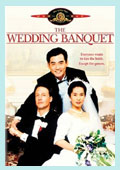
| THE WEDDING BANQUET 1993 - Taiwan - 111 min. - Feature, Color AKA -Hsi Yen Xiyan Director -Ang Lee |
| Genre/Type -Comedy Drama, Romantic Comedy, Gay & Lesbian Films Flags -Not For Children, Nudity, Adult Situations, Strong Sexual Content MPAA Rating -R Keywords -banquet, ceremony, deception, family, generation-gap, green-card, homosexual, wedding, Asian-American,cultural-traditions, immigrant Themes -Marriages of Convenience, Culture Clash, Wedding Bells, Otherwise Engaged Tones -Witty, Poignant, Literate, Humorous, Quirky, Understated Box office -$6.234 million Color type -Duart Produced by -Central Motion Picture Corporation / Good Machine DVD Street Date -Jun 15, 2004 Languages -English, MANDARIN Subtitles -English, French, Spanish Screen Formats -Letterbox for 16x9 TVs Sound -Dolby Digital Mono Aspect Ratio -1.85:1 (DVD) Studio -MGM Home Entertainment Cast Winston Chao -- Wai Tung May Chin -- Wei-Wei Mitchell Lichtenstein -- Simon Sihung Lung -- Mr. Gao Ah-Leh Gua -- Mrs. Gao Neal Huff -- Steve Michael Gaston -- Justice of the Peace Mason Lee -- Child Jumping on Bed (uncredited) Jeffrey Howard -- Street Musician John Nathan -- Joe Patricia Sullivan -- Mariane Ang Lee -- Wedding Guest |
|
 |
|
 |
|
|
 |
 |
 |