 |
 |
 |
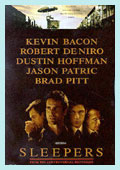
| SLEEPERS 1996 - USA - 152 min. - Feature, Made for TV, Color Director - Barry Levinson |
| Genre / Type - Drama, Crime, Crime Drama, Courtroom Drama, Buddy Film Flags - Not For Children, Adult Situations, Strong Sexual Content, Graphic Violence Keywords - abuse, lawyer, revenge, friendship, guard, priest, reformatory, reporter, murder-trial, sexual-abuse, sexual-assault Themes - Haunted By the Past, Righting the Wronged, Whistleblowers, Inner City Blues Tones - Disturbing, Bleak, Grim, Gritty, Melancholy, Menacing, Reflective DVD Street Date - Apr 1, 1997 Languages - English Subtitles - French/English/Spanish Screen Format - Widescreen Sound - Dolby Digital 5.1 Aspect Ratio - 2.35:1 (Original) 2.35:1 (DVD) Studio - Warner Home Video Cast Kevin Bacon - Sean Nokes Robert De Niro - Father Bobby Dustin Hoffman - Danny Snyder Billy Crudup - Tommy Marcano Bruce "Bruno" Kirby, Jr. - Shakes' Father Jason Patric - Lorenzo, a.k.a. Shakes Vittorio Gassman - King Benny Brad Pitt - Michael Minnie Driver - Carol Ron Eldard - John Brad Renfro - Young Michael Sullivan Wendell Pierce - Little Caesar Aida Turturro - Mrs Salinas Terry Kinney - Ferguson John Slattery - Fred Carlson Joe Urla - Carson Joe Perrino - Young Shakes |
| Plot Synopsis Barry Levinson directed this crime drama based on a controversial bestseller. Jason Patrick stars as Lorenzo, a New York reporter more commonly called "Shakes," a nickname courtesy of his three childhood pals from Hell's Kitchen - Michael (Brad Pitt), John (Ron Eldard), and Tommy (Billy Crudup). As kids, all four were sent to reform school after accidentally killing someone during a cruel prank. There, the boys were raped and beaten by several guards, including Sean Nokes (Kevin Bacon), a fact that they've kept secret into adulthood. Michael is now a rising star in the district attorney's office, while John and Tommy are founders of the Irish gang the Westies. When Nokes walks into John and Tommy's hangout, they kill him in cold blood and go on trial, defended by a drug-addicted lawyer (Dustin Hoffman). Michael and Shakes conspire with childhood friend Carol (Minnie Driver) and local priest Father Bobby (Robert DeNiro) to free their friends and get even with the surviving guards. Based on a true story chronicled by Lorenzo Carcaterra in his novel of the same name, Sleepers stirred controversy when the veracity of the book was challenged by reporters who could find no documentation of the events described. - Karl Williams, All Movie Guide Reviews James Berardinelli, Reelviews |
| Robert DeNiro. Dustin Hoffman. Brad Pitt. Jason Patric. Kevin Bacon. Minnie Driver. With a talented cast like this, it's virtually impossible to envision a bad movie, and, in that regard, Sleepers doesn't surprise or disappoint. This is easily Barry Levinson's best effort of the decade, and it helps to erase the bad taste left by his early-'90s mega-flops Toys and Jimmy Hollywood. Despite protests from the Catholic Church (which whines about any movie that portrays priests as anything less-than-pure), Sleepers, which represents two and one- half hours of gripping entertainment, is well worth the price of admission. The movie is about revenge and redemption, and how, in America's darkest social corridors and backalleys, the two can be inextricably linked. It's also a condemnation of a criminal justice system that allows innocence to be callously destroyed. Yet, even though Sleepers is basically a vigilante motion picture, it exists on a much higher plane than something like Death Wish, which offers a least common denominator, visceral satisfaction. There's little thrill in watching the vengeance extracted by the protagonists of this film because Sleepers approaches its subject with a conscience. The movie's moral compass is Robert DeNiro's Father Bobby, a Catholic priest who recognizes that friendship and loyalty can require sacrifices of the soul, but who doesn't tread lightly across the line separating what's legally correct from what's ethically mandated. In fact, Father Bobby's dilemma is arguably the most compelling aspect of Sleepers' second half. The film's sluggish final hour is its weakest portion, but there's still enough there to maintain audience interest. We've spent a long time with these characters, and we're not about to abandon them because Levinson doesn't move things as smoothly to the climax as we might prefer. Sleepers, which may or may not be based on a true story (the author of the novel, Lorenzo Carcaterra, isn't doing interviews these days), spans fifteen years. Much of the action transpires in New York's Hell's Kitchen, which stretches from 34th to 56th Street west of 8th Avenue to the Hudson River. During the film's era, the neighborhood was ruled by two vastly different powers: the mob (represented by gangster King Benny, played by Vittorio Gassman) and the Catholic Church (represented by Father Bobby). Every child learned to respect both, and live by a simple creed: never commit a crime against someone else in the neighborhood. Such offenses were not permitted; the people of Hell's Kitchen looked after one another. The film opens in 1966 by introducing us to four inseparable friends: Lorenzo (Joseph Perrino), Michael (Brad Renfro), John (Geoffrey Wigdor), and Tommy (Jonathan Tucker). Like most boys, they're curious about sex, enjoy playing stickball, and have an appetite for pranks. One such practical joke, gone horribly wrong, changes their lives. When their theft of a hot dog vendor's cart nearly causes a man's death, Lorenzo and his friends are found guilty of reckless endangerment and sent to the Wilkinson Reform School. There, under the watchful eye of a sadistic guard named Sean Nokes (Kevin Bacon), they are subjected to mental, physical, and sexual abuse. Although their sentences are only for a year, those twelve months fundamentally alter their personalities. When we next meet them, in 1981, their lives have moved on, but the submerged hatred lingers. Lorenzo (now played by Jason Patric) is an aspiring reporter working for the New York Daily News. Michael (Brad Pitt) is an attorney in the D.A.'s office. John (Ron Eldard) and Tommy (Billy Crudup) are hardened criminals. All four are forced to confront their shared past when John and Tommy encounter Nokes in a restaurant. Their actions provide the catalyst for a plan that Michael devises to bring the entire Wilkinson experience into the open. So, with the help of Lorenzo; John's lover, Carol (Minnie Driver); and a burned-out lawyer (Dustin Hoffman), Michael strives to attain redemption and revenge for them all. Sleepers' provocative script is marred only by an unnecessarily verbose voiceover narrative and the protracted final third. One of the most fascinating aspects of the movie is watching how the law can be manipulated to deliver justice in a manner that was never intended. And, while Michael's scheme may be a little too convoluted to be plausible, it's nevertheless entertaining to watch the pieces fall into place. Then there's Father Bobby's dilemma, which, in some ways, echoes the one agonized over by the protagonist of Antonia Bird's Priest. At what point do the demands of basic humanity take precedence over the oaths and responsibilities of the Cloth? Much of this struggle is not played out in words, but in Bobby's face, and, with an actor of lesser ability than DeNiro, the emotional resonance of the internal war could have been lost. DeNiro isn't the only one to turn in a powerful performance. Sleepers is as well-acted as it is deftly-crafted. There are those who may be disconcerted by the intensity of the reform school scenes (nothing overly graphic is shown, but much is implied). Levinson takes us through every phase of the boys' torture so that, when the time comes, we can understand and sympathize with their need to emulate the hero of their favorite book, The Count of Monte Cristo, and exact decisive retribution. As Sleepers opens in theaters, members of the media are trying to determine how much of this film is grounded in reality. Ultimately, however, it doesn't make much difference whether the events of Sleepers happened or not. The themes and messages are no less valid either way, and, even if it isn't a true story, events like these could have transpired. Fact or fiction, this is a memorable motion picture. Rob Blackwelder, Splicedwire |
"Sleepers" is a movie of exacting and meticulous revenge. Revenge movies are a simple lot -- all audiences usually need is an appeal to the right instincts, anger and empathy, and they will play along. But "Sleepers," about four men from Hell's Kitchen who avenge their boyhood loss of innocence at the hands of reform school guards, goes far beyond a simple formula. It explores whole lives, capturing terror, shame, vulnerability and the burning, fleeting satisfaction of retribution. And it leaves it's audience speechless. Adapted by director Barry Levinson ("Bugsy," "Rain Man"), "Sleepers" opens in a perfectly-rendered 1966 with a tour of the rough lives the four men lead as children. Complete with domestic violence and petty crime these kids have one roll model -- Father Bobby, a unorthodox, street smart priest played by Robert De Niro -- who tries to steer them straight against the odds. On a hot, still, city day, childhood mischief turns deadly when the boys steal a hot dog cart and push it down a subway stairwell, killing a man and trading whatever security they had in their unstable world for a turn in the clink. But the sympathy card isn't played until they are beaten and sexually assaulted by a group of prison guards lead by Kevin Bacon, in a paticularly creepy performance. The assaults are brief, handled on the screen emotionally rather than visually, and driving home the point without being offensively graphic. Fifteen years later, two of the boys, now gang toughs, come across former guard Bacon in a bar and revert to their scared younger selves before mustering the anger to kill him on the spot. The vulnerability that comes out in the faces of these hardened men is one of the strongest images in "Sleepers" and strikes at the kind of depth and attention to character that drives this film. The rest of "Sleepers" is a complex and risky conspiracy, with one of the four boys who is now an assistant district attorney (Brad Pitt) prosecuting his old chums while at the same time secretly plotting not only their acquittal but vengeance on every guard that hurt them at that school so many years before. Narrated by Jason Patric ("Rush"), as the only member of the foursome who has come to terms with his past, the audience is guided through a maze of well-mapped twists that turn the trial into an indictment against the abusive guards they were forced to tolerate as delinquent prisoners. "Sleepers" is so complex that describing it hardly leaves room to argue it's technical merits and it's bounty of memorable performances. Suffice to say "Sleepers" will be swimming in Oscar nominations. De Niro will likely geta nod, paticularly for the scene in which Father Bobby is asked to provide a false alibi for the killers after being told the whole story of the injustices they suffered at the reform school. The scene has only muted dialogue, and is mostly close-ups of De Niro's reactions to the horrors he is hearing. Dustin Hoffman, who relishes his role as the older boys drunkard defense lawyer, is another probable nominee. Director of photography Michael Ballhaus is certainly Oscar-bound. Resplendent with shadowy black and white flashbacks (in one scene a memory is projected on a character's hands as he cries -- a brilliant visual stroke) and bold shots of the younger boys' faces super-imposed on the older men, the visuals serve to highlight the dizzying emotions delivered throughout "Sleepers." And while Brad Pitt probably isn't a contender, he certainly has another performance he can point to when accused of being nothing but a pretty face. In its last few minutes of "Sleepers" one character is conspicuously missing, and it will nag at you when the credits roll. But in perspective this is a minor infraction in what is thus far the paragon movie of 1996. |
|
 |
 |
|
 |
 |
 |
 |
 |
 |
 |
 |
 |