 |
| Plot Synopsis John Cameron Mitchell, who created a cult sensation as writer and director of Hedwig and the Angry Inch, blazes a brave new trail with this comedy-drama which combines the stories of a handful of emotionally unsatisfied New Yorkers with some of the most explicit sexual material to ever appear in a mainstream motion picture. Sofia (Sook-Yin Lee) is a couples' therapist who has a major relationship problem of her own - she's never had an orgasm, and her husband Rob (Raphael Barker) doesn't seem capable of giving her one. Sophia's clients include James and Jamie (Paul Dawson and PJ DeBoy), a gay couple who have been together for five years and are beginning to grow tired of one another. As James and Jamie discuss the possibility of bringing another man into the bedroom, Sophia accidentally mentions her problem, and they tell her of an upcoming "Shortbus Party," a sexual free-for-all in which straight, gay, and lesbian couples are all welcome to either talk about sex or take a more active role in the main ballroom. As James and Jamie hook up with Ceth (Jay Brannan) for some mutually satisfying action at the bash, Sophia experiments with Sapphic diversions, and begins to truly find herself when she encounters Severin (Lindsay Beamish), a professional dominatrix. However, while Sophia begins to find what she needs with Severin, she discovers that while Severin is able to casually enter into a sexual relationship, she's never been able to emotionally commit herself to someone else. Shortbus was screened in competition at the 2006 Toronto Film Festival. Reviews Mark Bourne DVDJournal.com First, let's say what Shortbus is. Directed by John Cameron Mitchell (Hedwig and the Angry Inch), Shortbus is a modestly budgeted indie romantic comedy-drama. It played the metropolitan and festival circuits in 2006, premiering at Cannes and headlining at the Toronto Film Festival, the 50th annual London Film Festival, and so on. It's an Altmanesque study of interweaving New Yorkers who are dealing with their emotional isolation and their need for support and interaction. ("...in post-9/11 America," adds the already clich� clip-on descriptor. Shortbus does tilt in that direction, especially in its opening scene overlooking Ground Zero, but as usual there's little here that wasn't true pre-9/11 too.) It is engagingly crafted with a pleasing ensemble of newbie actors. It's an observant little rom-com about relationships - relationships with long-time partners, new encounters, and with oneself. It is charming, soft-spoken, and often quite funny. Now, what Shortbus is not. It is not "art-house porn." It's not pornographic in any sleazy sense. That's important to note about a film that integrates scenes of authentic, explicit, see-it-all, holy smokes, "WTF?!", non-simulated sex. That sex springs from copious points across the adjust-to-fit sexuality continuum: het and gay and bi, married and un-, kinky and kinkless, electrically aided, solo, duo, trio, and orchestral. We witness more tattoos than taboos here. These sex scenes aim not to arouse, but to simply be. To be truthful, friendly, romantic, honest, joyful, and purposeful. Shortbus is not "shocking" for shock's sake, although some initial discomfort is part of Mitchell's benignly subversive contract with us; its payoff comes the moment we notice that the discomfort evaporates under the light of the film's more disarming sensibilities. Shortbus is not, above all, "dirty." What it is, in fact, is a nice movie, one of the nicest to come down the pike since March of the Penguins. Pulling together Shortbus' multiple threads is Sophia (Sook-Yin Lee), a happily married sex therapist ("I prefer 'couples counselor'") who has never herself experienced an orgasm. A monogamous gay couple come to her as clients, Jamie (PJ DeBoy) and James (Paul Dawson). James wants to bring other men into their relationship, although his own depression points to a tragic ulterior motive. They invite Sofia to Shortbus, a "salon for the gifted and challenged" where adults of all ages and sexual predispositions gather to connect through art, music, conversation, play, and sex. "It's just like the sixties, only with less hope. See anything you like?" says Shortbus' host/sensei (Justin Bond of the cabaret duo Kiki & Herb). There "the Jamies" meet an attractive model and singer-songwriter, Ceth (pronounced "Seth," played by Jay Brannon), who joins them as a possible new partner. However, a voyeuristic photographer (Peter Stickle) who has been watching the Jamies voices his own objections to that. Sophia finds counsel in Severin (Lindsay Beamish), a spike-haired dominatrix with troubles of her own. As stories unfold - everyone gets his or her Vagina Monologues moment - shared fears and vulnerabilities intermix and collide, sometimes explosively. All the while, New York City experiences power blackouts that might be caused by the energies discharging among the characters. The score's nearly wall-to-wall music includes Yo La Tengo, Azure Ray, and Mitchell's onscreen friends from the New York scene. (There's also a marching band and a proctological rendition of the "Star-Spangled Banner.") What makes Shortbus something other than just an experiment in mainstreaming hardcore prurience is that it's as affectionate as it is licentious. Mitchell and his cast break through the skin with humor and tenderly staged revelations, and the film treats its screwed-up "special needs" busriders with genuine warmth of feeling. We could wish that Mitchell's bravado extended further into portions of Shortbus' script, which he developed over more than two and a half years in collaborative improv workshops with his cast. Key elements come off as pat or banal. The arc of Sophia's ironic plight, James' suicidal YouTubed melancholy, Severin's goth-eyed angst.... These are old hooks to hang the movie's boxers and bustiers on. Yet the whole exceeds the sum of its occasionally shopworn parts. While it's true that, for instance, the movie's Magnolia-redolent climax succumbs to more than one trite-and-true impulse, it does so with an affirming, feel-good, kumbaya objective. In deliberate opposition to the recent spate of Eurogloom art-house films that also used real sex (Baise Moi, the appropriately titled Anatomy of Hell, etc.), Mitchell's happy ending doesn't tumble his progressive pilgrims into the Slough of Despond or leave them run over by some metaphorical truck as punishment for imagined "sins." There's nothing in his vision that's mean-spirited, cruel, or hurtful. Nor does he step into the easy trap of condescension or dismissiveness toward potential viewers whose personal comfort zones aren't even on the same continent as Shortbus. We could ask for more protein in its story and greater original zazz in its characters, as well as more of the swinging directorial zowie! we saw in Hedwig. Nonetheless, for all its no-brow outrageousness, Shortbus strives for a thoughtful, respectful, big-hearted resonance that's in short supply both in and out of the cineplex. Mitchell makes sure you're fully informed what plane he's working on within the first six fluid-flying minutes. But saying that Shortbus "isn't for everyone" belabors an obviousness that applies to every movie ever made. It's fairer to say that fans of, say, Nerve.com or writer Dan Savage are already tuned into Shortbus' vibe. Mitchell is more inclusive even than that, though, and Shortbus' "we're all in this together" compassion becomes an open invitation in the most catholic sense. It's no accident that Shortbus opens with a close-up on the Statue of Liberty. In its unselfconscious embrace of constitutional freedoms and the life, liberty, pursuit-of-happiness ethic, what it is, in fact, is one of the most decent, moral, and American movies of the year. Velocity/Thinkfilm's DVD release of Shortbus presents a flawless image (1.78:1, anamorphic) with DD 5.1 and 2.0 stereo audio options. The relaxed scene-specific commentary comes from Mitchell with castmembers Justin Bond, Sook-Yin Lee, Paul Dawson, and PJ DeBoy reminiscing about the scenes and other castmembers, and revealing the processes and improvisational moments that helped shape the final product. A Sundance Channel behind-the-scenes featurette, "Gifted and Talented: The Making of Shortbus" (30 mins.), brings us Mitchell and his cast chronicling the production from the unusually frank auditions to the group workshopping and principal shooting. It concludes with home-movie footage of the cast during the invitational premiere at Cannes and other festivals. "How to Shoot Sex: A Docu-Primer" (8 mins.), with optional (and necessary) commentary from Mitchell and Lee, collects some unique behind-the-scenes considerations required for the bountifully populated big-loft-full-of-sex scene. Shanti Carson, a heartstartingly lovely real-life fire-eater and clothing designer, is aptly lauded for her presence here. We also get eight deleted/extended scenes with optional commentary from Mitchell and the cast, plus the film's various trailers. When you load the disc, it frontloads the eight-minute ThinkFilm trailer gallery before the main menu. The gallery is also accessible from the Special Features list, so press "Menu" to skip it. Keep-case. -Mark Bourne David Ansen Newsweek Updated: 4:58 p.m. ET Oct. 5, 2006 The drag queen host (Justin Bond) of the Brooklyn salon that gives John Cameron Mitchell's "Shortbus" its name, surveys the room where a frisky and friendly orgy is in full swing, and pronounces: "It's just like the '60s � only with less hope." It's a great line, destined to be much quoted. It's also not a bad description of Mitchell's boundary-breaking movie, his first since the cult hit "Hedwig and the Angry Inch." There's a distinct echo of the '60s in Mitchell's open embrace of sexuality in all its gender-blurring varieties, but the idealism of what in those days was called "the sexual revolution" comes tempered by three decades of AIDS, neofundamentalism and Internet pornography. What's remarkable is that a glimmer of utopianism still beats in "Shortbus"'s large, polymorphous-perverse heart. The first thing you need to know about Mitchell's movie is that it contains lots of real and totally graphic sex. One of the first things we see is a very flexible young man attempting to give himself oral sex. The sex in "Shortbus" comes in all permutations-hetero and homo, standard-issue and fetishistic, performed solo, in couples, groups and in one surprisingly funny turn, a light-hearted threesome among gay men who perform (without derision) "The Star Spangled Banner." Setting aside those who will find all of this beyond the pale (there will be many parts of the country where "Shortbus" will not be exhibited), viewers will quickly glean that Mitchell's methods, style and tone are the opposite of the pornographer's. Titillation is not the point, nor is shock. Mitchell's more radical agenda is to normalize the outr�, to beguile us through his comedy of sexual manners into seeing sex as just another expression of character, as worthy of cinematic exploration as an itch to maim, murder or bake a cake. His movie is a celebration and demonstration of outsider Eros. Mitchell developed his story with the collaboration of the actors, who incorporated aspects of their own lives into their characters. Sophie (Sook-Yin Lee) is a sex therapist plagued by her inability-in spite of athletic bouts of sex with her husband, Rob (Raphael Barker)-to have an orgasm. Among her clients are the gay couple James (Paul Dawson) and Jamie (PJ DeBoy). The depressive James, a filmmaker, is tormented by his inability to feel, to receive the love that's offered him. The third soul in need of healing is the lonely dominatrix Severin (Lindsay Beamish)-usually seen with her young, trust-fund "slave" in tow-who wonders why she can't form a meaningful relationship. It's Severin who offers to help Sophia achieve her orgasmic goal-introducing her to the denizens of the Shortbus salon in return for free therapy. James and Jamie open their relationship to Ceth (Jay Brannan) who falls for them as a couple, a development that is watched with horror by the voyeur across the way (Peter Stickles), who is wrapped up in his fantasy that James and Jamie are the perfect couple. Among the supporting characters is a gay former mayor of New York haunted by the thought that he didn't do enough to stop the spread of AIDS because he was in the closet. Hmm, who might that be? "Shortbus" tends to work better in its first, comic half, than in its second, more serious stretch, where the characters' trials and tribulations flirt with soap opera. The actors, formidable with their clothes off, aren't always as expressive fully dressed. Beamish's conflicted dominatrix stands out for her understatement: she understands nuance and stillness, where some of the others settle for the broad gesture. Dawson's James haunts as well: the bitter taste of his despair feels real. And though Mitchell is wonderfully democratic in his openness to all sexual categories, it has to be said that his heterosexual men are the movie's least convincing, and sketchiest, figures. But if the brush strokes are sometimes a bit sloppy, the grand design of "Shortbus" endears. Mitchell is trying something no one has done before. Other films (mainly foreign) have certainly given us totally explicit sex before. Think of Catherine Breillat's "Romance" and "Anatomy of Hell." Or the grittily aggressive "B--se-moi." But these were all films that rewarded prurience with punishment (in the form of either graphically unpleasant sex or windy French philosophizing). Mitchell brings an all-American cheerfulness to his sex romp, a native-born faith in the therapeutic benefits of unfettered desire. With his Felliniesque carnival finale, he's inviting one and all into his Big Tent of Desire. This is XXX with a happy face. Jeffrey M. Anderson Rating: 3 Stars (out of 4) John Cameron Mitchell, the triple-threat filmmaker behind the exuberant Hedwig and the Angry Inch (2001) turns in his sophomore effort while remaining squarely behind the camera. (Sad, because his performance as Hedwig was that film's strongest factor.) Not surprisingly, the graphic sex on display in Shortbus has eclipsed all other considerations, including the fact that it's a fairly interesting movie. As with Hedwig, Mitchell brings a stagy theatricality to the new film, which is set mainly in the sex club of the title. But at the same time, he attempts to "open up" his material, converting it to cinematic proportions (the great, transitional "miniature model" images of New York City add to the film's wistful feel). The main focus is on sex therapist Sofia (Sook-Yin Lee) and her husband Rob (Raphael Barker), who converse in psychiatrist-speak ("I understand your anger and I acknowledge it"). Sofia counsels a gay couple, sad, soulful James (Paul Dawson) and the slightly dim Jamie (PJ DeBoy), and reveals that she's been faking her orgasms. They invite her to the club, and a multi-character pastiche begins. Sofia meets the dominatrix Bitch (played by herself) and the two begin sessions together, each trying to get to the center of the other's sexual shortcomings. Mitchell gets a lovely, streamlined emotional pull from the material, but the theatrical limitations prevent any kind of a major breakthrough. Mitchell reportedly developed the story with the aid of his largely amateur cast. |
 |
 |
 |
 |
|
|
 |
 |
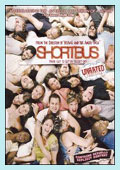
| Shortbus 2006 - USA - 101 min. - Feature - Color Director - John Cameron Mitchell |
| Genre / Type - Comedy, Drama, Ensemble Film, Sex Comedy, Urban Drama Flags - Not For Children, Strong Sexual Content, Profanity, Nudity, Adult Humor Keywords - city, husband, orgy, sex, sex-therapist, orgasm Themes - Intersecting Lives, Looking For Love, Sexual Awakening Tones - Intimate, Biting, Irreverent, Raunchy, Sexual Sound by - Dolby Digital Produced by - Fortissimo Films / Process Productions / Q Television Release - Oct 6, 2006 (USA - Limited) Released by - Fortissimo Films / The Works (UK) / THINKFilm (USA) DVD Street Date - Mar 13, 2007 Languages - English Subtitles - French, Spanish Screen Format - Color, Widescreen Sound - DD5.1/DD2 Aspect Ratio - 1.78:1 (DVD) Studio - Velocity / Thinkfilm Cast Sook-Yin Lee -- Sofia Paul Dawson -- James Lindsay Beamish -- Severin PJ DeBoy -- Jamie Raphael Barker -- Rob Peter Stickles -- Caleb Jay Brannan -- Ceth Alan Mandell Adam Hardman Ray Rivas Bob Bitchen Shanti Carson Justin Hagan Jan Hilmer Stephen Kent Jusick Yolonda Ross JD Samson Daniela Sea Miriam Shor Rachael Cyna Smith Paul Oakley Stovall Lex Vaughn Justin Bond |
|
 |
 |
 |
 |
 |
 |
 |
|