 |
 |
 |
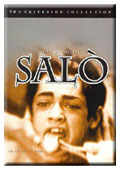
| SALO 1Studio -Criterion Collection 1975 - Italy / France - 117 min. - Feature, Color AKA -120 Days of Sodom Salo o le Centoventi Giornate di Sodoma Sal� o le 120 giornate di Sodoma (Original Foreign title) Director -Pier Paolo Pasolini |
| Genre/Type - Drama, Political Drama Artistic/ Production Styles - Allegory Flags - Violence, Nudity, Not For Children, Strong Sexual Content Keywords - child-abuse, assault, atrocity, attack, child, seduction, group, Italy, kidnap, sex, villa, violence, war Tones - Disturbing, Bleak, Confrontational, Harsh, Lurid Set In - war, World War II Produced by - Produzioni Europee Associati / United Artists Release - Jan 10, 1976 (Italy) DVD Street Date - Aug 12, 1998 Languages - ITA Subtitles - English Screen Formats - Letterbox for 16x9 TVs Sound - PCM Mono Aspect Ratio - 1.85:1 (DVD) Region - All (RALL) DVD Sides -1 Cast Paolo Bonacelli -- Duke Umberto P. Quinavalle - Caterina Boratto -- Castelli H�l�ne Surg�re -- Vaccari Sonia Saviange -- Virtuoso Ines Pellegrini -- The slavegirl Aldo Valletti -- The President Marco Bellocchio -- The President [Voice] Franco Merli - Laura Betti -- Signora Vaccari [Voice] Giorgio Cataldi -- The Bishop |
| Plot Synopsis The final work of notorious Italian director Pier Paolo Pasolini, this film updates the Marquis de Sade's most extreme novel to fascist Italy in the final days of WW II. Dispensing with the novel's meditations on sexual liberation and the search for truth, Pasolini presents four decadents who kidnap dozens of young men and women and subject them to the most hideous forms of torture and perversion in an isolated villa. Rape, murder, and a coprophagic banquet are only the beginning of the atrocities on display. Photographed by Tonino Delli Colli, the film also features a lavish score by Ennio Morricone. � Robert Firsching, All Movie Guide Reviews Michael Thomson, BBCi Updated 17 October 2000 |
|
 |
 |
 |
| Given that juggernaut American films continue to dominate the world's screens, so squeezing out more specialist fare, it is perfectly understandable why small distributors shy away from new films by unknown directors, relying instead on known directors who may be big enough to be brand names. But why the British Film Institute should re-release Pasolini's "Sal�" (which was awful in 1975, and is still awful now) is anyone's guess. Perhaps, at a time when promotional budgets for non-mainstream films are almost invisible, the BFI knows all too well that a film stuffed with brutal demonstrations of power and perversion of every kind will at least get noticed. Yet the re-launch of "Sal�" is, just as the making of it was, a sad, if spectacular, waste of energy. Notionally a metaphor for Fascism (it is set in Italy in 1944), and specifically about the connection between politics, violence, and sexual excitement, "Sal�" has in fact no meaningful link to Fascism whatsoever, but is simply a display of twisted lust, spun by the fantasies of four extreme perverts, not to mention the director himself. Clearly Pasolini (who could either be exceptionally inspired or - as here - absolutely dire) had hit the creative buffers, and so - in his tale of four power-mad, sexually-warped members of the ruling elite - seems to relish serving up endless examples of the most gruesome conduct, which include the forced consumption of food spiked with nails, nipples being branded, and - most ghastly of all - the consumption of excrement. Needless to say, the young men and women horrifically abused by the four condescending establishment tyrants are treated like so much available meat. Grim and pointless in equal measure. Jeremy Heilman, MOVIEMARTYR.COM September, 2001 |
 |
 |
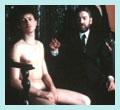
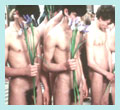
| Made in 1975 and directed by Pasolini (his final film), Salo is based on Marquis DeSade's 120 Days of Sodom (which I've never read) , but places the degradation in that book in a different context : fascist Italy. I thought it was an effective, if over-the-top, skewering of the evils of a fascist dictatorship, especially as it is portrayed as it is here (at the end of WWII, losing, and with nothing to lose). The film opens with the rounding up and inspection of a group of teenagers. The most attractive are selected and whisked off to a castle where they are subjected to several sex acts by the province's president and guests, then systematically tortured and killed. I suppose the film's infamous because of its depictions of homosexuality, child (they seem to be about 16-20) nudity, scatology, torture, and the like, but Pasolini's camera rarely show us these scenes in close-up, so we're able to remain, thankfully, a bit detached and process what we're seeing intellectually rather than emotionally. I suppose I was a bit trained by the film's reputation to expect to see that sort of thing, so I wasn't exceptionally shocked. That's sort of the point though... throughout the film, we're made to watch atrocities, yet we continue to watch silently. Even worse, the parade of cruelty grows somewhat tedious as the film goes on. It makes it a little clearer how something so horrible as the Holocaust could occur. It becomes apparent that the film itself is not evil, rather that the film tries to show us something evil (fascism) and to do so requires some uncomfortable moments. All in all, I was impressed how well the film was done. It made it's point quite well (if excessively). It's true that it has a scene in which an imprisoned girl is made to urinate on one of the nobility, but in the context of the film, it makes sense. We understand that here the director is telling us that the ruling class gets off on the degradation of its subjects. The film is quite well-acted and shot, and there is a truly excellent score by Ennio Morricone, but it's definitely more admirable than enjoyable (though there are some wry moments of humor). Clearly, the film isn't exploitation, however, I definitely wouldn't suggest it to anyone who's offended easily, even if I was more intellectually engaged than offended while watching it. |
 |
 |
 |
 |
 |