 |
 |
 |
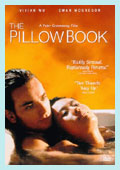
| THE PILLOW BOOK 1996 - Uk/France/Netherlands - 123 min. - Feature, Color Director - Peter Greenaway |
| Genre/Type -Drama, Avant-garde, Erotic Drama Keywords -writing, marriage-problems, publisher, sex, tattoo, calligraphy, fetish [sexual], poetry Themes -Star-crossed lovers, out for revenge, culture clash, dying young Tones - Cerebral, sttlized, lavish, reflective, sexual, deliberate, meditative Moods - Flames of passion Produced by - Alpha Films / Channel 4 / Delux Productions / Kasander & Wigman Productions / StudioCanal / Woodline Films DVD Street Date - December 15, 1998 Studio: Sony Home Pictures, Ent. Languages -French Subtitles -English DVD Sides -1 Features - Scene Selection Cast Vivian Wu - Nagiko Ewan McGregor - Jerome Yoshi Oida - The Publisher Ken Ogata - The Father Hideko Yoshida - The Aunt/The Maid Juddy Ongg - The Mother Barbara Lott - Jerome's Mother Yuki Nou - Nagiko's Friend Yuko Nozawa - Model Michell Leigh Nicholson Kiymi Nomura - Model Masami Nishio - Nagiko's Friend Nguyen Duc Nhan - Calligrapher Roger To Thanh Hien - Calligrapher See Wah Leung - Intruder Yasuko Ogawa - 10th Century Woman Ohko - Model Poon Wing Hong Chizuru Ohnishi - Young Nagiko See Yan Leung - Bookshop Manager Michiko Matsuo - Nagiko's Friend Atsushi Miura - Husband's Friend Takashi Miyake - 10th Century Man Doris Lai Fong Lui Kentaro Matsuo - Calligrapher |
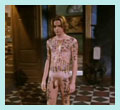
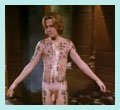
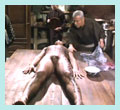
| Plot Synopsis Peter Greenaway directed this elliptical and visually intricate tale of the far side of erotic and intellectual attraction. As a girl, Nagiko would receive a special gift each year from her father: a calligrapher (Ken Ogata) who would carefully paint a poem on her face, as her aunt (Hideko Yoshida) read aloud from The Pillow Book, a classic Japanese text on the art of love. As Nagiko (Vivian Wu) reached adulthood, her father insisted on putting a stop to this ritual, and he persuaded her to marry the nephew of his publisher (Ken Mitsuishi). But Nagiko is not satisfied with her husband, and after finding success as a model, she seeks a lover who will indulge her fondness for literature by writing verse on her naked body. In time, she finds happiness with a British expatriate named Jerome (Ewan McGregor), who persuades her to use his body as paper for her poetry, but the interference of her father's publisher (Yoshi Oida) gives their relationship a tragic turn. Greenaway deliberately mistranslated some of the French and Japanese dialogue for The Pillow Book, hoping that the occasionally fractured language would give the film a "Tower of Babel" quality. Reviews Todd Kristel, All Movie Guide |
| Some films get the audience emotionally involved in the lives of thoroughly developed characters; other films use characters as props and place the main emphasis on ideas or visual style. The Pillow Book falls into the latter category. Greenaway doesn't exude much compassion for his characters, even the sympathetic ones; although this film is ostensibly about erotic attraction, it's too cold and detached to generate much passion or sexual arousal. In some respects, Greenaway resembles Stanley Kubrick, whose clinical approach to his characters suggested that he viewed himself as an entomologist examining the behavior of an inferior life form under a microscope. Of course, some people would consider it a great compliment to be compared to Kubrick, and The Pillow Book demonstrates that Greenaway, like Kubrick, has a strong visual sense. Indeed, the visual elements of The Pillow Book are crucial because the film isn't just about people who happen to be involved in calligraphy; it's about the beauty of calligraphy itself, as well as a showcase for Greenaway and his colleagues to manipulate the visual (and audio) elements of the film. For example, Greenaway uses this movie to explore the differences between Eastern and Western forms of calligraphy and fine arts, including the direction of reading text and both the framing and fragmentation of picture space. You could say that he directs like a painter whose visual style depends more on the simultaneous placement of images on the picture frame than on editing or camera movement; you could say that he seems more excited by the ways he can densely pack his film with visual information than by the naked coupling of Vivian Wu and Ewan McGregor; and you could also say that his love of art compensates, at least partly, for his detached approach to his characters. So while Greenaway could have done more to get viewers involved in the relationship between Nagiko and Jerome, at least he offers us something interesting to look at. Rob Blackwelder, SPLICEDwire |
| I have seen the future of movies, and it is picture- in- picture. You know, like a fancy TV where you can watch a second channel in the corner of the screen. The effect will be used for flashbacks and to show parallel plot lines at once. Action movies will use it to show explosion from several angles at the same time. And hardly anyone will remember that Peter Greenaway, the most ambitious visual auteur in modern film, did it first in "Prospero's Books" and even more effectively in "The Pillow Book," an outstanding visual and cerebral feast traveling art house theaters throughout the summer. A much less assaulting alternative to MTV-style editing, Greenaway (best known for "The Cook, the Thief, His Wife and Her Lover") uses picture-in-picture images throughout his new film -- the absorbing story of Nagiko (Vivian Wu), a beautiful, young Japanese writer living Hong Kong, who has a fetish for writing on flesh. "The Pillow Book" requires a turbo-charged right brain to take in its multiple layers of symbolism, time and emotion, but the pay-off is big -- this is the most beautiful and complex film so far this year. The first part of the story largely concerns her quest for "the perfect calligrapher/lover." As a writer herself, she often covers her lovers with poems and allusions in Japanese and Chinese. She immediately kicks out of bed anyone without an artisan's hand and something interesting to write on her body. She developed her unusual concupiscence in childhood when her father would gingerly jot a traditional Japanese creationism myth on her face every birthday. When she meets Jerome (Ewan McGregor from "Trainspotting") and he learns to paint her body to her specifications, Greenaway uses the picture-in-picture to show a flashback to an early birthday, Jerome's brush strokes mirroring those of her father. While collectively it's only used for maybe 15 minutes of the picture, Greenaway also employs the smaller image as a transition from scene to scene and to parallel Nagiko's life to that of a young woman in ancient Japan who wrote the pillow book that inspires our heroine's literary ambitions. Even with Greenaway's focus on visual fabric, his characters are intricate and the performances richly layered. Wu gives Nagiko an ethereal quality -- she is brilliant and sensual. Jerome is the most complex person in her life, which is why she is patient with his initially clumsy penmanship. His life is precariously balanced between his impassioned affair with Nagiko and his purely physical trysts with a male book editor. The second half of the film focuses mainly on Nagiko's determined revenge against this editor, who is the same man who years before betrayed her father. When she discovers this, she sets out to drive him mad -- in part by submitting to him profoundly eloquent manuscripts using Jerome and other men as her medium. Aside from being about 20 minutes too long (but I haven't a clue what he could have cut) and having the Peter Greenaway Obligatory Gross-Out Scene (painted flesh being cut from a dead body), "The Pillow Book" is a visually astounding, intellectually engrossing and emotionally fascinating film that celebrates, as said so aptly in the movie itself "the delights of the flesh and the delights of literature." |
|
 |
 |
 |
 |
 |
 |
 |
 |
 |
 |
 |