 |
 |
 |
 |
 |
|
 |
 |
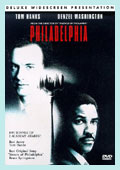
| PHILADELPHIA 1993 - USA - 125 min. - Feature, Color Director -Jonathan Demme |
| Genre/Type -Message Movie, Courtroom Drama, Gay & Lesbian Films, Medical Drama, Drama Flags -Questionable for Children, Adult Situations, Profanity MPAA Rating -PG13 Keywords -AIDS, lawyer, courtroom, handicapped, disease, doctor/nurse, homophobia, homosexual, terminal-illness, lawsuit, love, prejudice, employer/employee, against-the-system Themes -Social Injustice, Fighting the System, Social Injustice, Whistleblowers, Fighting the System, Living With AIDS Tones -Compassionate, Confrontational, Deliberate, Earnest, Melancholy, Poignant, Reflective, Warm, Tearjerking Sound by -Dolby Produced by -TriStar DVD Street Date - Jul 19, 2004 Languages - English Subtitles - English, French, German, ITALIAN Screen Format - Color, WS Aspect Ratio - 1.85:1 (DVD) Studio - Columbia Tristar Studio - Showtime Entertainment Cast Tom Hanks -- Andrew Beckett Denzel Washington -- Joe Miller Jason Robards, Jr. -- Charles Wheeler Mary Steenburgen -- Belinda Conine Antonio Banderas -- Miguel Alvarez Ron Vawter -- Bob Seidman Charles Napier -- Judge Garnett Joanne Woodward -- Sarah Beckett Andre B. Blake -- Young Man in Pharmacy Robert Castle -- Bud Beckett Daniel Chapman -- Clinic Storyteller Roger Corman -- Mr. Laird Ann Dowd -- Jill Beckett David Drake - Bruno Charles Glenn -- Kenneth Killcoyne Paul Lazar -- Dr. Klenstein Roberta Maxwell -- Judge Tate Warren Miller -- Mr. Finley Joey Perillo -- Filko Lauren Roselli -- Iris Anna Deavere Smith -- Anthea Burton Daniel Von Bargen -- Jury Foreman |
 |
 |
 |
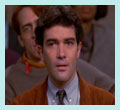 |
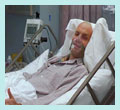
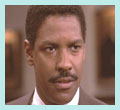
| Plot Synopsis At the time of its release, Jonathan Demme's Philadelphia was the first big-budget Hollywood film to tackle the medical, political and social issues of AIDS. Tom Hanks, in his first Academy Award-winning performance, plays Andrew Beckett, a talented lawyer at a stodgy Philadelphia law firm. Andrew has contracted AIDS but fears informing his firm about the disease. The firm's senior partner, Charles Wheeler (Jason Robards), assigns Andrew a case involving their most important client. Andrew begins diligently working on the case, but soon the lesions associated with AIDS are visible on his face. Wheeler abruptly removes Andrew from the case and fires him from the firm. Andrew believes he has been fired because of his illness and plans to fight the firm in court. But because of the firm's reputation, no lawyer in Philadelphia will risk handling his case. In desperation, Andrew hires Joe Miller (Denzel Washington), a black lawyer who advertises on television, mainly handling personal injury cases. Miller dislikes homosexuals but agrees to take the case for the money and exposure. As Miller prepares for the courtroom battle against one of the law firm's key litigators, Belinda Conine (Mary Steenburgen), Miller begins to realize the discrimination practiced against Andrew is no different from the discrimination Miller himself has to battle against. - Paul Brenner(AMG) Reviews JASON CLARK AMG (High Historical Importance) Widely noted as the first mainstream studio film to deal with AIDS, and featuring two of the world's biggest actors (Tom Hanks and Denzel Washington), Jonathan Demme's moving, well-intentioned drama, despite its naysayers, is a challenging and sometimes surprising work. Both leads (especially Hanks, in his first Oscar-winning role) deliver wonderfully nuanced portrayals, and Demme's signature touches (particularly the potent use of close-ups and music) are perfectly suited to this material. Denounced by many gay audiences as timid and tentative about its central romantic pairing (Hanks and Antonio Banderas) - not to mention its eagerness to please mass American viewers - the film nonetheless benefits from its decency and warm approach in dealing with its characters. For whatever missteps the film makes (framing a deeply tragic character study within the auspices of a courtroom drama, for one), its emotions are indelible and its risk-taking is appreciated. Bruce Springsteen won an Oscar for his haunting, elegant opening-titles theme, Streets of Philadelphia, and in an odd case of art imitating life, Hanks' tearful, memorable Oscar acceptance speech (where he thanked his gay acting teacher from years back) became the source material for the 1997 comedy In & Out, starring Kevin Kline. ROGER EBERT Chicago Sun-Times Jan 14, 1994 More than a decade after AIDS was first identified as a disease, "Philadelphia" marks the first time Hollywood has risked a big-budget film on the subject. No points for timeliness here; made-for-TV docudramas and the independent film "Longtime Companion" have already explored the subject, and "Philadelphia" breaks no new dramatic ground. Instead, it relies on the safe formula of the courtroom drama to add suspense and resolution to a story that, by its nature, should have little suspense and only one possible outcome. And yet "Philadelphia" is quite a good film, on its own terms. And for moviegoers with an antipathy to AIDS but an enthusiasm for stars like Tom Hanks and Denzel Washington, it may help to broaden understanding of the disease. It's a ground-breaker like "Guess Who's Coming to Dinner" (1967), the first major film about an interracial romance; it uses the chemistry of popular stars in a reliable genre to sidestep what looks like controversy. The story involves Hanks as Andrew Beckett, a skillful lawyer in a big, old-line Philadelphia law firm. We know, although at first the law firm doesn't, that Beckett has AIDS. Visits to the clinic are part of his routine. Charles Wheeler, the senior partner (Jason Robards) hands Beckett a case involving the firm's most important client, and then, a few days later, another lawyer notices on Beckett's forehead the telltale lesions of the skin cancer associated with AIDS. Beckett is yanked off the case and informed he doesn't have a future with the firm. He suspects he's being fired for being sick. He's correct. (Wheeler, feeling somehow contaminated by association, barks to an associate, "He brought AIDS into our offices - into our men's room!") Beckett determines to take a stand, and sue the law firm. But his old firm is so powerful that no attorney in Philadelphia wants to take it on, until Beckett finally goes in desperation to Joe Miller (Denzel Washington), one of those lawyers who advertises on TV, promising to save your driver's license. Miller doesn't like homosexuals, but agrees to take the case, mostly for the money and exposure. And then the story falls into the familiar patterns of a courtroom confrontation, with Mary Steenburgen playing the counsel for the old firm. (Her character has no appetite for what is obviously a fraudulent defense, and whispers "I hate this case!" to a member of her team.) The screenplay by Ron Nyswaner works subtly to avoid the standard cliches of the courtroom. Even as the case is progressing, the film's center of gravity switches from the trial to the progress of Beckett's disease, and we briefly meet his lover (Antonio Banderas) and his family, most especially his mother (Joanne Woodward), whose role is small but supplies two of the most powerful moments in the film. By the time the trial reaches its conclusion, the predictable outcome serves mostly as counterpoint for the movie's real ending. The film was directed by Jonathan Demme, who with Nyswaner finds original ways to deal with some of the inevitable developments of their story. For example, it's obvious that at some point the scales will fall from the eyes of the Washington character, and he'll realize that his prejudices against homosexuals are wrong; he'll be able to see the Hanks character as a fellow human worthy of affection and respect. Such changes of heart are obligatory (see, for example, Spencer Tracy's acceptance of Sidney Poitier in "Guess Who's Coming to Dinner"). But "Philadelphia" doesn't handle that transitional scene with lame dialogue or soppy extrusions of sincerity. Instead, in a brilliant and original scene, Hanks plays an aria from his favorite opera, one he identifies with in his dying state. Washington isn't an opera fan, but as the music plays and Hanks talks over it, passionately explaining it, Washington undergoes a conversion of the soul. What he sees, finally, is a man who loves life and does not want to leave it. And then the action cuts to Washington's home, late at night, as he stares sleeplessly into the darkness, and we understand what he is feeling. Scenes like that are not only wonderful, but frustrating, because they suggest what the whole movie could have been like if the filmmakers had taken a leap of faith. But then the film might not have been made at all; the reassuring rhythms of the courtroom drama, I imagine, are what made this material palatable to the executives in charge of signing the checks. "Philadelphia" is a good movie, and sometimes more than that, and the Hanks performance (which, after all, really exists outside the plot) is one of the best of the year. Sooner or later, Hollywood had to address one of the most important subjects of our time, and with "Philadelphia" the ice has been broken. In a year or two, it will be time for another film to consider the subject more unblinkingly. This is a righteous first step. Awards 1993 Academy Best Actor (win) -Tom Hanks Best Makeup (nom) -Alan D'Angerio/Carl Fullerton Best Original Screenplay (nom) -Ron Nyswaner Best Song (nom) -"Philadelphia" Neil Young Best Song (win) - "Streets Of Philadelphia" Bruce Springsteen 1994 Golden Globe Best Actor (Drama) (win) -Tom Hanks Best Original Song (win) -Bruce Springsteen Best Screenplay (nom) -Nyswaner, Rob Other Awards Silver Bear (Best Actor) (win) -Tom Hanks -1994 Berlin International Film Festival |
|
 |
 |
 |
 |
|