 |
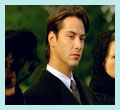
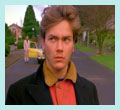
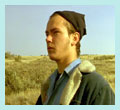
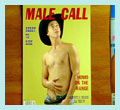
| Plot Synopsis Gus Van Sant's dreamtime riff on Shakespeare's "Henry IV, Parts I and II" features River Phoenix as Mike Waters, a narcoleptic male hustler who is first seen drifting on a stretch of highway in Idaho. Mike shifts from Seattle to Portland, where he has taken up with Scott Favor (Keanu Reeves), who is also a hustler. The difference between them is Mike's sleepy state betrays an uncertain future, while Scott is ready to inherit a fortune from his father within a week. Mike feels a real affection for Scott, but Scott does not believe men can really love each other. Besides, Scott is mostly hustling as a means of slumming and killing time before he inherits his money. Mike, however, delusionally thinks Scott will continue with his life as a drifter after receiving his inheritance. Mike's belief is shared by the dregs of Portland, who live out of an abandoned hotel with their spiritual leader Bob (film director William Richert). They're convinced Scott's fortune will benefit them all, when in reality Scott plans to use the money to escape his bleak existence and abandon his friends. - Paul Brenner, All Movie Guide Reviews REBECCA FLINT MARX All Movie Guide High Artistic Quality Gus Van Sant's third feature further established him as a spokesman not just for alienated gay men but also for disaffected youth in general. A harsh, beautiful, and fervently original portrait of alienation, betrayal, and unrequited love, My Own Private Idaho was one of the defining films of both Van Sant's career and the New Queer Cinema of the 1990s. While Drugstore Cowboy (1989), Van Sant's previous film, had focused on a group of people driven to society's fringes by their drug addiction, Idaho dramatizes a group of people driven to soceity's fringes by their sexuality. As in Cowboy, Van Sant refrains from grand pronouncements about the lifestyle of the social/sexual outlaw; and his focus on the relationship between River Phoenix's Mike and Keanu Reeves' Scott gives the film emotional resonance. Phoenix in particular is heartbreaking as the lovelorn, narcoleptic Mike, whose campfire-side declaration of love for Scott remains one of the most poignant and honest depictions of male-to-male longing ever captured onscreen. Phoenix's quiet, raw portrayal of the young hustler would be constantly referenced in tributes to the actor following his untimely death in 1993, and the close association seems fitting: with its bleak, dreamy ambience and mournful yet unsentimental story, My Own Private Idaho feels less like a narrative than like an elegy for the romantic aimlessness of youthful alienation. MATT BRUNSON Creative Loafing Published 03.02.05 MY OWN PRIVATE IDAHO (1991). Calling Gus Van Sant's My Own Private Idaho a great film would clearly be stretching it, but calling it a great exercise in film experimentation would be right on the money. Van Sant, still flush from the critical success of 1989's Drugstore Cowboy, made what's in essence a homosexual road movie that espouses the family values of a Disney feature and the pop art sensibilities of a Warhol piece - with a liberal dose of Shakespeare thrown in for good measure. River Phoenix, in a bold performance that earned him Best Actor honors from the National Society of Film Critics, is cast as Mike Waters, a Portland street hustler who deals with stressful situations by tumbling into a narcoleptic state. His only true friend is Scott Favor (Keanu Reeves), who abandoned his privileged life as the son of Portland's mayor to hang out on the streets with other boy toys. Deeply in love with Scott, Mike counts on his pal to help him find his mother, embarking on a journey that will take them to Idaho and then Italy. Van Sant packs his movie with all manner of unusual narrative devices and offbeat visual flourishes, and, perhaps not surprisingly, the end result is a mishmash of things that work (the animated gay porn magazine covers) and things that don't (the Henry IV homage that dominates the middle of the movie). Yet for all of Van Sant's idiosyncrasies, the picture's most memorable component is the aching performance by Phoenix, who would suffer a drug-induced death almost exactly two years after this movie's debut. Extras in the two-disc Criterion set include a 64-page booklet packed with essays and interviews, an audio interview with Van Sant conducted by director Todd Haynes (Far From Heaven), deleted scenes, a making-of documentary, and a recent conversation between producer Laurie Parker and River's sister, Rain Phoenix. JON LAP Apollo Guide Score: 93 Non-normative texts concern themselves with subject matter that is marginalized, or not widely accepted as "normal." Gus Van Sant's My Own Private Idaho - an ode to the abandoned, and the isolated - is an example. It's an exercise in brilliant directorial innovation, and cinematic ingenuity - required viewing for the capsized, fissure-ridden heart. The film offers up a discourse on the fragility, and the emotional and intellectual convolution, of children who are left with the burden of trying to understand why their parents have abandoned them. This search becomes obdurate and lost, in the cases of Mike Waters (a physical and emotional narcoleptic, played to perfection by River Phoenix), and Scott Favor (Keanu Reeves); Mike is subverted by an idyllic yearning for the past, while Scott is consumed by familial regret and rebellion. We are introduced to the seedy life of the male street-hustler, meeting an interesting cast of characters such as William Richert's Bob (an aging hustler dubbed the "grandfather" of the streets), and his sidekick, played well by Flea. The surface plot follows Mike and Scott, as one attempts to find his missing mom, while the other plays "rebel-without-a-cause" to spite his capitalistic, superficial father. Their journey at first invites escapist vice and decadence, leading them through the hustler-dense areas of Portland, Oregon and then to Italy, where Scott meets an idyllic girl who makes him want to lead a normal, straight life, and then on to the trailer park that houses Mike's biological father, and finally, to a funeral. The outset of the film sets the metaphoric stage well, as Mike is alone, in the middle of a barren street, equipped with an object that iconographically controls time (a watch), and accompanied by an enduring symbol of innocence (a bunny)� both of which are no longer reliable. Van Sant skilfully externalizes the internal in this opening sequence, with "cinema-of-attraction-shots" (single-shot visuals that resonate, whether or not they're included in a full-length narrative), like the use of a collapsing house to underscore perverse pleasure, or the jarring sight of a school of salmon swimming against the current. Van Sant builds on this externalizing-of-the-internal throughout the film, with a colour code that exposes the symbiotic relationship between garish reds, which connote heat, passionate-rebellion, liveliness, and danger, with antiseptic whites - representing emotional sterility and blankness. By including handheld camera shots, zooms, tracking-shots, and visuals layered with a musical choice that patronizes American folklore songs, a strong and pertinent social commentary begins� one that asserts the innate fallibility of American values. This commentary bookends the film, as the visual depiction that concludes the proceedings is one of American greed, and callousness� Mike's fate being the unfortunate sum to life's harsh equation. Motifs of America's need to pledge allegiance to normality (found in references to white-picket fences, pets, and family cars), and the struggle inherent in nature, lend to the film's brilliance - the freedom experienced by fish is undermined visually throughout the film, as they are swimming backward, or seen in states of ossification as frozen, or as a statue. In the end, Mike is a self-proclaimed, "connoisseur of roads, who's tasted all different kinds of roads." There are many other points of interest that deserve mention; simply said, My Own Private Idaho is a cult-American classic that - like anything cleverly multi-layered - should be surveyed and examined several times in order to fully appreciate how and why this film works as a brilliant piece of art, and entertainment. Awards 1991 Independent Spirit Award Best Actor (win) - River Phoenix Best Cinematography (nom) - Eric Alan Edwards, John Campbell Best Director (nom) - Gus Van Sant Best Film Music (win) - Gus Van Sant Best Picture (nom) Best Screenplay (win)-Gus Van Sant Other Awards Best Actor (win) - 1990 National Society of Film Critics Volpi Cup for Best Actor (win)-River Phoenix -1991 Venice |
 |
 |
 |
 |
|
|
 |
 |
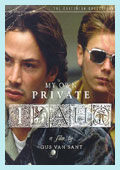
| MY OWN PRIVATE IDAHO 1991 - USA - 105 min. - Feature - Color Director - Gus Van Sant |
| Genre / Type - Drama, Gay & Lesbian Films, Road Movie, Buddy Film Flags - Not For Children Violence Nudity Strong Sexual Content, Profanity, Substance Abuse (Alcohol Drugs) MPAA Rating - R Keywords - alienation, bisexual, prostitute/prostitution, friendship, gigolo, homosexual, love teenagers narcolepsy, coming-of-age, on-the-road Themes - Unrequited Love, Faltering Friendships, Fathers and Sons, Prostitutes Tones - Compassionate, Lyrical, Enigmatic, Warm, Elegiac Box office - $6,401,336 Color type - Alpha Cine color Sound by - Ultra Stereo Produced by - New Line Cinema Release - Sep 29, 1991 (USA) Released by - Fine Line Features MPAA Reasons - for strong sensuality, language and drug use DVDStreet Date - Jun 27, 2005 Languages - English Subtitles - English Screen Format - Color, WS Aspect Ratio - 1.85:1 (DVD) Studio - EIV Cast River Phoenix -- Mike Waters Keanu Reeves -- Scott Favor James Russo -- Richard Waters William Richert -- Bob Pigeon Rodney Harvey -- Gary Chiara Caselli -- Carmella Jesse Thomas -- Denise Flea -- Budd Grace Zabriskie -- Alena Melanie Mosely -- Lounge Hostess Greg Murphy -- Carl Stephen Clark Pachosa -- Hotel Manager Pat Patterson -- Cop Robert Lee Pitchlynn -- Walt Vana O'Brien -- Sharon Waters Conrad "Bud" Montgomery -- Rock Promoter Mark Weaver -- Rock Promoter Tiger Warren -- Himself Michael Parker -- Digger Jesse Merz -- Mean Kid (uncredited) David Reppinhagen -- Yuppie at Jake's Lannie Swerdlow -- Disco Manager Mario Stracciarolo -- Mike's Italian Client Steve Vernelson -- Cop Douglas Tollenen -- Little Richard Tom Troupe -- Jack Favor Brian Wilson -- Rock Promoter |
|
 |
 |
 |
 |
 |
 |
 |
 |