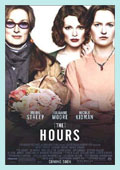
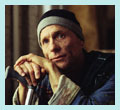
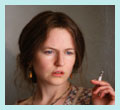
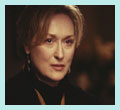
| Plot Synopsis Three women, separated by a span of nearly 80 years, find themselves weathering similar crises, all linked by a single work of literature in this film adaptation of the Pulitzer Prize-winning novel by Michael Cunningham. In 1923, Virginia Woolf (Nicole Kidman) is attempting to start work on her novel Mrs. Dalloway, in which she chronicles one day in the life of a troubled woman. But Virginia has demons of her own, and she struggles to overcome the depression and suicidal impulses that have followed her throughout her life, as her husband Leonard (Stephen Dillane) ineffectually tries to help. In 1951, Laura Brown (Julianne Moore) is a housewife living in suburban Los Angeles, where she looks after her son Richie (Jack Rovello) and husband Dan (John C. Reilly). Laura is also an avid reader who is currently making her way through Mrs. Dalloway. The farther she gets into the novel, the more Laura discovers that it reflects a dissatisfaction she feels in her own life, and she finds herself pondering the notion of leaving her life behind. Finally, in 2000, Clarissa Vaughn (Meryl Streep) is a literary editor who is caring for Richard Brown (Ed Harris), a former boyfriend and noted author, who is slowly losing his fight with AIDS. Clarissa is trying to arrange a party to celebrate the fact that Richard has won a prestigious literary award, but is getting little help from Richard's lover, Louis (Jeff Daniels). As she labors to help Richard through another day, he wonders if his life is worth the unending struggle. The Hours also features Toni Collette, Miranda Richardson, Allison Janney, and Claire Danes. - Mark Deming, All Movie Guide Reviews LUCIA BOZZOLA AMG Boasting all of the elements of a prestigious Hollywood production, The Hours (2002) is that rarity of rarities: a thoughtful studio movie. Adapted from Michael Cunningham's "unadaptable" Pulitzer prize winner, David Hare's literate screenplay succeeds in translating Cunningham's interior-driven novel about a day in the lives of three different women into engaging cinema. Deftly interweaving the stories of writer Virginia Woolf as she struggles to create her 1925 masterpiece Mrs. Dalloway; 1951 reader Laura Brown, who finds solace in Woolf's book; and 2001 editor and Mrs. Dalloway-esque party planner Clarissa, director Stephen Daldry reveals the underlying connections between the disparate women as each realizes that a life of self-abnegation - whether as mother, wife, patient, or friend - doesn't guarantee happiness. Meryl Streep, Julianne Moore, and Nicole Kidman play their complex, not always sympathetic roles with delicacy and gusto; Kidman, in particular, is a well-costumed revelation as the brilliant, wry, and disturbed Woolf. Though Ed Harris overplays the poetry in his AIDS-stricken scribe, the rest of the supporting cast superbly complements the lead trio. Even Philip Glass's score of his love 'em-or-hate 'em signature triplets and repetitions neatly underpins The Hours' thematic and emotional structure. ERICA ABEEL Film Journal International 'I stayed alive for you, but now you have to let me go,' says an AIDS-ravaged man to his friend and former lover. That pretty much sets the tone for this wrenching film with a non-linear structure that's willing to confront pain and suffering in a way that would be anathema to Hollywood. Based on the Pulitzer Prize-winning novel by Michael Cunningham, The Hours is a bold attempt to adapt the thematically interwoven stories of Virginia Woolf's last days before her suicide in 1941 and the lives of a '50s housewife and a present-day New York editor. For its seriousness, high literary aspirations and stunning acting, the film can only be applauded. Yet unlike the magical adaptation of The English Patient, which some feel actually improved on Michael Ondaatje's novel, The Hours only partially succeeds in capturing the book's lived textures. The film is bookended by Woolf's suicidal drowning in a local river, her pockets loaded with stones, the image of her body pulled by the current through the brown weedy water reinforced by Philip Glass's portentous score. The rushing current mirrors the fluid, unpunctuated style elected by screenwriter David Hare to interweave the three portraits. Woolf (Nicole Kidman, hiding behind a proboscis and smoke-cured voice), is driven to suicide by the madness colonizing her, despite the legendary devotion of husband Leonard (Stephen Dillane). In New York, editor Clarissa Vaughn (Meryl Streep)-nicknamed Mrs. Dalloway by her poet friend Richard (Ed Harris), the man dying of AIDS-plans a party to celebrate a prestigious poetry prize he's been awarded. In this most poignant and fleshed-out panel in the triptych, Clarissa, now in a relationship with a woman, yearns for the peak period when she and Richard were youthful lovers. In the third story, with its surprising link to the Richard/Clarissa story (which I won't reveal), suburban housewife Laura Brown (Julianne Moore) is trapped with an adored son in an asphyxiating marriage. Her story also interwines with the other two through her passion for Woolf's Mrs. Dalloway-in fact, the film, as in the novel, evokes a transgenerational community based on a single potent literary work. To capture the novel's alternating stories-which are abidingly sad and built around the impulse to self-annihilation-Hare fractured the original, reweaving it in smaller increments and discovering fresh connections. Exactly how Laura Brown connects to the Clarissa story, and the identity of her son, is thrillingly revealed in a single deft image. Gestures and motifs echo, ricochet and repeat-just as Laura tosses her failed cake into the trash, so Clarissa sweeps the 'crab thing' into the garbage after tragedy has annulled the party. In each story, the three heroines kiss other women on the mouth. If Bloomsbury was ambisexual, so are this film's women, while Richard once commuted from Clarissa's bed to a boyfriend's. In fact, the sexuality of The Hours may make straights feel hopelessly square, and perhaps it's fair, if not p.c., to say that it will carry more resonance for gay viewers. Because the novel is built on interior epiphanies, at times The Hours turns incoherent: What, you wonder, is basically ailing these able-bodied, well-fixed, yet hugely depressed women? Can we really be expected to sympathize with Woolf's servant problem? What would interest Woolf scholars here comes off as petulance. And while the novel's subtext points to repressed lesbian leanings, in the film Laura Brown's angst remains mystifying. Glass' maddening, repetitive score (which even Miramax poobah Harvey Weinstein disliked) acts like another stone in Woolf's pocket. And while ever the pro, Kidman's disguise is a distraction; she impersonates rather than embodies. (One clever insider casting choice: Laura Brown's son is the image of Michael Cunningham.) In the press notes, the actors uniformly marvel that anyone could make a movie of this book. The truth is, maybe you can't. Yet this honorable effort by an inspired team led by director Stephen Daldry not only distills a melancholy poetry and power all its own, it may send you back to Cunningham's novel or, better yet, Virginia Woolf. DEAN KISH thezreview.co.uk What is The Hours? Which hours are they referring to? Maybe it is just the hours that we get through in any given day. Based on the best-selling novel by Sean Cunningham, The Hours is centered upon the classic novel "Mrs. Dalloway". In 1923, Virginia Woolf (Nicole Kidman) is suicidal and at a pivotable moment in her life as her great novel, "Mrs Dalloway" is coming to fruition. Meanwhile in 1951, housewife Laura Brown (Julianne Moore) is battling her own war which is threatening to overwhelm her. Then finally in 2001, Clarissa Vaughn (Meryl Streep), a gay woman is preparing for a party to honor her author friend (Ed Harris) who is struck with AIDS. Each woman is involved with the novel in some way. One is writing it, another is reading it and the final lady is living it. How will each woman deal with her life's battle? Who will win and who will lose? So are the hours in these fractured lives. The Hours represents probably three of the best actresses working in Hollywood today. It also almost shows a lineage or evolution in these three actresses' careers. Meryl Streep has garnered infamy and been decorated many times in her career. Julianne Moore is on the verge of being decorated in her career and has already garnered infamy. Nicole Kidman is the new-comer to prestige as she is waiting for her wake of decoration. Each woman is deeply talented and deserves the recognition. For me, the film was utterly uncomfortable and unbelievably heavy to sit through. It felt like every inch or thread of dialogue was rapt with emotion. I couldn't breathe or feel comfortable watching it. I did find myself, over time, being absorbed in one of the stories more than the others. The whole story of Virginia Woolf intrigued me and I wanted to learn more but the film kept showing the other two stories as well. I found the whole 1951 story to be confusing. What exactly was the woman's problem? It was hard to relate since I didn't know the time-period. I did find myself relating to the 2001 story just before the story climaxed. When it finally did I did find it interesting but wasn't sure if it was a fair pay-off. I do hope that Nicole Kidman is looked at come Oscar time for her portrayal of Virginia Woolf because I haven't seen better performance from an actress all year except maybe Salma Hayek in "Frida". The Hours is a deep, enveloping movie about menopausal depression. There is so much sadness and emotion wedged into this film that it forgets to let the audience breathe once in a while. Maybe too much of a good thing is too much. The Hours is hard to forget but I am not sure if I recommend the journey. Awards 2002 Academy Best Actress (win) -Nicole Kidman Best Adapted Screenplay (nom) -David Hare Best Costume Design (nom) Best Director (nom) -Stephen Daldry Best Film Editing (nom) Best Original Score (nom) Best Picture (nom) Best Supporting Actor (nom) -Ed Harris Best Supporting Actress (nom) -Julianne Moore 2002 Broadcast Film Critics Association Best Acting Ensemble (nom) Best Actress (nom) -Nicole Kidman Best Composer (nom) -Philip Glass Best Picture (nom) 2002 Golden Globe Best Actress - Drama (nom) -Meryl Streep Best Actress - Drama (win) -Nicole Kidman Best Director (nom) -Stephen Daldry Best Film (win) Best Original Score (nom) -Philip Glass Best Screenplay (nom) -David Hare Best Supporting Actor (nom) -Ed Harris 2002 L.A. Film Critics Association Best Musical Score (Runner-up) (win) -Philip Glass Best Actress (win) -Julianne Moore 2002 Screen Actors Guild Best Actress (nom) -Nicole Kidman Best Supporting Actor (nom) -Ed Harris Best Supporting Actress (nom) -Julianne Moore Best Cast (nom) Other Awards Best Adapted Screenplay (nom) -David Hare -2002 -Writers Guild of America Best Actress (win) -Streep/Kidman/Moore -2003 -Berlin Film Festival Best Director (nom) -Stephen Daldry -2002 -Director's Guild of America Top Ten Movie of the Year (win) - -2002 -AFI Best Film (win) - -2002 -National Board of Review |
 |
 |
 |
 |
 |
|
 |
 |
| THE HOURS 2002 - USA - 114 min. - Feature, Color Director -Stephen Daldry |
| Genre/Type -Period Film, Psychological Drama, Feminist Film, Drama Flags -Adult Situations MPAA Rating -PG13 Keywords -AIDS, angst, mental-breakdown, depression, mental-illness, novel, party, regret, suicide, self-determination, family-abandonment, reading, writer Themes -Writer's Life, Tortured Genius, Mothers and Sons, Faltering Friendships, Suicidal Tendencies, Midlife Crises Tones -Melancholy, Literate, Reflective, Elegiac, Intimate, Elegant, Downbeat, Lyrical Produced by -Miramax Films / Paramount Pictures / Robert Fox / Scott Rudin Productions Release -Dec 27, 2002 (USA- Limited) / Jan 17, 2003 (USA) Released by -Miramax Films / Paramount Pictures DVD Street Date -Jun 24, 2003 Languages -English, French Subtitles -English Screen Formats -Letterbox for 16x9 TVs Sound -S5.0, DOLBY DIGITAL SURROUND Aspect Ratio -1.85:1 (Original) 1.85:1 (DVD) Studio -Paramount Home Entertainment DVD Sides -1 Cast Meryl Streep -- Clarissa Vaughn Julianne Moore -- Laura Brown Nicole Kidman -- Virginia Woolf Ed Harris -- Richard Brown Toni Collette -- Kitty Claire Danes -- Julia Vaughan Jeff Daniels -- Louis Waters Stephen Dillane -- Leonard Woolf Allison Janney -- Sally Lester John C. Reilly -- Dan Brown Miranda Richardson -- Vanessa Bell Eileen Atkins -- Barbara in the flower shop Margo Martindale -- Mrs. Latch Linda Bassett -- Nelly Boxall Jack Rovello -- Ritchie Brown |
|
 |
|
 |
|
 |
 |
 |
 |
 |