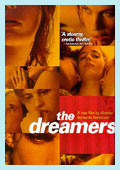
| Plot Synopsis Veteran Italian filmmaker Bernardo Bertolucci directs the erotic drama The Dreamers, adapted from the novel The Holy Innocents: A Romance by Gilbert Adair. American student Matthew (Michael Pitt) is studying in Paris during the politically turbulent late '60s. The story begins in 1968 with the firing of Henri Langlois, the founder of the French Cin�math�que. At a protest demonstration, Matthew meets cinema-obsessed Isabelle (Eva Green) and her twin brother, Theo (Louis Garrel). When their Bohemian parents (Robin Renucci and Anna Chancellor) leave for the summer, the twins invite Matthew to live with them. While the revolution rages on outside, the three young people stay in the comfortable flat playing decadent sexual games. Bertolucci incorporates clips from classic films like Queen Christina, Band of Outsiders, and Breathless. After showing at several European film festivals, The Dreamers made its U.S. premiere at the Sundance Film Festival in 2004. - Andrea LeVasseur Reviews BRIAN J. DILLARD AMG Though it marks writer/director Bernardo Bertolucci's return to the themes of Last Tango in Paris and features loving homages to many classics of world cinema, The Dreamers falls short of the movies it echoes. A muddled allegory about the tension between art and life, the film sets out to denounce the infantile excesses of aestheticism but ends up glorifying them instead - with endless scenes of nubile young flesh, lovingly photographed. As the three main characters wallow in a womb-like apartment, engaging in adolescent sexual gamesmanship and Lord of the Flies-lite squalor, they close themselves off from the political firestorm raging across Paris in May 1968. Only when their regression has reached its neurotic end point does the real world intrude, in the form of a deus ex machina that would be appalling if Bertolucci's symbolism hadn't been equally heavy-handed throughout. The enigmatic conclusion offers no firm answers about the battle between political engagement and swooning cinephilia, mostly because the politics remain resoundingly abstract compared to the fever dream of naked bodies that's gone before. As muddy as the thematic waters become, though, the performances of all three principals remain exemplary, especially that of Eva Green as the imperious Isabelle. Fine acting, gorgeous cinematography, and alluring eye candy abound - just don't expect it to add up to anything too concrete. PERRY SEIBERT AMG DVD Review The Dreamers, Bernardo Bertolucci's sexually charged ode to the late '60s -- a time when politics, sex, and cinema intertwined and commented on each other in ways that shaped the new generation -- makes its debut on DVD with an anamorphic widescreen transfer that preserves the original theatrical aspect ratio of 1.85:1. Bertolucci is widely considered to be one of the most visually arresting filmmakers of his time, and this transfer shows that his skills have not abated with age. The English soundtrack is rendered in Dolby Digital 5.1, while Spanish and French soundtracks have been recorded in Dolby Digital Surround. Supplemental materials include a commentary track recorded by the director along with screenwriter Gilbert Adair (who also wrote the novel on which he based the film) and producer Jeremy Thomas. They are full of anecdotes about the conception of the story, the film, and the time period in which the film transpires. The history of the film is showcased in a featurette about the volatile events that transpired in France during May of 1968. A making-of featurette, the theatrical trailer, and a music video for lead actor Michael Pitt's cover of "Hey Joe," round out this excellent package from 20th Century Fox. Two versions of the film are available on DVD, this edition contains the R-rated cut which differs from the NC-17 edition that played in theaters. PETER TRAVERS Rolling Stone January 29, 2004 Dream on if you think the NC-17 stamp that the ratings board stupidly slapped on Bernardo Bertolucci's The Dreamers means you're in for porn with your popcorn. The film provides a view of a vagina (full frontal) and two dicks (limp), plus one scene of jerking off (faked) that is far less sticky than anything in the R-rated There's Something About Mary. That's Hollywood hypocrisy. You can blow a head off and get by with an R, but show someone giving head and you're accused of rocking the foundation of George W.'s America. Will the film be hurt by the rating? Yes, in that some theaters won't show NC-17 films, and many newspapers won't take ads for them. But this film was never meant to fit in with multiplex drool. Bertolucci, the Italian master behind Last Tango in Paris, The Conformist and the Oscar-winning Last Emperor, stirs things up. The Dreamers may go slack when you most want it to soar, but it also seduces with eroticism and resonates with ideas. The setting is Paris in 1968. Matthew, an American student played with implosive intensity by Michael Pitt (Hedwig and the Angry Inch), spends hours absorbing movie culture at the Cinematheque Francaise. Matthew sits up front wanting to feel the images as they come off the screen "still fresh, still new." New Wave directors are revolutionizing film. Outside, young protesters take on the government. It's in this surging atmosphere that Matthew meets Isabelle (Eva Green) and her twin brother, Theo (Louis Garrel). He moves into their apartment -- their parents are away for a month -- and is pulled into their incestuous games. The Dreamers, like its three main characters, is drunk on movies. Bertolucci includes clips, from Chaplin and Garbo to the exhilarating moment in Godard's Band of Outsiders when the lead actors race through the Louvre, a scene Matthew, Isabelle and Theo re-create. Bertolucci, fighting the stilted script by Gilbert Adair, revels in this atmosphere, especially when Theo is forced by his sister to masturbate to a photo of Marlene Dietrich as punishment for not guessing the name of one of her films. The early scenes of playful sexuality -- the three in a tub, and Matthew gazing wonderingly up at Isabelle's crotch as he sucks her toes -- take on a toxicity as jealousy kicks in and secrets are revealed. Matthew and Isabelle go at it on the kitchen floor while Theo fries eggs and pretends not to notice. Bertolucci and his superb cinematographer Fabio Cianchetti notice everything. And the three actors -- Green has a startling beauty -- provide the canvas for the play of conflicting emotions. The film errs only when it tries for a profundity it can't support. But there's no denying the thrill when the trio -- now possessed of a hard-won self-awareness -- gets swept up in the street riots and a new world of danger and possibility. Bertolucci provokes audiences instead of pacifying them. Boy, do we need him now. ROGER EBERT February 13, 2004 In the spring of 1968, three planets -- Sex, Politics and the Cinema -- came into alignment and exerted a gravitational pull on the status quo. In Paris, what began as a protest over the ouster of Henri Langlois, the legendary founder of the Cinematheque Francais, grew into a popular revolt that threatened to topple the government. There were barricades in the streets, firebombs, clashes with the police, a crisis of confidence. In a way that seems inexplicable today, the director Jean-Luc Godard and his films were at the center of the maelstrom. Other New Wave directors and the cinema in general seemed to act as the agitprop arm of the revolution. Here are two memories from that time. In the spring of 1968, I was on vacation in Paris. Demonstrators had barricaded one end of the street where my cheap Left Bank hotel was located. Police were massed at the other end. I was in the middle, standing outside my hotel, taking it all in. The police charged, I was pushed out in front of them, and rubber truncheons pounded on my legs. "Tourist!" I shouted, trying to make myself into a neutral. Later I realized they might have thought I was saying tourista, which is slang for diarrhea. Unwise. The second memory is more pleasant. In April of 1969, driving past the Three Penny Cinema on Lincoln Avenue, I saw a crowd lined up under umbrellas on the sidewalk, waiting in the rain to get into the next screening of Godard's "Weekend." Today you couldn't pay most Chicago moviegoers to see a film by Godard, but at that moment, the year after the Battle of Grant Park, at the height of opposition to the Vietnam War, it was all part of the same alignment. Oh, and sex. By the summer of 1969, I was in Hollywood, writing the screenplay for Russ Meyer's "Beyond the Valley of the Dolls." It would be an X-rated movie from 20th Century-Fox, and although it seems tame today (R-rated, probably), it was part of a moment when sex had entered the mainstream and was part of a whole sense of society in flux. I indulge in this autobiography because I have just seen Bernardo Bertolucci's "The Dreamers," and am filled with poignant and powerful nostalgia. To be 16 in 1968 is to be 50 today, and so most younger moviegoers will find this film as historical as "Cold Mountain." For me, it is yesterday; above all it evokes a time when the movies -- good movies, both classic and newborn -- were at the center of youth culture. "The Movie Generation," Time magazine called us in a cover story. I got my job at the Sun-Times because of it; they looked around the features department and appointed the long-haired new kid who had written a story about the underground films on Monday nights at Second City. Bertolucci is two years older than I am. An Italian who made his first important film, "Before the Revolution," when he was only 24, he would in 1972 make "Last Tango in Paris," a film starring Marlon Brando and the unknown Maria Schneider in a tragedy about loss, grief and sudden sex between two strangers who find it a form of urgent communication. Pauline Kael said, "Bertolucci and Brando have altered the face of an art form." Well, in those days we talked about movies that way. It is important to have this background in mind when you go to see "The Dreamers," because Bertolucci certainly does. His film, like "Last Tango," takes place largely in a vast Parisian apartment. It is about transgressive sex. Outside the windows, there are riots in the streets, and indeed, in a moment of obvious symbolism, a stone thrown through a window saves the lives of the characters, the revolution interrupting their introverted triangle. The three characters are Matthew (Michael Pitt), a young American from San Diego who is in Paris to study for a year but actually spends all of his time at the Cinematheque, and the twins Isabelle (Eva Green) and Theo (Louis Garrel), children of a famous French poet and his British wife. They also spend all of their time at the movies. Almost the first thing Isabelle tells Matthew is, "You're awfully clean for someone who goes to the cinema so much." He's clean in more ways than one; he's a naive, idealistic American, and the movie treats him to these strange Europeans in the same way Henry James sacrifices his Yankee innocents on the altar of continental decadence. These are the children of the cinema. Isabelle tells Matthew, "I entered this world on the Champs Elysees in 1959, and my very first words were, "New York Herald Tribune!" Bertolucci cuts to the opening scene in Godard's "Breathless" (1959), one of the founding moments of the New Wave, as Jean Seberg shouts out those words on the boulevard. In other words, the New Wave, not her parents, gave birth to Isabelle. There are many moments when the characters quiz each other about the movies, or re-enact scenes they remember; a particularly lovely scene has Isabelle moving around a room, touching surfaces, in a perfect imitation of Garbo in "Queen Christina." And there's a bitter argument between Matthew and Theo about who is greater -- Keaton or Chaplin? Matthew, the American, of course knows that the answer is Keaton. Only a Frenchman could think it was Chaplin. But "The Dreamers" is not Bertolucci's version of Trivial Pursuit. Within the apartment, sex becomes the proving ground and then the battle ground for the revolutionary ideas in the air. Matthew meets the twins at the Cinematheque during a demonstration in favor of Langlois (Bertolucci intercuts newsreel footage of Jean-Pierre Leaud in 1968 with new footage of Leaud today, and we also get glimpses of Truffaut, Godard and Nicholas Ray). They invite him back to their parents' apartment. The parents are going to the seaside for a month, and the twins invite him to stay. At first it is delightful. "I have at last met some real Parisians!" Matthew writes his parents. Enclosed in the claustrophobic world of the apartment, he finds himself absorbed in the sexual obsessions of the twins. He glimpses one night that they sleep together, naked. Isabelle defeats Theo in a movie quiz and orders him to masturbate (on his knees, in front of a photo of Garbo). Theo wins a quiz and orders Matthew to make love to his sister. Matthew is sometimes a little drunk, sometimes high, sometimes driven by lust, but at the bottom he knows this is wrong, and his more conventional values set up the ending of the film, in which sex and the cinema are engines, but politics is the train. The film is extraordinarily beautiful. Bertolucci is one of the great painters of the screen. He has a voluptuous way here of bathing his characters in scenes from great movies, and referring to others. Sometimes his movie references are subtle, and you should look for a lovely one. Matthew looks out a window as rain falls on the glass, and the light through the window makes it seem that the drops are running down his face. This is a quote from a famous shot by Conrad L. Hall in Richard Brooks' "In Cold Blood" (1967). And although Michael Pitt usually looks a little like Leonardo DiCaprio, in this shot, at that angle, with that lighting, he embodies for a moment the young Marlon Brando. Another quotation: As the three young people run down an outdoor staircase, they are pursued by their own giant shadows, in a nod to "The Third Man." The movie is rated NC-17, for adults only, because of the themes and because of some frontal nudity. So discredited is the NC-17 rating that Fox Searchlight at first thought to edit the film for an R, but why bother to distribute a Bertolucci film except in the form he made it? The sexual content evokes that time and place. The movie is like a classic argument for an A rating, between the R and NC-17, which would identify movies intended for adults but not actually pornographic. What has happened in our society to make us embrace violence and shy away from sexuality? Bertolucci titles his film "The Dreamers," I think, because his characters are dreaming, until the brick through the window shatters their cocoon, and the real world of tear gas and Molotov cocktails enters their lives. It is clear now that Godard and sexual liberation were never going to change the world. It only seemed that way, for a time. The people who really run things do not go much to the movies, or perhaps think much about sex. They are driven by money and power. Matthew finds he cannot follow the twins into whatever fantasy the times have inspired in them. He turns away and disappears into the crowd of rioters, walking in the opposite direction. Walking into a future in which, perhaps, he will become the director of this movie. |
 |
 |
 |
 |
 |
|
|
 |
 |
| THE DREAMERS 2003 - France / Italy / UK - 116 min. - Feature, Color AKA -I Sognatori (Italian title), Paris '68 (Working title) Director -Drama, Erotic Drama, Coming-of-Age, Period Film |
| Flags -Not For Children, Adult Situations, Strong Sexual Content, Nudity, Profanity MPAA Rating -NC17 Keywords -incest, riot [uprising], sexual-awakening, sibling, student, political-unrest, sexual-revolution, study-abroad Themes -Love Triangles, Sexual Awakening, Sibling Relationships From book -The Holy Innocents Produced by -Fiction Films / Fox Searchlight / HanWay / Medusa Folm / Peninsula Films / Recorded Picture Company Release -Feb 6, 2004 (USA - Limited) Premiere -2003 09 01 (Venice International Film Festival) Released by -Fox Searchlight DVD Street Date -Jul 13, 2004 Languages -English, French, Spanish Subtitles -English, Spanish Screen Formats -Letterbox for 16x9 TVs Sound -DDDDS Aspect Ratio -1.85:1 (DVD) Studio -20th Century Fox Home Entertainment DVD Sides -1 Cast Michael Pitt -- Matthew Eva Green -- Isabelle Louis Garrel -- Theo Robin Renucci -- Father Anna Chancellor -- Mother Florian Cadiou -- Patrick Jean-Pierre L�aud -- Himself Jean-Pierre Kalfon - Himself |
 |
 |
 |
 |
 |
 |
|
|
|