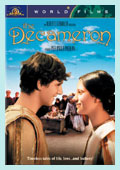
| Plot Synopsis Decameron was the first of director Pier Paolo Pasolini's "trilogy of life." The film, based on the sexually supercharged tales of Boccaccio, is a patchwork of many of Pasolini's favorite themes. Pasolini himself plays the role of an aspiring fresco painter who is advised that his completed work will never be as satisfying as his dream of that work. The film was followed by Pasolini's Canterbury Tales and Arabian Nights. - Hal Erickson Reviews TOM WIENER AMG (High Artistic Quality) Although Pier Paolo Pasolini does away with the framing device and the story structure of Giovanni Boccaccio's classic set of tales, he does follow the source's sense of playfulness about matters both sensual and romantic. Sex is a device for deceit for many of the characters: a woman invites a wealthy young man to her home, presumably to entertain him but then "reveals" that she is actually his sister and proceeds to rob and humiliate him; a young man pretends to be a deaf-mute to get a job in a convent where he might seduce the younger nuns, but then all of them, including the mother superior, demand a piece of the action; a priest is talked into providing a secret spell for an impoverished couple, only to use his powers as an excuse to have sex with the wife; a young woman claims to need an open-air balcony for sleeping on a hot night, when what she really wants is a trysting spot with her lover. Pasolini appears several times as Giotto, who is seen contemplating the creation of a mural in a church, though in the end he asks, "Why execute a work when it's so beautiful to dream it?" Nearly all eight stories here are well executed, but Pasolini, like so many artists, understands the gap between the conception of a piece and its actual realization. Perry Seibert, AMG DVD Reviews Pier Paolo Passolini's episode film The Decameron comes to DVD with a widescreen anamorphic transfer that preserves the original theatrical aspect ratio of 1.85:1. The Italian soundtrack is rendered in Dolby Digital Mono. English, Spanish, and French subtitles are accessible. Supplemental materials include the original theatrical trailer. This is a fine release from MGM/UA that is particularly recommended to those with an interest in Italian cinema and fans of the great Passolini. JOHN NESBIT Culturedose.Net 08/03/2003 Satirizing the church with ribald adaptations of ten stories from Bocaccio, Pier Paolo Pasolini's lively and entertaining Il Decameron depicts 14th century Naples life. The middle of an unofficial trilogy of erotic medieval literary adaptations that include The Arabian Nights and The Canterbury Tales, this film has been debunked by the church for its profaneness. Pasolini's nihilistic vision didn't sit well with church officials that had previously praised his faithful rendering of Christ in his 1964 film. Two brothers make a pact to come back and inform the other what the afterlife is like, so when the womanizing brother dies first and informs the pious brother that sex isn't considered a mortal sin, the surviving brother tosses his rosary beads aside and gleefully jumps on a willing woman. Such is the spirit of this down to earth film, that isn't as much a period piece as it is a commentary on the modern human condition. The first images show Ciappelletto (Franco Citti, who had debuted as the lead in Accattone) clubbing someone to death and carrying his covered body through a series of nicely framed arches. It turns out that the local usurers engage his services to collect debts and literally dispose of deadbeats. Ironically, when the guilt ridden Ciappelletto suffers a terminal illness, the high priest is summoned to give the last rites and hear his final confession. Unable to recount any sin greater than spitting in the church, the priest ironically declares the dying Ciappelletto a saint while the usurers continue on with their dark ways. Such is the folly of humanity. A convent should be a place of righteousness and refuge for spirituality. However, when a young man poses as a deaf-mute to gain employment as the convent gardener, soon the curious women want to know if the rumors of sexual ecstasy are true. The poor man finds that servicing ten sex-starved nuns daily is more than he can handle. Pasolini also satirizes hypocritical priests to show that they are just as fallible and human as the ordinary man-an imaginative priest attempts to seduce his friend's wife right before his very eyes with a false tale of magic. Pasolini's Marxist inclinations also come into play where he differentiates class differences between two young couples that engage in illicit sex, which by law and tradition can result in a death sentence. When Caterina's middle class father catches his naked daughter on the terrace with wealthy lover Ricciardo, he insists on marriage. On the other hand, when Elisabetta's merchant class brothers discover that she's fooling around with servant Lorenzo, they kill him. Various other tales of cuckoldry and swindling are unveiled during the 112 minute film. Perhaps closest to Pasolini's heart is the vignette about the muralist, who must wait to be inspired before applying his art to the church wall. When this occurs, he works in a frenzied state, imploring his team of workers to follow suit. At the end, he realizes that the creative process is the most rewarding and wonders if his efforts will have lasting effects. As with much of his work, this simple tale illustrates both Pasolini's attraction towards the world's beauty while simultaneously echoing his despair and disappointment. Initially rated X in the United States before being re-rated R more recently, Il Decameron is more accessible than most of Pasolini's other works. The disjointedness of the story lines becomes irrelevant, as it's easy to adjust to the conceit and follow the well paced narratives. It contains many scenes with bawdy humor that won't appeal to all audiences, but it stands as a down to earth indictment of human folly well worth checking out. LEO GOLDSMITH Not Coming to a Theater Near You For his adaptation of The Decameron, Pasolini tells ten stories of Neopolitan peasant life, taking roughly one story from each of the ten sections of the book. Rather than using the device of the storytellers (who, in Boccaccio, spend ten days in seclusion while waiting out the plague), the film presents the stories in two parts, with each part structured around one story that frames the others. In the first section, stories are simply and somewhat haphazardly interspersed with portions of the story of Ciappelletto, a murderer, thief, and homosexual who makes a false confession on his deathbed and thereafter becomes a saint. In the second part, however, the stories are woven together with a more traditional frame-story. This story follows the artist Giotto, who has come to Naples to paint a fresco on the wall of the city's cathedral. Pasolini himself plays Giotto, and the stories told in the film's second part are framed by the artist's progress on the fresco. Indeed, Giotto literally frames these stories: the everyday circumstances of the Neopolitan peasants that he witnesses become scenes in the fresco that he is painting. Giotto is even seen framing these scenes between his fingers, like a cinematographer, before he commits them to paint on the wall of the church. What Pasolini here proposes is a harmonious unity of artwork and life. The peasants and their stories are incorporated into the artist's fresco, just as the artist Giotto and Pasolini himself are integrated into the film image. In one of the film's final episodes, Giotto dreams of the Virgin Mary, flanked by angels, with the peasants and sinners of the film's stories arranged below her. The image is flat and symmetrical, rather like the composition of a pre-Renaissance painting by the real Giotto or his mentor, Cimabue. This is the character Giotto's vision of the order of his world, a perfectly balanced and serene hierarchy of the divine and the human. Indeed, this image can also be interpreted as Pasolini's own vision of the divine order of this idealized medieval Naples, though it is quite distinct from any vision that the director has offered of modern society. It is perhaps for this reason that Giotto/ Pasolini, upon completing his fresco, wonders, "Why create a work of art when dreaming about it is so much sweeter?" At the end of an almost invariably sunny film, in which even sin and death are matters of little concern, this final line strikes a rather somber note. In concluding his film with this question, Pasolini is perhaps questioning his own dream, his idealization of this beautiful, bucolic world he has created in which peasant and artist and the Virgin Mary coexist in divine harmony. Awards Silver Bear - Special Jury Prize (win) - -1971 Berlin International Film Festival |
 |
 |
 |
 |
 |
|
|
 |
 |
| THE DECAMERON 1970 - Italy / France / West Germany - 107 min. - Feature, Color AKA -Il Decamerone (Original Foreign title) Director -Pier Paolo Pasolini |
| Genre/Type -Comedy, Sex Comedy, Period Film Artistic/ Production Styles -Episodic Flags -Questionable for Children, Nudity, Adult Situations, Strong Sexual Content Keywords -aristocrat, artist, freedom, lover, medieval, sex, fresco Tones -Racy, Humorous, Sexual, Bright, Easygoing, Upbeat, Light From book -Decameron, The Decameron Set In -Middle Ages Produced by -Produzioni Europee Associati / United Artists Release -Aug 25, 1971 (Italy) DVD Street Date -Nov 5, 2002 Languages -ITALIAN Subtitles -English, French, Spanish Screen Formats -Letterbox for 16x9 TVs Sound -Dolby Digital Mono Aspect Ratio -1.85:1 (DVD) Studio -MGM Home Entertainment Region -1 (USA & territories, Canada) DVD Sides -1 Cast Pier Paolo Pasolini -- Giotto Jovan Jovanovich Angela Luce -- Peronella Wolfgang Hillinger Gianni Rizzo Silvana Mangano -- Madonna Giacomo Rizzo Monique Van Vooren Patrizia Capparelli -- Alibech Franco Citti -- Ciappelletto Ninetto Davoli -- Andreuccio |
|
 |
 |
 |
 |
 |
 |