 |
| Plot Synopsis A Hong Kong fast food restaurant acts as the link between two unusual stories of police officers in love in this eccentric, stylish comedy-drama. Director Wong Kar-Wai plays freely with traditional narrative structure, dividing his film into two loosely connected segments. The first centers on a depressed cop struggling to come to terms with a recent break-up. His sad isolation is transformed when he encounters a beautiful, mysterious femme fatale, whose involvement with the criminal underworld proves troublesome for both. The second story explores the odd relationship between a female restaurant worker and another recently jilted police officer. The strange woman decides to regularly clean and redecorate the man's apartment in his absence, allowing the two to form a close intimacy without meeting face to face. Both stories present a beautifully atmospheric look at modern urban life and romance, with its combination of isolation and casual, unexpected meetings. Chungking Express came to the attention of American audiences thanks to the efforts of director Quentin Tarantino, whose own brand of fractured storytelling and urban cool owes a debt to Wong Kar-Wai. - Judd Blaise, All Movie Guide Reviews JONATHAN CHOW All Movie Guide Attributes - High Artistic Quality, High Historical Importance At a time when Hong Kong cinema was known more for its pyrotechnics and jaw-dropping feats of physical daring than for sensitive explorations of the human condition, Chungking Express was a revelation to both domestic and international audiences. The film swept the 1995 Hong Kong Film Academy awards and established director Wong Kar-wai as one of world cinema's most adventurous and influential filmmakers. Ironically, Chungking Express was made on a whim when Wong had a three-month break from his famously troubled production of Ashes of Time (1994). In contrast to the somber, weighty tone of that film, Wong wanted to make a film that was light, funny, and even whimsical. Writing the script during the day while shooting at night, he allowed himself to abandon the rigid confines of conventional narrative for a looser, more thematic structure. Consisting of two similar but unrelated stories, the film details the lonely lives of four of Hong Kong's most isolated, disconnected inhabitants as they cross paths. The characters' sole commonality is Hong Kong's urban landscape, which swoons with neon-lit melancholy thanks to Australian cinematographer Christopher Doyle's eye-popping camerawork. The result is a film infused with the melancholy of random, fleeting urban encounters as it also crackles with a rare vitality, reflecting both the conflicting emotions of city life in general and the bustle and uncertainty of Hong Kong in the anxious years leading up to its 1997 handover to China. DAN JARDINE Apollo Guide Apollo Score: 92 Why haven't more people seen Chungking Express, on of the best films of the 1990s? I suppose it could have something to do with how it's a) an art house film that, b) you have to read, and c) starring actors nobody has heard of. Oh, and I reckon if you factor in how Harvey Weinstein and company at Miramax Pictures bought the rights to distribute the film, and then stuck the tin on the bottom shelf of their library, apparently unclear (perhaps understandably, given the description I've given) on exactly what to do with it, you'd probably have the knife's edge of a cutting thesis to work with. Yet, this is a film that demands an audience. Chungking Express is right up there with Quentin Tarantino's Pulp Fiction, a movie with which it shares only a passing superficial narrative quirkiness, when I think of films that define 1990s cinematic sensibilities. While Pulp Fiction, with its self-aware exploration of cinematic tropes, is suffused with a post-modernist's wink-wink nudge-nudge hipper-than-thou sensibility, while offering a broadside on pop-culture iconography, Chungking Express is a gleefully goofy study in stylistic abandon, with nary a concession to the Gods of Irony. A great big romantic bear hug of a film, Chungking Express, like Pulp Fiction, makes ample use of clever pop-cultural references and combines it with a pastiche of self-aware cinematic technique. Perhaps the most gifted of the current crop of Hong Kong directors, Wong Kar-Wai (In the Mood for Love) here tells two separate but thinly-connected tales of Hong Kong street cops whose love has gone bad, and who find unusual but affecting means to recovery. The film opens with the story of a lovesick Hong Kong cop (Takishi Kaneshiro) attempting to come to terms with the recent break-up of a long-term relationship. In a bizarre twist of fate, he finds himself in a bar picking up a similarly singularly unhappy Brigitte Lin, who just happens to be a drug smuggler and assassin on the run from a deal gone sour. The second and more engaging, emotionally satisfying story is that of the burgeoning attraction between a recently heartbroken cop played by Tony Leung, and an enigmatically alluring coffee shop vendor (Faye Wong.) But it isn't the story that captures us; it is the evocative acting talents of the singularly great Leung (how can you resist a film where the puppy-eyed Leung gives pep talks to his household goods - a slivery bar of soap, a lumpily stuffed animal, a ragged dish cloth?), with strong supporting help from Lin, Kaneshiro and the wispy Wong. And how can you resist a film displaying the remarkable Wong Kar-Wai's talents with camera, music, editing and design, which he musters up to craft a film filled with a melancholy tenderness and silly romanticism? Critics who complained about the film's lack of conventional narrative and stylish excesses seem to have missed the boat. In the case of Wong Kar-Wai at least, style is substance, and form is content. The flashy camera work and self-consciously jagged editing don't exist merely to draw attention to themselves, but also to highlight the fractured nature of these character's lives in a modern urban environment. The search for wholeness, the appreciation of completion that can come only when dreams (California or otherwise) become reality, as isolated souls find connections to others is something that Wong's startlingly original style helps highlight for an alert and empathetic audience. With Chungking Express Wong Kar-Wai has achieves a near-perfect fusion of form and style, content and substance, crafting one of the great movies of its decade. Awards Best Picture (win)- -1993-Hong Kong Film Awards |
 |
 |
 |
 |
 |
|
 |
 |
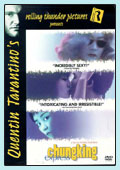
| CHUNKING EXPRESS 1994 - Hong Kong - 103 min. - Feature, Color AKA - Chong Qing Sen Lin (Mandarin title), Chunghing samlam (Cantonese title) Director - Wong Kar-Wai |
| Genre / Type - Drama, Urban Drama, Romantic Drama Artistic / Production Styles - Episodic Flags - Violence, Adult Situations, Adult Humor, Not For Children MPAA Rating - PG13 Keywords - police, depression, femme-fatale, intimacy, loneliness, love relationship, restaurant, separation, urban Themes - Brief Encounters, Mistaken Identities, Opposites Attract Tones - Dreamlike, Fanciful, Lyrical, Melancholy, Reflective, Stylized, Urbane, Nocturnal Moods - In a Minor Key Set In - Hong Kong, China Produced by - Jet Tone Films MPAA Reasons - for some violence, sexuality and drug content DVD Street Date - Jun 28, 2004 Languages - CANTONESE Subtitles - English Screen Format - Color, WS Studio - Artificial Eye Features - Wong Kar-Wai and Christopher Doyle filmographies Cast Brigitte Lin -- Woman in blonde wig Tony Leung Chiu-Wai -- Cop 663 Faye Wong -- Faye Takeshi Kaneshiro -- He Quiwu, Cop 223 Valerie Chow -- Air Hostess |
|
 |
 |
 |
 |