 |
 |
 |
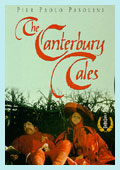
| THE CANTERBURY TALES 1971 -Italy/France - 111 min. - Feature, Color Director - Pier Paolo Pasolini |
| Genre/Type - Comedy, Sex Comedy, Satire, Period Film, Religious Comedy Keywords - Sex Tones - Lurid, Raunchy, Campy, Sexual Time Periods - Middle Ages Set In - England, Italy, 14th century From book - Canterbury Tales, The Canterbury Tales From poem by - Chaucer, Geoffrey Film Basis - Chaucerian Canterbury Tales Produced by - Produzioni Europee Associati / United Artists DVD Street Date -Nov 17, 1998 Languages - English Subtitles - none Screen Format - Widescreen Features - None DVD Sides -1 Cast John McLaren Jenny Runacre Franca Sciutto John Francis Lane Albert King Heather Johnson Willoughby Goddard Peter Stephens Adrian Street Pier Paolo Pasolini -- Geoffrey Chaucer Alan Webb -- Old Man |
| Plot Synopsis Italian director Pier Paolo Paolini's sexually explixit retelling of "The Canterbury Tales" takes Chaucer's famous stories into the realm of wild expressionalism and beyond. Filmed on location in England, Pasolini's "Canterbury Tales" brings the bawdy world of Chauser vividly to life, complete with the rendering of hell that would have made Hieronymus Bosch proud. Reviews Leo Goldsmith, Not Coming To A Theater Near You |
| "Why create a work of art when dreaming about it is so much sweeter?" This is Giotto's question at the end of Pasolini's Decameron. With this question in mind, the second film of the Trilogy of Life, The Canterbury Tales, reconfigures the relationship of the artist to the peasants of the stories. Instead of depicting the artist like Giotto, interacting with the people he depicts, Pasolini appears in the character of Chaucer, curiously removed from the marketplaces, fields and churches of the peasants' world. Largely dispensing with Chaucer's frame-story (which had pilgrims spinning different yarns along the road to Canterbury), Pasolini's Chaucer sits in his library, musing over various tales found in his collection of books. In this vision of rural, medieval England, the artist-figure is not united with peasant life in the same way that Giotto seemed to be, rather Chaucer is an intellectual, physically distant from the scenes of human interaction, though not indifferent to their circumstances. For Pasolini's Chaucer character, the stories of the peasants are not directly observed, but found among the books in his study. We even briefly see him playfully consulting a copy of The Decameron. This shift in the role of the artist is accompanied by more subtle changes in the general tone of the tales included in the film. Indeed, the facts of climate notwithstanding, Chaucer's England is portrayed in a far less sunny fashion than Boccaccio's Naples. Each film presents its own version of rural paradise - lush, sun-baked olive groves and ruins in the former, golden wheat fields and farmhouses in the latter - but Pasolini's camera clearly favors the bronze skin of the Neopolitan peasants to the sallow and spotty complexions of the English. In the earlier film, lust goes uninhibited: nuns and priests indulge themselves, and one character comes back from the dead to tell his friend that, in Purgatory, fornication does not really count as a sin. By contrast, the England of The Canterbury Tales is much more harsh in its treatment of vice of all kinds. Lust, greed, and hypocrisy meet with violent retribution in the form of public execution, everlasting damnation, and hot pokers between the buttocks. The film concludes, not with a beatific vision of the Virgin Mary, but with a comical, yet frightening premonition of Hell: demons rape and whip the sinners, and a giant Satan farts corrupt monks from an enormous red anus. Thus, if the beautiful symmetry of Cimabue and Giotto were the aesthetic models for the idealized vision of the trilogy's first film, the second film adapts the paintings of Brueghel and Bosch with their chaotic, warty images of rural life. As Brueghel's paintings embrace the ugly and raucous aspects of the peasants' world, Chaucer's tales are at once more scatological and more cruel than Boccaccio's, and so this second film is that much more gritty than its predecessor. IOFILM.COM.UK |
| Loosely sticking to the structure of Goeffrey Chaucer's poem, The Canterbury Tales revels in the sordid medieval spirit, with Pasolini portraying every imaginable form of sexual depravity and a few more beside (one involves a monk, a large watermelon and some very shocked chickens). The films forms the second part in Pasolini's Trilogy of Life, along with The Decameron and The Arabian Nights. Like many of his films, it was banned on its original release, this time because the Italian courts thought (maybe correctly) that it was obscene. Pasolini himself plays Geoffrey Chaucer, and delivers an entirely lavatorial take on the antics of such characters as The Wife of Bath and The Friar, painting a graphic and satirical picture of bawdy goings on in 14th-century England. Cue much shagging, shitting and farting intercut with the darker aspects of Chaucer's tales. It can be hard going at times, especially with the post-production dubbing of sound and the blank, detached acting Pasolini demanded, but it also contains some very funny and superbly-shot sequences. The final scene in which Satan loudly expels sinning friars from his posterior is perhaps one of the defining moments of Italian cinema. Awards Golden Bear (win) - 1972-Berlin International Film Festival |
|
 |
|
 |
 |
 |
 |
 |
 |
 |
 |