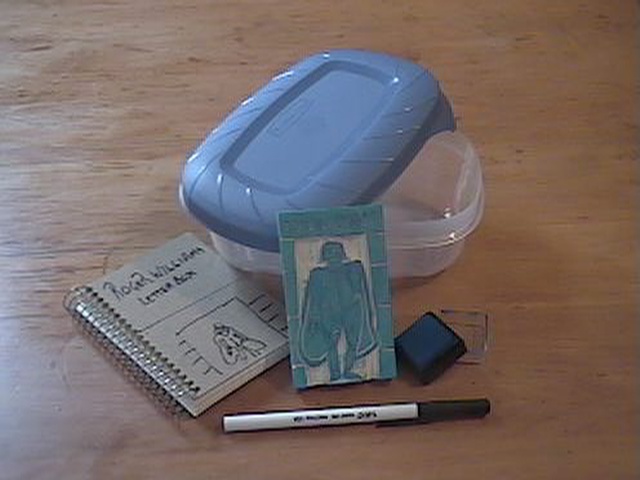
 |
A. The Box itself. Make certain that it seals watertight. B. A rubberstamp. This should relate to where the "box" is put. C. A logbook. Ensure the logbook can return to you by placing an email address in it! D. A pen! E. An ink pad. Some people do not like to include these. Personally, I like to co-ordinate the stamp and ink pad. It makes a nice touch! |
| 3. Now that you have your location scouted and your box assembled it is time to place the letterbox and write your clues. You can decide to make a clue easy and tell people exactly where it is, or make it varyingly difficult. Increase the knowledge neccessary by adding compass work, or include research that needs to be done in order to find the box. 4. Post your clues. Write them to the LBNA (Letterboxing North America) talk list. Or send your clues to Letterboxing International. You can even bring your clues into E.M.S. (Eastern Mountain Sports) in Waterford, CT. One can find many clues there not published anywhere else. Okay, so now you've shared your favorite places with the Letterboxing Public. Let's get your F-factor up. What's that? What's an F-factor? You may notice people signing emails crypticaly with P5F105X3 or some variant thereof. What does this all mean? The P refers to boxes that you have placed, yourself. Many people, myself included, count the replacement of Hitchhikers in the P-Factor. The F refers to boxes found. Count 1 for each box found. If a clue has 2 boxes, count the 2. The X refers to stamps eXchanged. A good way to increase this number is to visit a gathering. So you want to get your F-factor up? Get out and find some boxes. Start with clues you may already have, clues you can find at other sites or print up mine here. I will always be adding more! |
| F. A "What is Letterboxing" leaflet. Available here. |
| How to Build A Letterbox |

|